An XCSP parser that provides convenient methods to extract information from XCSP files. More...

Classes | |
| class | Relation |
| The representation of an XCSP relation. More... | |
Public Member Functions | |
| XCSPparser () | |
| Empty constructor. | |
| XCSPparser (Element root) | |
| Constructor from a JDOM root Element in XCSP format. | |
| XCSPparser (Document doc) | |
| Constructor from a JDOM Document in XCSP format. | |
| XCSPparser (Document doc, Boolean countNCCCs) | |
| Constructor from a JDOM Document in XCSP format. | |
| XCSPparser (Document doc, Boolean countNCCCs, HashSet< String > spacesToIgnore) | |
| Constructor from a JDOM Document in XCSP format. | |
| XCSPparser (Document doc, boolean countNCCCs, boolean extendedRandNeighborhoods) | |
| Constructor from a JDOM Document in XCSP format. | |
| XCSPparser (Document doc, boolean countNCCCs, boolean extendedRandNeighborhoods, boolean publicAgents) | |
| Constructor from a JDOM Document in XCSP format. | |
| XCSPparser (Document doc, Element params) | |
| Constructor. | |
| void | setDomClass (Class< V > domClass) |
| Sets the class to be used for variable values. | |
| Class< V > | getDomClass () |
| void | addSpaceToIgnore (String spaceToIgnore) |
| Adds a space to be ignored. | |
| void | setUtilClass (Class< U > utilClass) |
| Sets the class to be used for utility values. | |
| String | getAgent () |
| U | getZeroUtility () |
| U | getPlusInfUtility () |
| U | getMinInfUtility () |
| List< ? extends UtilitySolutionSpace< V, U > > | getProbabilitySpaces () |
| Extracts probability spaces from the constraints in the problem. | |
| List< ? extends UtilitySolutionSpace< V, U > > | getProbabilitySpaces (String var) |
| Extracts probability spaces involving the input variable from the constraints in the problem. | |
| List< ? extends UtilitySolutionSpace< V, U > > | getSolutionSpaces () |
| Returns the solution spaces in the problem. | |
| List< ? extends UtilitySolutionSpace< V, U > > | getSolutionSpaces (String var) |
| Extracts solution spaces involving the input variable from the constraints in the problem. | |
| List< ? extends UtilitySolutionSpace< V, U > > | getSolutionSpaces (final boolean withAnonymVars) |
| Extracts solution spaces from the constraints in the problem. | |
| List< ? extends UtilitySolutionSpace< V, U > > | getSolutionSpaces (DCOPProblemInterface< V, U > problem, final boolean withAnonymVars) |
| Extracts solution spaces from the constraints in the problem. | |
| List< ? extends UtilitySolutionSpace< V, U > > | getSolutionSpaces (String var, final boolean withAnonymVars) |
| Extracts solution spaces involving the input variable from the constraints in the problem. | |
| List<? extends UtilitySolutionSpace< V, U > > | getSolutionSpaces (String var, Set< String > forbiddenVars) |
| Returns the solution spaces involving the input variable and none of the forbidden variables. | |
| List<? extends UtilitySolutionSpace< V, U > > | getSolutionSpaces (String var, boolean withAnonymVars, Set< String > forbiddenVars) |
| Extracts solution spaces involving the input variable from the constraints in the problem. | |
| List<? extends UtilitySolutionSpace< V, U > > | getSolutionSpaces (Set< String > vars, boolean withAnonymVars, Set< String > forbiddenVars) |
| Extracts solution spaces involving the input variables from the constraints in the problem. | |
| boolean | isCountingNCCCs () |
| void | incrNCCCs (long incr) |
| Increments the number of constraint checks. | |
| void | setNCCCs (long ncccs) |
| Sets the NCCC count. | |
| long | getNCCCs () |
| boolean | removeSpace (String name) |
| Removes the space with the given name. | |
| boolean | addSolutionSpace (UtilitySolutionSpace< V, U > space) |
| Adds a solution space to the problem. | |
| Set< String > | getAgents () |
| String | getOwner (String var) |
| Returns the name of the agent owning the input variable. | |
| boolean | setOwner (String var, String owner) |
| Sets the owner agent for the input variable. | |
| Map< String, String > | getOwners () |
| int | getNbrVars () |
| Extracts the number of variables in the problem. | |
| int | getNbrVars (String owner) |
| Computes the number of variables owned by the input agent. | |
| int | getNbrIntVars () |
| Set< String > | getAllVars () |
| Set< String > | getVariables () |
| Set< String > | getVariables (String owner) |
| Returns the set of variables owned by a given agent. | |
| Set< String > | getMyVars () |
| Set< String > | getExtVars () |
| Set< String > | getAnonymVars () |
| boolean | addVariable (String name, String owner, String domain) |
| Adds a new variable. | |
| boolean | addVariable (String name, String owner, V[] domain) |
| Adds a new variable. | |
| XCSPparser< V, U > | getSubProblem (String agent) |
| Builds the subproblem description for a given agent by extracting it from the overall problem description. | |
| HashSet< String > | getNeighborVars (String var) |
| Extracts the collection of neighbors of a given variable. | |
| HashSet< String > | getNeighborVars (String var, final boolean withAnonymVars) |
| Extracts the collection of neighbors of a given variable. | |
| int | getNbrNeighbors (String var) |
| Extracts the number of neighbors of an input variable. | |
| int | getNbrNeighbors (String var, final boolean withAnonymVars) |
| Extracts the number of neighbors of an input variable. | |
| Map< String, HashSet< String > > | getNeighborhoods (String agent) |
| Parses the problem description to construct, for each variable owned by the input agent, its list of neighbors. | |
| Map< String, HashSet< String > > | getNeighborhoods () |
| Returns the neighborhood of each internal variable. | |
| Map< String, HashSet< String > > | getAnonymNeighborhoods (String agent) |
| Parses the problem description to construct, for each variable owned by the input agent, its list of neighbors with no specified owner. | |
| Map< String, HashSet< String > > | getAnonymNeighborhoods () |
| Map< String, HashSet< String > > | getNeighborhoods (String agent, final boolean withAnonymVars, final boolean onlyAnonymVars) |
| Parses the problem description to construct, for each variable owned by the input agent, its list of neighbors. | |
| Map< String, Integer > | getNeighborhoodSizes (String agent) |
| Computes the number of neighboring variables of all variables owned by a given agent. | |
| Map< String, Integer > | getNeighborhoodSizes () |
| Returns the number of neighboring variables of all internal variables. | |
| Map< String, Collection< String > > | getAgentNeighborhoods (String agent) |
| Gets the agent neighborhoods. | |
| Map< String, Collection< String > > | getAgentNeighborhoods () |
| Map< String, Collection< String > > | getBackyardNeighborhood (String var) |
| This method only makes sense in subclasses of XCSPparser that handle backyard variables. | |
| int | getDomainSize (String var) |
| Extracts the size of the domain of the input variable. | |
| V[] | getDomain (String var) |
| Extracts the domain of a given variable. | |
| void | setDomain (String var, V[] dom) |
| Sets the domain of a variable in the problem. | |
| void | setProbSpace (String var, Map< V, Double > prob) |
| Adds to the problem a probability space for the input random variable. | |
| String | toString () |
| String | toDOT () |
| boolean | isRandom (String var) |
| Returns whether the input variable is defined as a random variable. | |
| Document | groundVars (String[] vars, V[] values) |
| Transforms the problem into one where some variables' values have been fixed. | |
| UtilitySolutionSpace< V, U > | getUtility (Map< String, V > assignments) |
| Computes the total utility of the input assignment to variables, ignoring variables with no specified owner. | |
| UtilitySolutionSpace< V, U > | getUtility (Map< String, V > assignments, final boolean withAnonymVars) |
| Computes the total utility of the input assignment to variables. | |
| UtilitySolutionSpace< V, U > | getExpectedUtility (Map< String, V > assignments) |
| Computes the expectation over the random variables of the utility for the input assignments. | |
| UtilitySolutionSpace< V, U > | getParamUtility (Map< String[], BasicUtilitySolutionSpace< V, ArrayList< V > > > assignments) |
| Computes the total utility of the input assignment to variables, conditioned on the values of parameters. | |
| boolean | maximize () |
| void | setMaximize (boolean maximize) |
| Sets whether utility should be maximized, or cost minimized. | |
| void | rescale (U multiply, U add) |
| Rescales the problem. | |
| Document | switchMaxMin (int shiftInt) |
| Change the problem from a maximisation problem to a minimisation problem. | |
| void | reset (ProblemInterface< V, U > newProblem) |
| Resets this problem to be the same as the input one. | |
| int | getNumberOfCoordinationConstraints () |
| Returns the number of spaces that are shared between different agents. | |
| boolean | multipleTypes () |
| UtilitySolutionSpace< V, U > | addUnarySpace (String name, String var, V[] dom, U[] utils) |
| Add a unary solution space to the problem. | |
| DCOPProblemInterface< V, U > | parse () |
| Public Member Functions inherited from frodo2.algorithms.ParserInterface< V, U > | |
| ProblemInterface< V, U > | parse () |
Static Public Member Functions | |
| static Document | parse (File file) throws JDOMException, IOException |
| Creates a JDOM Document out of the input XML file in XCSP format. | |
| static Document | parse (File file, boolean checkXCSP) throws JDOMException, IOException |
| Creates a JDOM Document out of the input XML file (not necessarily in XCSP format). | |
| static Document | parse (String path) throws Exception |
| Creates a JDOM Document out of the input XML file path in XCSP format. | |
| static Document | parse (String path, boolean checkXCSP) throws Exception |
| Creates a JDOM Document out of the input XML file path (not necessarily in XCSP format). | |
| static Document | parse (InputStream stream) throws JDOMException, IOException |
| Creates a JDOM Document out of the input XML stream in XCSP format. | |
| static Document | parse (InputStream stream, boolean checkXCSP) throws JDOMException, IOException |
| Creates a JDOM Document out of the input XML stream (not necessarily in XCSP format). | |
| static String | toString (Document doc) |
| Returns a human-friendly String representation of the input JDOM Document. | |
| static String | toString (Element root) |
| Returns a human-friendly String representation of the input JDOM Element. | |
| static void | main (String[] args) throws Exception |
| Parses the input problem. | |
| static String | toDOT (Document doc) |
| Returns the constraint graph in DOT format. | |
| static String | toDOT (Element root) |
| Returns the constraint graph in DOT format. | |
| static< V extends Addable< V > Element | getRelation (UtilitySolutionSpace< V, ? extends Addable<?> > hypercube, String id, String nature) |
| Generates the XCSP "relation" or "probability" fragment corresponding to the input hypercube. | |
| static Element | getConstraint (UtilitySolutionSpace<?, ?> hypercube, String id, String ref) |
| Creates an XCSP-formated description of this contraint. | |
Protected Member Functions | |
| XCSPparser (Element root, boolean countNCCCs, boolean extendedRandNeighborhoods) | |
| Constructor from a JDOM root Element in XCSP format. | |
| XCSPparser (Element root, boolean countNCCCs, boolean extendedRandNeighborhoods, boolean publicAgents) | |
| Constructor from a JDOM root Element in XCSP format. | |
| XCSPparser (Element root, boolean countNCCCs) | |
| Constructor from a JDOM root Element in XCSP format. | |
| XCSPparser (Element root, boolean countNCCCs, boolean extendedRandNeighborhoods, HashSet< String > spacesToIgnoreNcccs, boolean mpc) | |
| Constructor from a JDOM root Element in XCSP format. | |
| XCSPparser< V, U > | newInstance (Element instance) |
| Calls the corresponding constructor. | |
| U | getInfeasibleUtil () |
| List< ? extends UtilitySolutionSpace< V, U > > | getSpaces (Set< String > vars, final boolean withAnonymVars, final boolean getProbs, Set< String > forbiddenVars, DCOPProblemInterface< V, U > problem) |
| Extracts hypercubes from the constraints in the problem. | |
| void | parseConstraint (ArrayList< UtilitySolutionSpace< V, U > > spaces, Element constraint, HashMap< String, V[]> variablesHashMap, HashMap< String, Relation< V, U > > relationInfos, Set< String > vars, final boolean getProbs, final boolean withAnonymVars, U infeasibleUtil, Set< String > forbiddenVars, DCOPProblemInterface< V, U > problem) |
| Parses a constraint. | |
| void | foundUndefinedRelations (HashSet< String > relationNames) |
| Prints out an error message. | |
| V[] | getDomain (Element domainElmt, final boolean debugLoad) |
| Parses and instantiates a domain from a domain Element. | |
| boolean | ignore (String spaceClass) |
Protected Attributes | |
| Element | root |
| JDOM Element in XCSP format. | |
| Class< U > | utilClass = (Class<U>) AddableInteger.class |
| The class to be used for utility values. | |
| V | valInstance = (V) new AddableInteger () |
| An instance of V. | |
| final boolean | extendedRandNeighborhoods |
If true, neighborhood relationships between decision variables are extended through random variables. | |
| final boolean | publicAgents |
| Whether each agent knows the identities of all agents. | |
| final boolean | mpc |
| Whether to behave in MPC mode. | |
| final boolean | countNCCCs |
| Whether to count constraint checks. | |
| HashSet< String > | spacesToIgnoreNcccs |
| a set of spaces for which ncccs should be ignored | |
Private Member Functions | |
| boolean | checkUniqueConstraintNames () |
| Checks that all constraints have unique names. | |
| HashSet< String > | getAgentNeighbors (String var) |
| Returns the neighboring agents of the input variable. | |
| HashSet< String > | getScope (String var) |
| Returns the agent scope of the variable. | |
| void | setDomain (String var, ArrayList< V > domain, Map< V, Double > weights) |
| Sets the domain of a variable. | |
Static Private Member Functions | |
| static String | usage () |
Private Attributes | |
| Class< V > | domClass = (Class<V>) AddableInteger.class |
| The class to be used for variable values. | |
| long | ncccCount |
| The NCCC count. | |
Detailed Description
An XCSP parser that provides convenient methods to extract information from XCSP files.
- Parameters
-
<U> the type used for variable values <V> the type used for utility values
Constructor & Destructor Documentation
◆ XCSPparser() [1/12]
| frodo2.algorithms.XCSPparser< V extends Addable< V >, U extends Addable< U > >.XCSPparser | ( | ) |
Empty constructor.
Referenced by getSubProblem(), main(), newInstance(), reset(), toDOT(), toDOT(), and toString().
◆ XCSPparser() [2/12]
| frodo2.algorithms.XCSPparser< V extends Addable< V >, U extends Addable< U > >.XCSPparser | ( | Element | root | ) |
Constructor from a JDOM root Element in XCSP format.
- Parameters
-
root the JDOM root Element in XCSP format
References checkUniqueConstraintNames(), and root.

◆ XCSPparser() [3/12]
|
protected |
Constructor from a JDOM root Element in XCSP format.
- Parameters
-
root the JDOM root Element in XCSP format countNCCCs Whether to count constraint checks extendedRandNeighborhoods whether we want extended random neighborhoods
References countNCCCs, extendedRandNeighborhoods, and root.
◆ XCSPparser() [4/12]
|
protected |
Constructor from a JDOM root Element in XCSP format.
- Parameters
-
root the JDOM root Element in XCSP format countNCCCs Whether to count constraint checks extendedRandNeighborhoods whether we want extended random neighborhoods publicAgents Whether each agent knows the identities of all agents
References checkUniqueConstraintNames(), countNCCCs, extendedRandNeighborhoods, publicAgents, and root.

◆ XCSPparser() [5/12]
|
protected |
Constructor from a JDOM root Element in XCSP format.
- Parameters
-
root the JDOM root Element in XCSP format countNCCCs Whether to count constraint checks
References countNCCCs, and root.
◆ XCSPparser() [6/12]
|
protected |
Constructor from a JDOM root Element in XCSP format.
- Parameters
-
root the JDOM root Element in XCSP format countNCCCs Whether to count constraint checks extendedRandNeighborhoods whether we want extended random neighborhoods spacesToIgnoreNcccs list of spaces for which NCCCs should NOT be counted mpc Whether to behave in MPC mode
References checkUniqueConstraintNames(), countNCCCs, extendedRandNeighborhoods, mpc, root, and spacesToIgnoreNcccs.

◆ XCSPparser() [7/12]
| frodo2.algorithms.XCSPparser< V extends Addable< V >, U extends Addable< U > >.XCSPparser | ( | Document | doc | ) |
Constructor from a JDOM Document in XCSP format.
- Parameters
-
doc the JDOM Document in XCSP format
◆ XCSPparser() [8/12]
| frodo2.algorithms.XCSPparser< V extends Addable< V >, U extends Addable< U > >.XCSPparser | ( | Document | doc, |
| Boolean | countNCCCs ) |
Constructor from a JDOM Document in XCSP format.
- Parameters
-
doc the JDOM Document in XCSP format countNCCCs Whether to count constraint checks
References countNCCCs.
◆ XCSPparser() [9/12]
| frodo2.algorithms.XCSPparser< V extends Addable< V >, U extends Addable< U > >.XCSPparser | ( | Document | doc, |
| Boolean | countNCCCs, | ||
| HashSet< String > | spacesToIgnore ) |
Constructor from a JDOM Document in XCSP format.
- Parameters
-
doc the JDOM Document in XCSP format countNCCCs Whether to count constraint checks spacesToIgnore list of spaces for which NCCCs should NOT be counted
References countNCCCs.
◆ XCSPparser() [10/12]
| frodo2.algorithms.XCSPparser< V extends Addable< V >, U extends Addable< U > >.XCSPparser | ( | Document | doc, |
| boolean | countNCCCs, | ||
| boolean | extendedRandNeighborhoods ) |
Constructor from a JDOM Document in XCSP format.
- Parameters
-
doc the JDOM Document in XCSP format countNCCCs Whether to count constraint checks extendedRandNeighborhoods whether we want extended random neighborhoods
References countNCCCs, and extendedRandNeighborhoods.
◆ XCSPparser() [11/12]
| frodo2.algorithms.XCSPparser< V extends Addable< V >, U extends Addable< U > >.XCSPparser | ( | Document | doc, |
| boolean | countNCCCs, | ||
| boolean | extendedRandNeighborhoods, | ||
| boolean | publicAgents ) |
Constructor from a JDOM Document in XCSP format.
- Parameters
-
doc the JDOM Document in XCSP format countNCCCs Whether to count constraint checks extendedRandNeighborhoods whether we want extended random neighborhoods publicAgents Whether each agent knows the identities of all agents
References countNCCCs, extendedRandNeighborhoods, and publicAgents.
◆ XCSPparser() [12/12]
| frodo2.algorithms.XCSPparser< V extends Addable< V >, U extends Addable< U > >.XCSPparser | ( | Document | doc, |
| Element | params ) |
Constructor.
- Parameters
-
doc the JDOM Document in XCSP format params the parameters of the solver
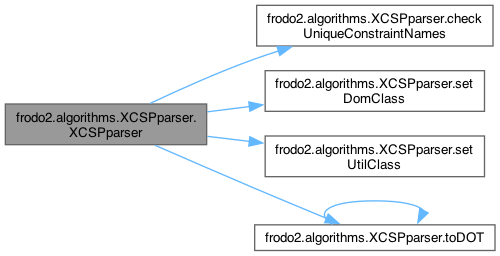
References checkUniqueConstraintNames(), domClass, setDomClass(), setUtilClass(), spacesToIgnoreNcccs, and toDOT().
Member Function Documentation
◆ addSolutionSpace()
| boolean frodo2.algorithms.XCSPparser< V extends Addable< V >, U extends Addable< U > >.addSolutionSpace | ( | UtilitySolutionSpace< V, U > | space | ) |
Adds a solution space to the problem.
- Parameters
-
space the solution space
- Returns
trueif the space was added,falseif the space's name is null or is already taken
- Note
- Ignores the relation name of this space, if any
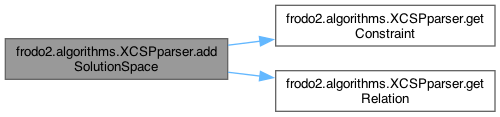
References getConstraint(), getRelation(), and root.
Referenced by addUnarySpace().
◆ addSpaceToIgnore()
| void frodo2.algorithms.XCSPparser< V extends Addable< V >, U extends Addable< U > >.addSpaceToIgnore | ( | String | spaceToIgnore | ) |
Adds a space to be ignored.
- Parameters
-
spaceToIgnore the name of the space to be ignored
Referenced by frodo2.algorithms.dpop.test.DPOPagentTest< V extends Addable< V >, U extends Addable< U > >.setUp().
◆ addUnarySpace()
| UtilitySolutionSpace< V, U > frodo2.algorithms.XCSPparser< V extends Addable< V >, U extends Addable< U > >.addUnarySpace | ( | String | name, |
| String | var, | ||
| V[] | dom, | ||
| U[] | utils ) |
Add a unary solution space to the problem.
- Parameters
-
name the name of the space var the unique variable in the space's scope dom the allowed variable values utils the valuation for each variable value
- Returns
- the newly added space
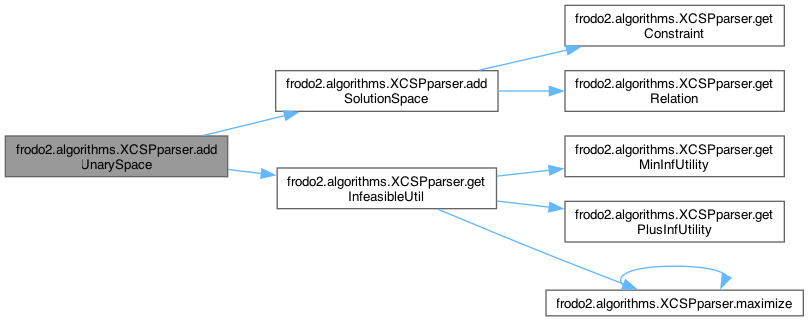
References addSolutionSpace(), and getInfeasibleUtil().
◆ addVariable() [1/2]
| boolean frodo2.algorithms.XCSPparser< V extends Addable< V >, U extends Addable< U > >.addVariable | ( | String | name, |
| String | owner, | ||
| String | domain ) |
Adds a new variable.
- Parameters
-
name variable name owner name of the variable's agent domain reference to the variable's domain
- Returns
trueif the variable was added,falseif a variable with the same name already exists or no domain with given name exists
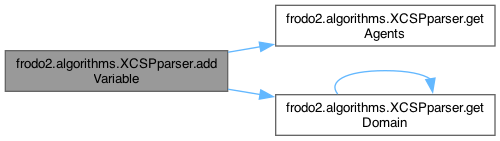
References getAgents(), getDomain(), and root.
Referenced by addVariable().
◆ addVariable() [2/2]
| boolean frodo2.algorithms.XCSPparser< V extends Addable< V >, U extends Addable< U > >.addVariable | ( | String | name, |
| String | owner, | ||
| V[] | domain ) |
Adds a new variable.
- Parameters
-
name variable name owner name of the variable's agent domain variable domain
- Returns
trueif the variable was added,falseif a variable with the same name already exists
References addVariable(), getDomain(), and root.

◆ checkUniqueConstraintNames()
|
private |
Checks that all constraints have unique names.
- Returns
- false if constraints with the same name have been detected
References root.
Referenced by XCSPparser(), XCSPparser(), XCSPparser(), and XCSPparser().
◆ foundUndefinedRelations()
|
protected |
Prints out an error message.
- Parameters
-
relationNames names of the undefined relations
Reimplemented in frodo2.benchmarks.vehiclerouting.XCSPparserVRP< U extends Addable< U > >, and frodo2.solutionSpaces.JaCoP.JaCoPxcspParser< V extends Addable< V > >.
References root.
Referenced by getSubProblem().
◆ getAgent()
| String frodo2.algorithms.XCSPparser< V extends Addable< V >, U extends Addable< U > >.getAgent | ( | ) |
- Returns
- the name of the agent corresponding to this subproblem
References root.
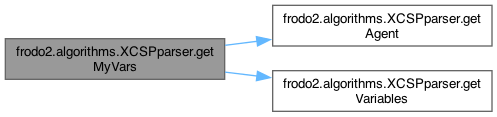
Referenced by getAgentNeighborhoods(), getAnonymNeighborhoods(), getExtVars(), getMyVars(), getNbrIntVars(), getNeighborhoods(), getNeighborhoodSizes(), parse(), frodo2.solutionSpaces.JaCoP.JaCoPxcspParser< V extends Addable< V > >.parse(), and toString().
◆ getAgentNeighborhoods() [1/2]
| Map< String, Collection< String > > frodo2.algorithms.XCSPparser< V extends Addable< V >, U extends Addable< U > >.getAgentNeighborhoods | ( | ) |
- Returns
- for each internal variable, the collection of neighboring agents
References getAgent(), and getAgentNeighborhoods().

◆ getAgentNeighborhoods() [2/2]
| Map< String, Collection< String > > frodo2.algorithms.XCSPparser< V extends Addable< V >, U extends Addable< U > >.getAgentNeighborhoods | ( | String | agent | ) |
Gets the agent neighborhoods.
- Parameters
-
agent the owner agent, or null if we want all variables
- Returns
- for each variable owned by the input agent (or for each variable if the input is null), the collection of neighboring agents
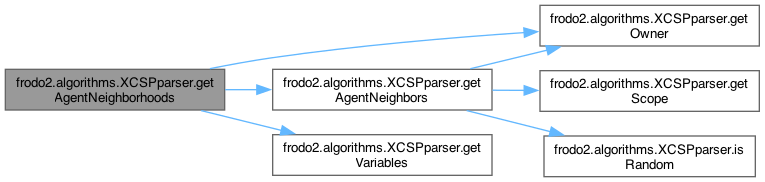
References getAgentNeighbors(), getOwner(), and getVariables().
Referenced by getAgentNeighborhoods().
◆ getAgentNeighbors()
|
private |
Returns the neighboring agents of the input variable.
- Parameters
-
var the variable
- Returns
- the variable's neighboring agents
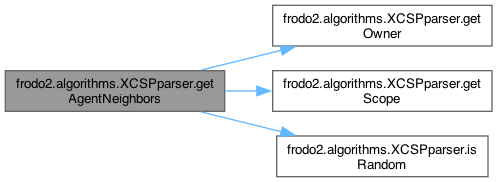
References getOwner(), getScope(), isRandom(), and root.
Referenced by getAgentNeighborhoods().
◆ getAgents()
| Set< String > frodo2.algorithms.XCSPparser< V extends Addable< V >, U extends Addable< U > >.getAgents | ( | ) |
- Returns
- the set of all agents mentioned in the problem
References root.
Referenced by addVariable(), getSubProblem(), frodo2.solutionSpaces.JaCoP.JaCoPxcspParser< V extends Addable< V > >.getSubProblem(), main(), parse(), frodo2.solutionSpaces.JaCoP.JaCoPxcspParser< V extends Addable< V > >.parse(), setOwner(), frodo2.algorithms.mpc_discsp.tests.MPC_DisWCSP4tests.test(), frodo2.algorithms.test.XCSPparserTest.testMaximize(), frodo2.solutionSpaces.JaCoP.tests.JaCoPtests< V extends Addable< V > >.testProblemFromRepository(), frodo2.algorithms.odpop.tests.ODPOPagentTest< V extends Addable< V >, U extends Addable< U > >.testRandom(), frodo2.algorithms.odpop.tests.ODPOPagentTestBinaryDomains< V extends Addable< V >, U extends Addable< U > >.testRandom(), frodo2.algorithms.odpop.tests.ODPOPagentTestFullDomain< V extends Addable< V >, U extends Addable< U > >.testRandom(), frodo2.solutionSpaces.JaCoP.tests.JaCoPtests< V extends Addable< V > >.testRandomExtensionalProblem(), and toDOT().
◆ getAllVars()
| Set< String > frodo2.algorithms.XCSPparser< V extends Addable< V >, U extends Addable< U > >.getAllVars | ( | ) |
- Returns
- all variables, including the ones with no specified owner
References getAnonymVars(), and getVariables().
Referenced by frodo2.algorithms.test.ProblemTest.testGetDomain(), and frodo2.algorithms.test.ProblemTest.testGetDomainSize().

◆ getAnonymNeighborhoods() [1/2]
| Map< String, HashSet< String > > frodo2.algorithms.XCSPparser< V extends Addable< V >, U extends Addable< U > >.getAnonymNeighborhoods | ( | ) |
- Returns
- for each internal variable, its collection of neighbors with no specified owner
References getAgent(), and getAnonymNeighborhoods().

◆ getAnonymNeighborhoods() [2/2]
| Map< String, HashSet< String > > frodo2.algorithms.XCSPparser< V extends Addable< V >, U extends Addable< U > >.getAnonymNeighborhoods | ( | String | agent | ) |
Parses the problem description to construct, for each variable owned by the input agent, its list of neighbors with no specified owner.
- Parameters
-
agent the name of the agent
- Returns
- for each of the agent's variables, its collection of neighbors with no specified owner
References getNeighborhoods().
Referenced by getAnonymNeighborhoods().

◆ getAnonymVars()
| Set< String > frodo2.algorithms.XCSPparser< V extends Addable< V >, U extends Addable< U > >.getAnonymVars | ( | ) |
- Returns
- the variables with no specified owner
References getVariables().
Referenced by getAllVars().

◆ getBackyardNeighborhood()
| Map< String, Collection< String > > frodo2.algorithms.XCSPparser< V extends Addable< V >, U extends Addable< U > >.getBackyardNeighborhood | ( | String | var | ) |
This method only makes sense in subclasses of XCSPparser that handle backyard variables.
- Parameters
-
var variable
- Returns
- an empty map
◆ getConstraint()
|
static |
Creates an XCSP-formated description of this contraint.
- Parameters
-
hypercube the constraint id the name of the constraint ref the name of the relation
- Returns
- the corresponding constraint description
Referenced by addSolutionSpace(), frodo2.algorithms.test.AllTests.generateProblem(), frodo2.benchmarks.maxdiscsp.MaxDisCSPProblemGenerator.generateProblem(), frodo2.algorithms.test.AllTests.generateSizedProblem(), and groundVars().
◆ getDomain() [1/2]
|
protected |
Parses and instantiates a domain from a domain Element.
- Parameters
-
domainElmt the JDOM Element representing the domain debugLoad if true, prints out some debug information
- Returns
- an array of domain values
References valInstance.
◆ getDomain() [2/2]
| V[] frodo2.algorithms.XCSPparser< V extends Addable< V >, U extends Addable< U > >.getDomain | ( | String | var | ) |
Extracts the domain of a given variable.
- Parameters
-
var the variable
- Returns
- an array of domain values
References getDomain(), and root.
Referenced by addVariable(), addVariable(), getDomain(), getSpaces(), parse(), and frodo2.algorithms.test.ProblemTest.testGetDomain().
◆ getDomainSize()
| int frodo2.algorithms.XCSPparser< V extends Addable< V >, U extends Addable< U > >.getDomainSize | ( | String | var | ) |
Extracts the size of the domain of the input variable.
- Parameters
-
var the variable
- Returns
- the size of the domain of var
References root.
Referenced by frodo2.algorithms.varOrdering.linear.tests.CentralLinearOrderingTest.notifyIn(), frodo2.algorithms.test.ProblemTest.testGetDomainSize(), and frodo2.algorithms.dpop.count.test.TestCountSolutions.testRandom().
◆ getDomClass()
| Class< V > frodo2.algorithms.XCSPparser< V extends Addable< V >, U extends Addable< U > >.getDomClass | ( | ) |
- Returns
- the class used for domain values
References domClass.
◆ getExpectedUtility()
| UtilitySolutionSpace< V, U > frodo2.algorithms.XCSPparser< V extends Addable< V >, U extends Addable< U > >.getExpectedUtility | ( | Map< String, V > | assignments | ) |
Computes the expectation over the random variables of the utility for the input assignments.
- Parameters
-
assignments values for variables
- Returns
- the expectation of the utility for the input assignments
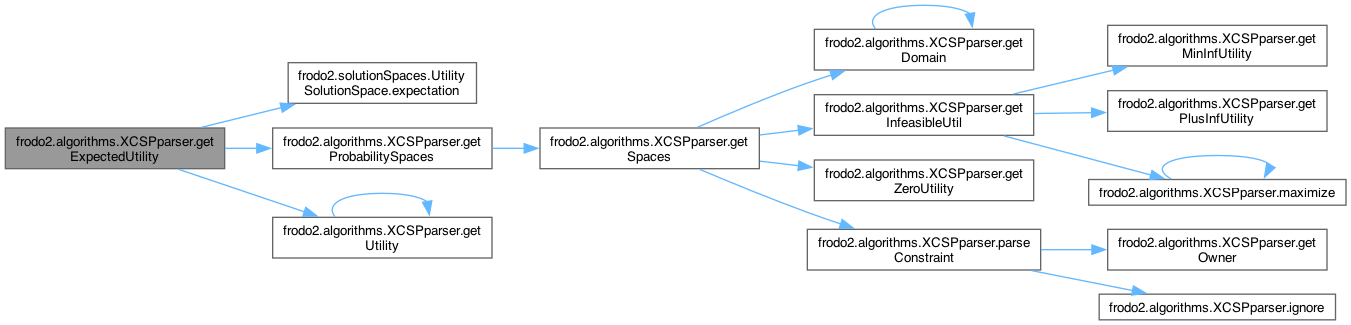
References frodo2.solutionSpaces.UtilitySolutionSpace< V extends Addable< V >, U extends Addable< U > >.expectation(), getProbabilitySpaces(), and getUtility().
◆ getExtVars()
| Set< String > frodo2.algorithms.XCSPparser< V extends Addable< V >, U extends Addable< U > >.getExtVars | ( | ) |
- Returns
- the variables that are owned by a different agent
References getAgent(), and root.

◆ getInfeasibleUtil()
|
protected |
- Returns
- -INF if we are maximizing, +INF if we are minimizing
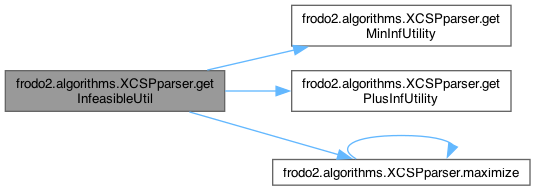
References getMinInfUtility(), getPlusInfUtility(), maximize(), and root.
Referenced by addUnarySpace(), getParamUtility(), getSpaces(), getUtility(), and frodo2.solutionSpaces.JaCoP.JaCoPxcspParser< V extends Addable< V > >.getUtility().
◆ getMinInfUtility()
| U frodo2.algorithms.XCSPparser< V extends Addable< V >, U extends Addable< U > >.getMinInfUtility | ( | ) |
- Returns
- the infinite negative utility value
References utilClass.
Referenced by getInfeasibleUtil(), frodo2.algorithms.localSearch.dsa.tests.TestDSA< U extends Addable< U > >.setUp(), and frodo2.algorithms.dpop.count.test.TestCountSolutions.testRandom().
◆ getMyVars()
| Set< String > frodo2.algorithms.XCSPparser< V extends Addable< V >, U extends Addable< U > >.getMyVars | ( | ) |
- Returns
- the internal variables
References getAgent(), and getVariables().
Referenced by frodo2.algorithms.test.ProblemTest.testGetNbrNeighbors().
◆ getNbrIntVars()
| int frodo2.algorithms.XCSPparser< V extends Addable< V >, U extends Addable< U > >.getNbrIntVars | ( | ) |
- Returns
- the number of internal variables
References getAgent(), and getNbrVars().

◆ getNbrNeighbors() [1/2]
| int frodo2.algorithms.XCSPparser< V extends Addable< V >, U extends Addable< U > >.getNbrNeighbors | ( | String | var | ) |
Extracts the number of neighbors of an input variable.
- Parameters
-
var the variable
- Returns
- the number of neighbor variables of var
- Warning
- Ignores variables with no specified owner.
References getNbrNeighbors().
Referenced by getNbrNeighbors(), and frodo2.algorithms.test.ProblemTest.testGetNbrNeighbors().
◆ getNbrNeighbors() [2/2]
| int frodo2.algorithms.XCSPparser< V extends Addable< V >, U extends Addable< U > >.getNbrNeighbors | ( | String | var, |
| final boolean | withAnonymVars ) |
Extracts the number of neighbors of an input variable.
- Parameters
-
var the variable withAnonymVars if false, ignores variables with no specified owner
- Returns
- the number of neighbor variables of var
References getNeighborVars().

◆ getNbrVars() [1/2]
| int frodo2.algorithms.XCSPparser< V extends Addable< V >, U extends Addable< U > >.getNbrVars | ( | ) |
Extracts the number of variables in the problem.
- Returns
- the number of variables in the problem
- Warning
- Ignores variables with no specified owner.
References getVariables().
Referenced by getNbrIntVars(), getOwners(), frodo2.algorithms.dpop.privacy.test.P2_DPOPagentTest< V extends Addable< V >, E extends AddableLimited< AddableInteger, E >.test(), frodo2.algorithms.dpop.privacy.test.P3halves_DPOPagentTest< V extends Addable< V >, E extends AddableLimited< AddableInteger, E >.test(), frodo2.algorithms.dpop.privacy.test.P_DPOPagentTest< V extends Addable< V > >.testP_DPOPvsDPOP(), frodo2.solutionSpaces.JaCoP.tests.JaCoPtests< V extends Addable< V > >.testRandomExtensionalProblem(), and toDOT().

◆ getNbrVars() [2/2]
| int frodo2.algorithms.XCSPparser< V extends Addable< V >, U extends Addable< U > >.getNbrVars | ( | String | owner | ) |
Computes the number of variables owned by the input agent.
- Parameters
-
owner name of the agent
- Returns
- the number of variables owned by owner
References root.
◆ getNCCCs()
| long frodo2.algorithms.XCSPparser< V extends Addable< V >, U extends Addable< U > >.getNCCCs | ( | ) |
- Returns
- the number of constraint checks
◆ getNeighborhoods() [1/3]
| Map< String, HashSet< String > > frodo2.algorithms.XCSPparser< V extends Addable< V >, U extends Addable< U > >.getNeighborhoods | ( | ) |
Returns the neighborhood of each internal variable.
- Returns
- for each of the agent's variables, its collection of neighbors
- Warning
- Ignores variables with no specified owner.
References getAgent(), and getNeighborhoods().
◆ getNeighborhoods() [2/3]
| Map< String, HashSet< String > > frodo2.algorithms.XCSPparser< V extends Addable< V >, U extends Addable< U > >.getNeighborhoods | ( | String | agent | ) |
Parses the problem description to construct, for each variable owned by the input agent, its list of neighbors.
- Parameters
-
agent the name of the agent
- Returns
- for each of the agent's variables, its collection of neighbors
- Warning
- Ignores variables with no specified owner.
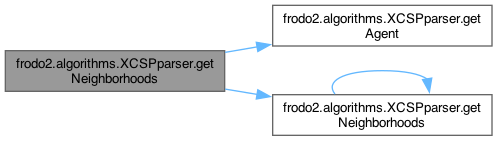
References getNeighborhoods().
Referenced by getAnonymNeighborhoods(), getNeighborhoods(), getNeighborhoods(), and getNeighborhoodSizes().
◆ getNeighborhoods() [3/3]
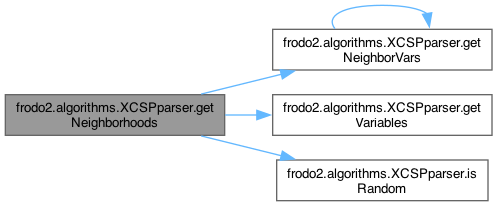
| Map< String, HashSet< String > > frodo2.algorithms.XCSPparser< V extends Addable< V >, U extends Addable< U > >.getNeighborhoods | ( | String | agent, |
| final boolean | withAnonymVars, | ||
| final boolean | onlyAnonymVars ) |
Parses the problem description to construct, for each variable owned by the input agent, its list of neighbors.
- Parameters
-
agent the name of the agent withAnonymVars if false, ignores variables with no specified owneronlyAnonymVars if true, only considers variables with no specified owner (in which case this superseeds withAnonymVars)
- Returns
- for each of the agent's variables, its collection of neighbors
- Todo
- Improve the performance by avoiding to call getNeighborVars on each variable, which requires parsing the constraints multiple times.
References getNeighborVars(), getVariables(), and isRandom().
◆ getNeighborhoodSizes() [1/2]
| Map< String, Integer > frodo2.algorithms.XCSPparser< V extends Addable< V >, U extends Addable< U > >.getNeighborhoodSizes | ( | ) |
Returns the number of neighboring variables of all internal variables.
- Returns
- for each internal variable, its number of neighboring variables
- Warning
- Ignores variables with no specified owner.
References getAgent(), and getNeighborhoodSizes().

◆ getNeighborhoodSizes() [2/2]
| Map< String, Integer > frodo2.algorithms.XCSPparser< V extends Addable< V >, U extends Addable< U > >.getNeighborhoodSizes | ( | String | agent | ) |
Computes the number of neighboring variables of all variables owned by a given agent.
- Parameters
-
agent name of the agent
- Returns
- for each variable owned by agent, its number of neighboring variables
- Warning
- Ignores variables with no specified owner.
References getNeighborhoods().
Referenced by getNeighborhoodSizes().

◆ getNeighborVars() [1/2]
| HashSet< String > frodo2.algorithms.XCSPparser< V extends Addable< V >, U extends Addable< U > >.getNeighborVars | ( | String | var | ) |
Extracts the collection of neighbors of a given variable.
- Parameters
-
var the name of the variable
- Returns
- a collection of neighbor variables of var
- Warning
- Ignores variables with no specified owner.
References getNeighborVars().
Referenced by getNbrNeighbors(), getNeighborhoods(), getNeighborVars(), frodo2.algorithms.varOrdering.linear.tests.CentralLinearOrderingTest.notifyIn(), frodo2.algorithms.dpop.stochastic.test.SamplingPhaseTest.setUp(), and toDOT().
◆ getNeighborVars() [2/2]
| HashSet< String > frodo2.algorithms.XCSPparser< V extends Addable< V >, U extends Addable< U > >.getNeighborVars | ( | String | var, |
| final boolean | withAnonymVars ) |
Extracts the collection of neighbors of a given variable.
- Parameters
-
var the name of the variable withAnonymVars if false, ignores variables with no specified owner
- Returns
- a collection of neighbor variables of var
References isRandom(), and root.

◆ getNumberOfCoordinationConstraints()
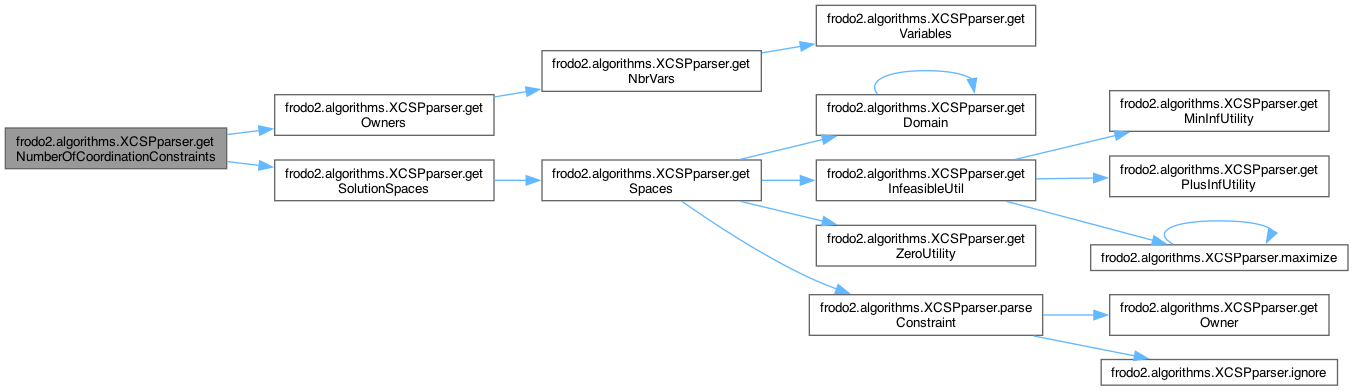
| int frodo2.algorithms.XCSPparser< V extends Addable< V >, U extends Addable< U > >.getNumberOfCoordinationConstraints | ( | ) |
Returns the number of spaces that are shared between different agents.
- Returns
- the number of spaces that are shared between different agents
References getOwners(), and getSolutionSpaces().
◆ getOwner()
| String frodo2.algorithms.XCSPparser< V extends Addable< V >, U extends Addable< U > >.getOwner | ( | String | var | ) |
Returns the name of the agent owning the input variable.
- Parameters
-
var the name of the variable
- Returns
- the owner of the input variable
References root.
Referenced by getAgentNeighborhoods(), getAgentNeighbors(), getSubProblem(), frodo2.solutionSpaces.JaCoP.JaCoPxcspParser< V extends Addable< V > >.getSubProblem(), parse(), frodo2.solutionSpaces.JaCoP.JaCoPxcspParser< V extends Addable< V > >.parse(), parseConstraint(), frodo2.solutionSpaces.JaCoP.JaCoPxcspParser< V extends Addable< V > >.parseConstraint(), frodo2.algorithms.test.ProblemTest.testGetOwner(), and toDOT().
◆ getOwners()
| Map< String, String > frodo2.algorithms.XCSPparser< V extends Addable< V >, U extends Addable< U > >.getOwners | ( | ) |
- Returns
- for each variable, the name of its owner agent
References getNbrVars(), and root.
Referenced by getNumberOfCoordinationConstraints().

◆ getParamUtility()
| UtilitySolutionSpace< V, U > frodo2.algorithms.XCSPparser< V extends Addable< V >, U extends Addable< U > >.getParamUtility | ( | Map< String[], BasicUtilitySolutionSpace< V, ArrayList< V > > > | assignments | ) |
Computes the total utility of the input assignment to variables, conditioned on the values of parameters.
- Parameters
-
assignments values for variables
- Returns
- the optimal conditional utility corresponding to the input assignment
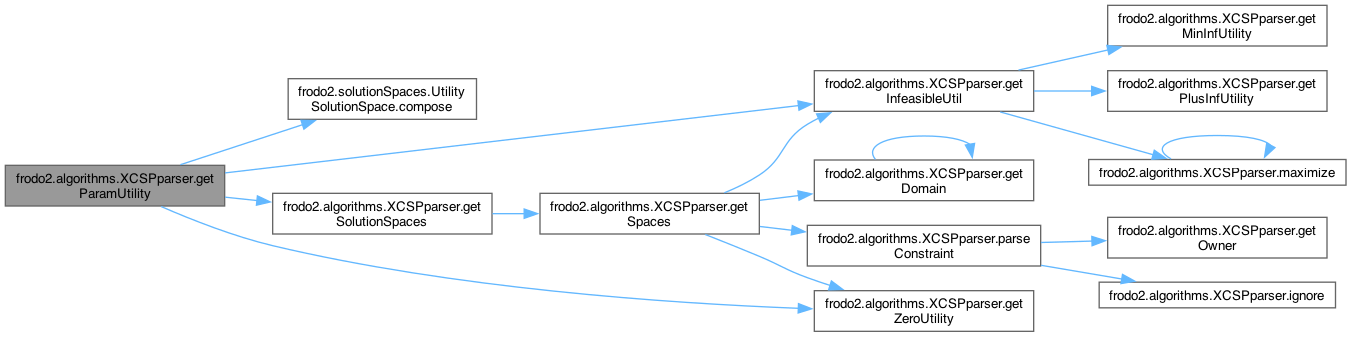
References frodo2.solutionSpaces.UtilitySolutionSpace< V extends Addable< V >, U extends Addable< U > >.compose(), getInfeasibleUtil(), getSolutionSpaces(), getZeroUtility(), and frodo2.output.
◆ getPlusInfUtility()
| U frodo2.algorithms.XCSPparser< V extends Addable< V >, U extends Addable< U > >.getPlusInfUtility | ( | ) |
- Returns
- the infinite positive utility value
References utilClass.
Referenced by getInfeasibleUtil(), frodo2.algorithms.localSearch.dsa.tests.TestDSA< U extends Addable< U > >.setUp(), and frodo2.algorithms.dpop.count.test.TestCountSolutions.testRandom().
◆ getProbabilitySpaces() [1/2]
| List< ? extends UtilitySolutionSpace< V, U > > frodo2.algorithms.XCSPparser< V extends Addable< V >, U extends Addable< U > >.getProbabilitySpaces | ( | ) |
Extracts probability spaces from the constraints in the problem.
- Returns
- a list of hypercubes, or
nullif some information is missing in the problem file
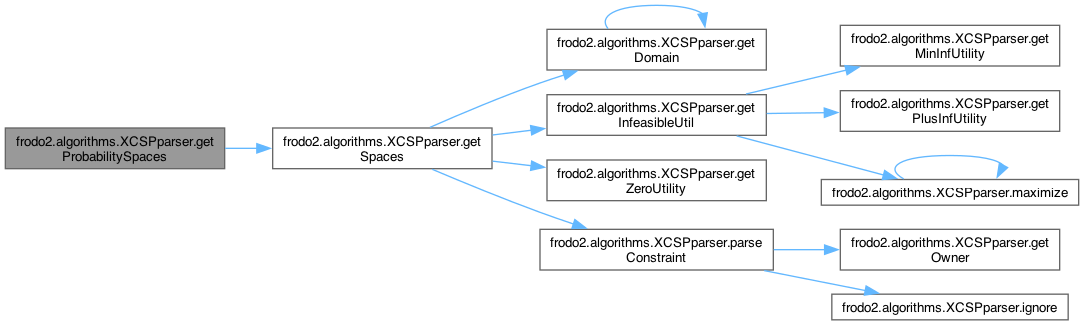
References getSpaces().
Referenced by frodo2.algorithms.dpop.param.ParamDPOPsolver< V extends Addable< V >, U extends Addable< U > >.getExpectedOptUtil(), getExpectedUtility(), and parse().
◆ getProbabilitySpaces() [2/2]
| List< ? extends UtilitySolutionSpace< V, U > > frodo2.algorithms.XCSPparser< V extends Addable< V >, U extends Addable< U > >.getProbabilitySpaces | ( | String | var | ) |
Extracts probability spaces involving the input variable from the constraints in the problem.
- Returns
- a list of hypercubes, or
nullif some information is missing in the problem file
- Parameters
-
var the variable of interest
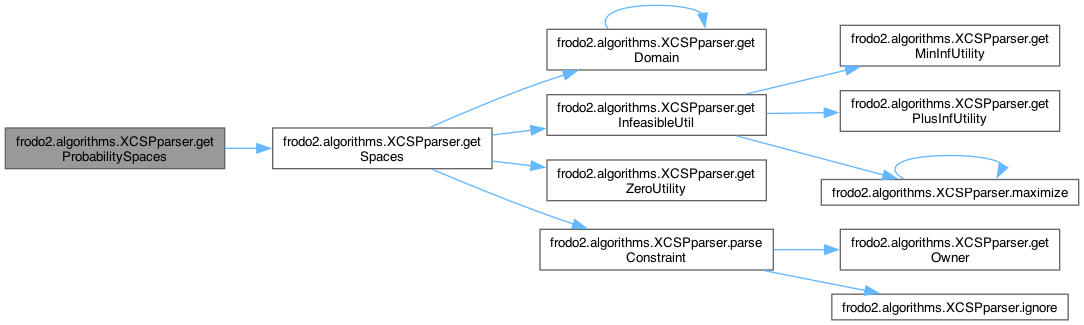
References getSpaces().
◆ getRelation()
|
static |
Generates the XCSP "relation" or "probability" fragment corresponding to the input hypercube.
- Parameters
-
<V> the type used for variable values hypercube the hypercube id id of the relation/probability nature either "relation" or "probability"
- Returns
- the XCSP "relation" or "probability" fragment corresponding to the input hypercube
Referenced by addSolutionSpace(), frodo2.algorithms.test.AllTests.generateProblem(), frodo2.algorithms.test.AllTests.generateSizedProblem(), groundVars(), and setDomain().
◆ getScope()
|
private |
Returns the agent scope of the variable.
- Parameters
-
var the variable
- Returns
- the agent scope of the variable
References root.
Referenced by getAgentNeighbors().
◆ getSolutionSpaces() [1/8]
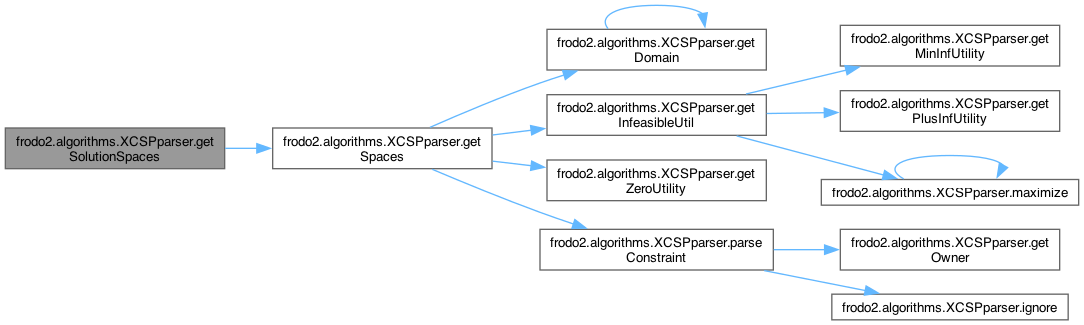
| List< ? extends UtilitySolutionSpace< V, U > > frodo2.algorithms.XCSPparser< V extends Addable< V >, U extends Addable< U > >.getSolutionSpaces | ( | ) |
Returns the solution spaces in the problem.
- Returns
- a list of spaces, or
nullif some information is missing
- Warning
- Ignores variables with unknown owners.
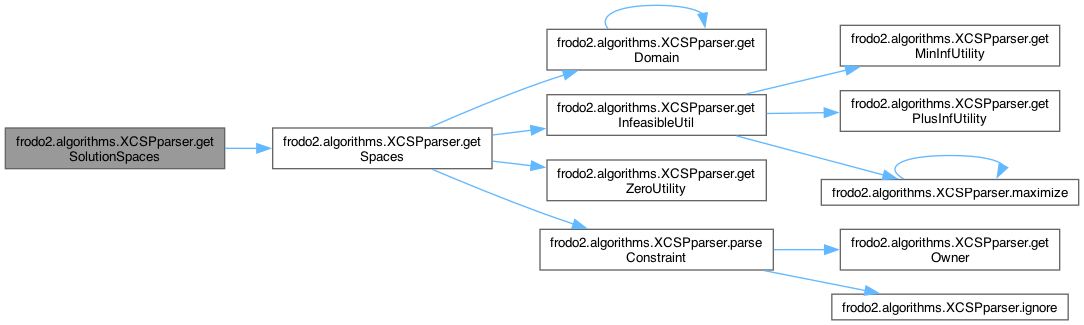
References getSpaces().
Referenced by getNumberOfCoordinationConstraints(), getParamUtility(), getSolutionSpaces(), getUtility(), frodo2.solutionSpaces.JaCoP.JaCoPxcspParser< V extends Addable< V > >.getUtility(), groundVars(), parse(), frodo2.solutionSpaces.JaCoP.JaCoPxcspParser< V extends Addable< V > >.parse(), frodo2.algorithms.dpop.privacy.test.P2_DPOPagentTest< V extends Addable< V >, E extends AddableLimited< AddableInteger, E >.test(), frodo2.algorithms.mpc_discsp.tests.MPC_DisWCSP4tests.test(), frodo2.solutionSpaces.vehiclerouting.test.VRPtests.testBestFirstiterator(), frodo2.algorithms.test.ProblemTest.testGetSolutionSpaces(), frodo2.solutionSpaces.JaCoP.tests.JaCoPtests< V extends Addable< V > >.testProblemFromRepository(), frodo2.algorithms.dpop.count.test.TestCountSolutions.testRandom(), and frodo2.solutionSpaces.JaCoP.tests.JaCoPtests< V extends Addable< V > >.testRandomExtensionalProblem().
◆ getSolutionSpaces() [2/8]
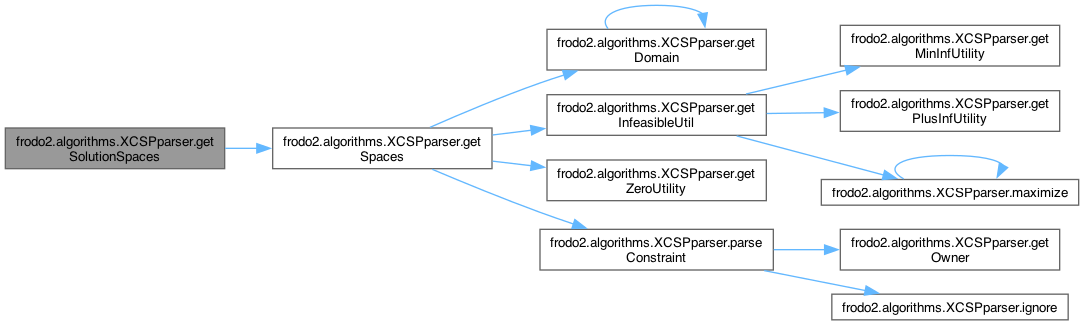
| List< ? extends UtilitySolutionSpace< V, U > > frodo2.algorithms.XCSPparser< V extends Addable< V >, U extends Addable< U > >.getSolutionSpaces | ( | DCOPProblemInterface< V, U > | problem, |
| final boolean | withAnonymVars ) |
Extracts solution spaces from the constraints in the problem.
- Parameters
-
problem the problem instance that should be notified of contraint checks withAnonymVars whether hypercubes involving variables with unknown owners should be taken into account
- Returns
- a list of hypercubes, or
nullif some information is missing in the problem file
References getSpaces().
◆ getSolutionSpaces() [3/8]
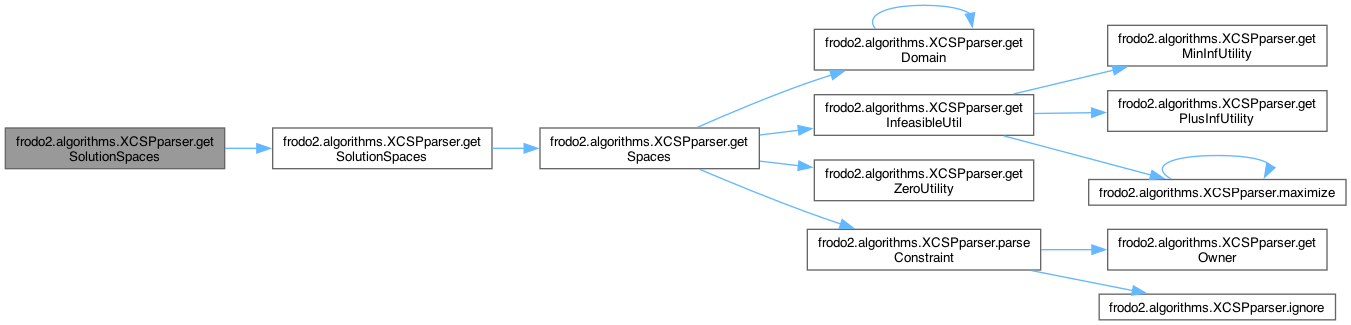
| List< ? extends UtilitySolutionSpace< V, U > > frodo2.algorithms.XCSPparser< V extends Addable< V >, U extends Addable< U > >.getSolutionSpaces | ( | final boolean | withAnonymVars | ) |
Extracts solution spaces from the constraints in the problem.
- Returns
- a list of hypercubes, or
nullif some information is missing in the problem file
- Parameters
-
withAnonymVars whether hypercubes involving variables with unknown owners should be taken into account
References getSolutionSpaces().
◆ getSolutionSpaces() [4/8]
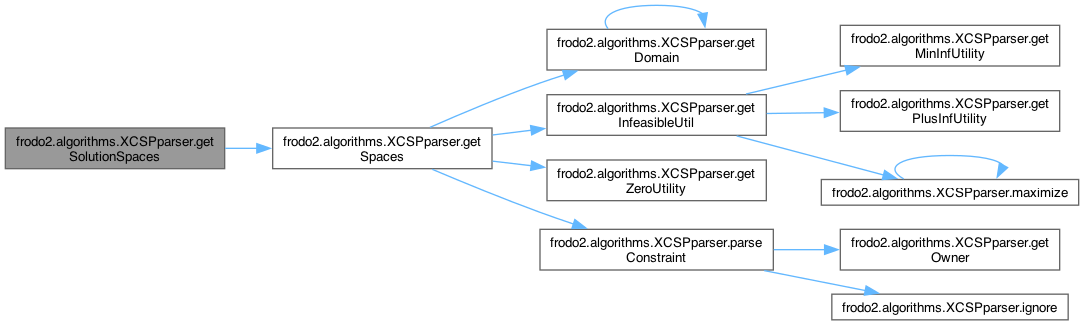
| List<? extends UtilitySolutionSpace< V, U > > frodo2.algorithms.XCSPparser< V extends Addable< V >, U extends Addable< U > >.getSolutionSpaces | ( | Set< String > | vars, |
| boolean | withAnonymVars, | ||
| Set< String > | forbiddenVars ) |
Extracts solution spaces involving the input variables from the constraints in the problem.
- Returns
- a list of hypercubes, or
nullif some information is missing in the problem file
- Parameters
-
vars the variables of interest withAnonymVars whether hypercubes involving variables with unknown owners should be taken into account forbiddenVars any space involving any of these variables will be ignored
References getSpaces().
◆ getSolutionSpaces() [5/8]
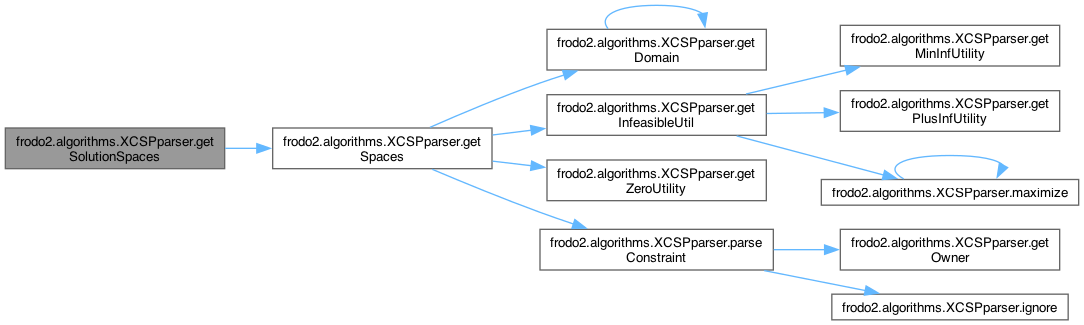
| List< ? extends UtilitySolutionSpace< V, U > > frodo2.algorithms.XCSPparser< V extends Addable< V >, U extends Addable< U > >.getSolutionSpaces | ( | String | var | ) |
Extracts solution spaces involving the input variable from the constraints in the problem.
- Returns
- a list of hypercubes, or
nullif some information is missing in the problem file
- Parameters
-
var the variable of interest
- Warning
- Ignores hypercubes involving variables whose owner is unknown.
References getSpaces().
◆ getSolutionSpaces() [6/8]
| List<? extends UtilitySolutionSpace< V, U > > frodo2.algorithms.XCSPparser< V extends Addable< V >, U extends Addable< U > >.getSolutionSpaces | ( | String | var, |
| boolean | withAnonymVars, | ||
| Set< String > | forbiddenVars ) |
Extracts solution spaces involving the input variable from the constraints in the problem.
- Returns
- a list of hypercubes, or
nullif some information is missing in the problem file
- Parameters
-
var the variable of interest withAnonymVars whether hypercubes involving variables with unknown owners should be taken into account forbiddenVars any space involving any of these variables will be ignored
References getSpaces().
◆ getSolutionSpaces() [7/8]
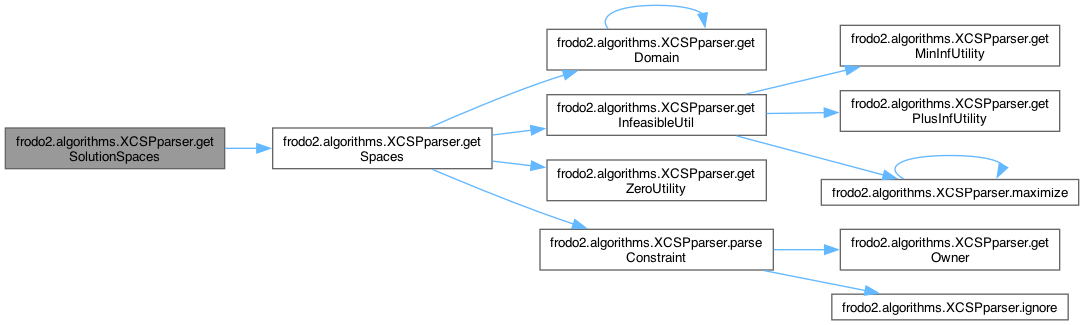
| List< ? extends UtilitySolutionSpace< V, U > > frodo2.algorithms.XCSPparser< V extends Addable< V >, U extends Addable< U > >.getSolutionSpaces | ( | String | var, |
| final boolean | withAnonymVars ) |
Extracts solution spaces involving the input variable from the constraints in the problem.
- Returns
- a list of hypercubes, or
nullif some information is missing in the problem file
- Parameters
-
var the variable of interest withAnonymVars whether hypercubes involving variables with unknown owners should be taken into account
References getSpaces().
◆ getSolutionSpaces() [8/8]
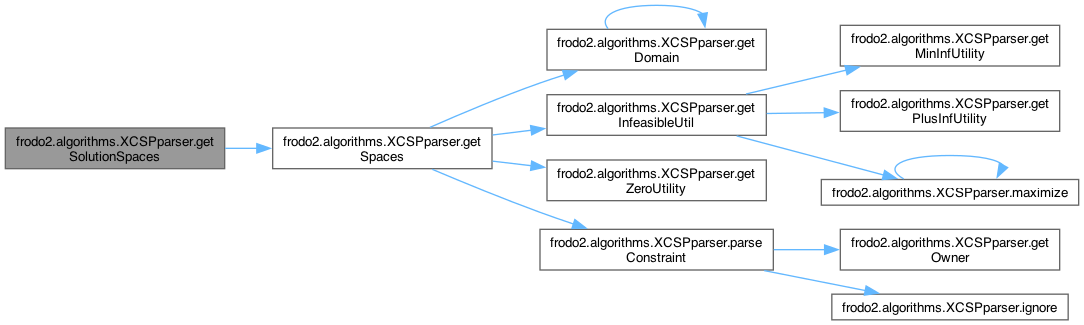
| List<? extends UtilitySolutionSpace< V, U > > frodo2.algorithms.XCSPparser< V extends Addable< V >, U extends Addable< U > >.getSolutionSpaces | ( | String | var, |
| Set< String > | forbiddenVars ) |
Returns the solution spaces involving the input variable and none of the forbidden variables.
- Parameters
-
var the variable of interest forbiddenVars any space involving any of these variables will be ignored
- Returns
- a list of spaces, or
nullif some information is missing
References getSpaces().
◆ getSpaces()
|
protected |
Extracts hypercubes from the constraints in the problem.
- Returns
- a list of hypercubes, or
nullif some information is missing in the problem file
- Parameters
-
vars if null, returns all constraints; otherwise, returns only the constraints involving at least one of the variables in varswithAnonymVars whether hypercubes involving variables with unknown owners should be taken into account getProbs if true, returns the probability spaces (ignoring withAnonymVars); else, returns the solution spacesforbiddenVars any space involving any of these variables will be ignored problem the problem instance that should be notified of constraint checks
- Todo
- The implementation can be improved so as to only parse things that are needed (wrt var).
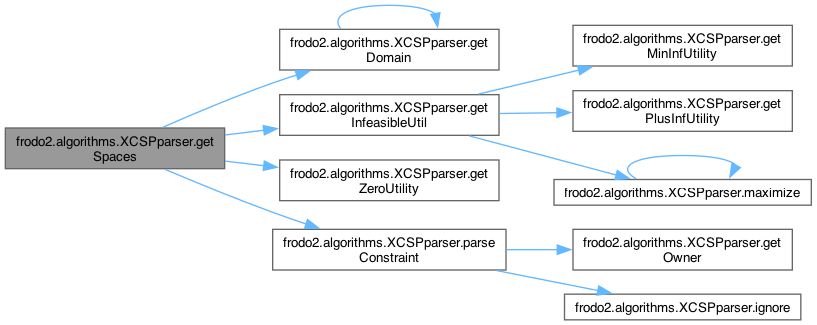
References getDomain(), getInfeasibleUtil(), getZeroUtility(), parseConstraint(), root, utilClass, and valInstance.
Referenced by getProbabilitySpaces(), getProbabilitySpaces(), getSolutionSpaces(), getSolutionSpaces(), getSolutionSpaces(), getSolutionSpaces(), getSolutionSpaces(), getSolutionSpaces(), and getSolutionSpaces().
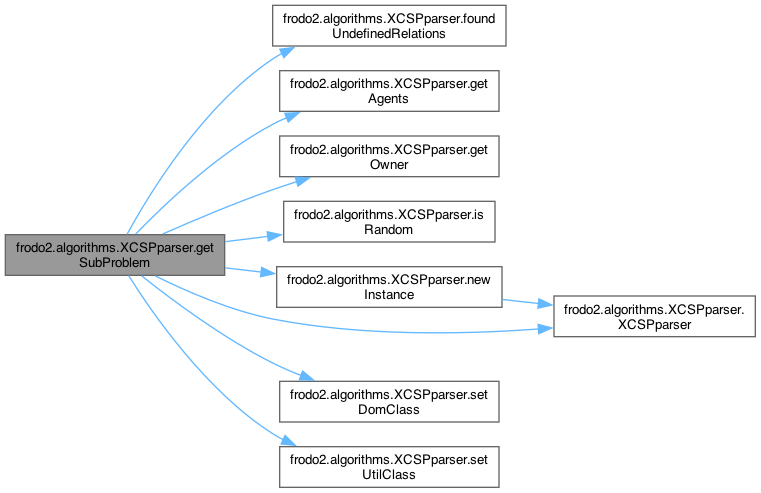
◆ getSubProblem()
| XCSPparser< V, U > frodo2.algorithms.XCSPparser< V extends Addable< V >, U extends Addable< U > >.getSubProblem | ( | String | agent | ) |
Builds the subproblem description for a given agent by extracting it from the overall problem description.
- Parameters
-
agent the name of the agent
- Returns
- the subproblem corresponding to agent, or
nullif agent owns no variable
Reimplemented in frodo2.benchmarks.vehiclerouting.XCSPparserVRP< U extends Addable< U > >, and frodo2.solutionSpaces.JaCoP.JaCoPxcspParser< V extends Addable< V > >.
References domClass, foundUndefinedRelations(), getAgents(), getOwner(), isRandom(), newInstance(), root, setDomClass(), setUtilClass(), utilClass, and XCSPparser().
Referenced by main().
◆ getUtility() [1/2]
| UtilitySolutionSpace< V, U > frodo2.algorithms.XCSPparser< V extends Addable< V >, U extends Addable< U > >.getUtility | ( | Map< String, V > | assignments | ) |
Computes the total utility of the input assignment to variables, ignoring variables with no specified owner.
This methods actually returns a UtilitySolutionSpace. If not all variables in the problem are assigned a value, the space will represent the utility of the assignment, conditioned on the free variables. If all variables are grounded, the method returns a scalar UtilitySolutionSpace.
- Parameters
-
assignments values for variables
- Returns
- the optimal (possibly conditional) utility corresponding to the input assignment
References getUtility().
Referenced by getExpectedUtility(), getUtility(), frodo2.algorithms.dpop.privacy.test.P2_DPOPagentTest< V extends Addable< V >, E extends AddableLimited< AddableInteger, E >.test(), frodo2.algorithms.dpop.privacy.test.P3halves_DPOPagentTest< V extends Addable< V >, E extends AddableLimited< AddableInteger, E >.test(), frodo2.algorithms.maxsum.tests.MaxSumTests< V extends Addable< V >, U extends Addable< U > >.test(), frodo2.algorithms.odpop.tests.ODPOPagentTest< V extends Addable< V >, U extends Addable< U > >.testRandom(), frodo2.algorithms.odpop.tests.ODPOPagentTestBinaryDomains< V extends Addable< V >, U extends Addable< U > >.testRandom(), and frodo2.algorithms.odpop.tests.ODPOPagentTestFullDomain< V extends Addable< V >, U extends Addable< U > >.testRandom().
◆ getUtility() [2/2]
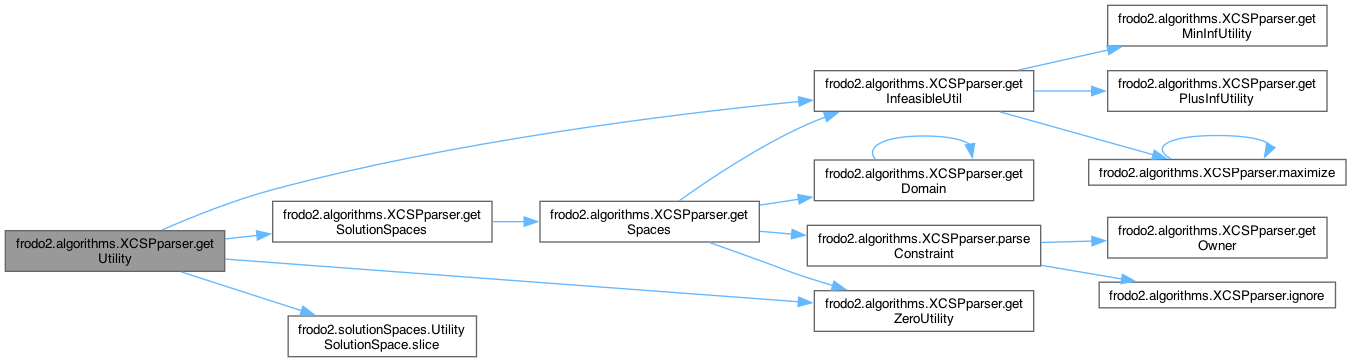
| UtilitySolutionSpace< V, U > frodo2.algorithms.XCSPparser< V extends Addable< V >, U extends Addable< U > >.getUtility | ( | Map< String, V > | assignments, |
| final boolean | withAnonymVars ) |
Computes the total utility of the input assignment to variables.
This methods actually returns a UtilitySolutionSpace. If not all variables in the problem are assigned a value, the space will represent the utility of the assignment, conditioned on the free variables. If all variables are grounded, the method returns a scalar UtilitySolutionSpace.
- Parameters
-
assignments values for variables withAnonymVars if false, ignores variable with no specified owner
- Returns
- the optimal (possibly conditional) utility corresponding to the input assignment
References getInfeasibleUtil(), getSolutionSpaces(), getZeroUtility(), frodo2.output, and frodo2.solutionSpaces.UtilitySolutionSpace< V extends Addable< V >, U extends Addable< U > >.slice().
◆ getVariables() [1/2]
| Set< String > frodo2.algorithms.XCSPparser< V extends Addable< V >, U extends Addable< U > >.getVariables | ( | ) |
- Returns
- all variables with a known owner
References root.
Referenced by getAgentNeighborhoods(), getAllVars(), getAnonymVars(), getMyVars(), getNbrVars(), getNeighborhoods(), parse(), frodo2.algorithms.dpop.stochastic.test.SamplingPhaseTest.setUp(), frodo2.algorithms.localSearch.dsa.tests.TestDSA< U extends Addable< U > >.setUp(), frodo2.algorithms.test.ProblemTest.setUp(), frodo2.algorithms.test.ProblemTest.testGetOwner(), frodo2.algorithms.dpop.count.test.TestCountSolutions.testRandom(), and toDOT().
◆ getVariables() [2/2]
| Set< String > frodo2.algorithms.XCSPparser< V extends Addable< V >, U extends Addable< U > >.getVariables | ( | String | owner | ) |
Returns the set of variables owned by a given agent.
- Parameters
-
owner the name of the agent; if null, returns all variables with no specified owner
- Returns
- a set of variables owned by owner
References root.
◆ getZeroUtility()
| U frodo2.algorithms.XCSPparser< V extends Addable< V >, U extends Addable< U > >.getZeroUtility | ( | ) |
- Returns
- a utility of value 0
References utilClass.
Referenced by getParamUtility(), getSpaces(), getUtility(), frodo2.solutionSpaces.JaCoP.JaCoPxcspParser< V extends Addable< V > >.getUtility(), and frodo2.algorithms.localSearch.dsa.tests.TestDSA< U extends Addable< U > >.setUp().
◆ groundVars()
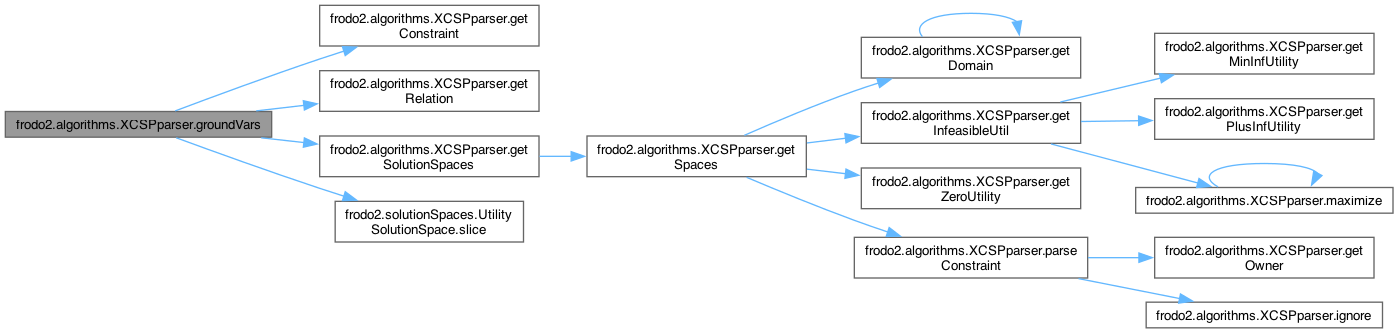
| Document frodo2.algorithms.XCSPparser< V extends Addable< V >, U extends Addable< U > >.groundVars | ( | String[] | vars, |
| V[] | values ) |
Transforms the problem into one where some variables' values have been fixed.
- Parameters
-
vars the variables whoses values should be fixed values the values for the variables
- Returns
- the transformed problem
- Warning
- Does not work if one of the contraints sees all its variables grounded.
- Todo
- Test this method.
References getConstraint(), getRelation(), getSolutionSpaces(), root, and frodo2.solutionSpaces.UtilitySolutionSpace< V extends Addable< V >, U extends Addable< U > >.slice().
◆ ignore()
|
protected |
- Parameters
-
spaceClass the space class for which we want to know whether ncccs should be ignored or not
- Returns
truewhen ncccs should be ignored, andfalseotherwise
Referenced by parseConstraint().
◆ incrNCCCs()
| void frodo2.algorithms.XCSPparser< V extends Addable< V >, U extends Addable< U > >.incrNCCCs | ( | long | incr | ) |
Increments the number of constraint checks.
- Parameters
-
incr the increment
◆ isCountingNCCCs()
| boolean frodo2.algorithms.XCSPparser< V extends Addable< V >, U extends Addable< U > >.isCountingNCCCs | ( | ) |
- Returns
- whether this parser is counting NCCCs
◆ isRandom()
| boolean frodo2.algorithms.XCSPparser< V extends Addable< V >, U extends Addable< U > >.isRandom | ( | String | var | ) |
Returns whether the input variable is defined as a random variable.
- Parameters
-
var the name of the variable
- Returns
trueif the input variable is a random variable,falseif not or if the variable is unknown
References root.
Referenced by getAgentNeighbors(), getNeighborhoods(), getNeighborVars(), getSubProblem(), frodo2.solutionSpaces.JaCoP.JaCoPxcspParser< V extends Addable< V > >.getSubProblem(), parse(), and setDomain().
◆ main()
|
static |
Parses the input problem.
- Parameters
-
args the path to the XCSP file
- Exceptions
-
Exception if an error occurs
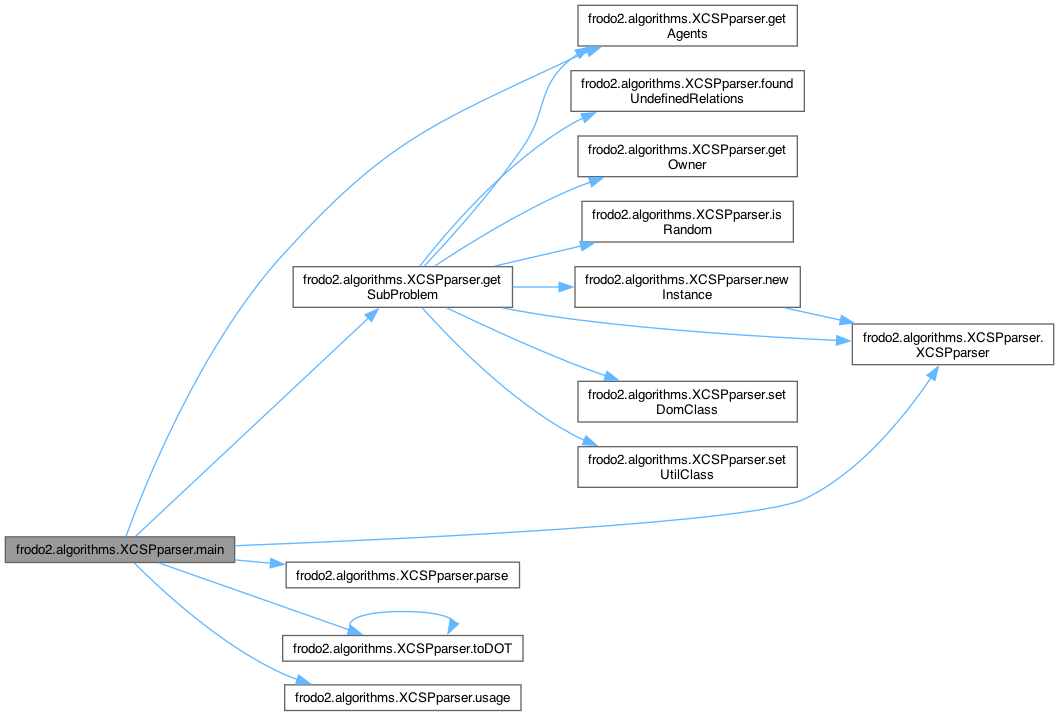
References getAgents(), getSubProblem(), frodo2.outFile, parse(), root, toDOT(), usage(), and XCSPparser().
◆ maximize()
| boolean frodo2.algorithms.XCSPparser< V extends Addable< V >, U extends Addable< U > >.maximize | ( | ) |
- Returns
trueif this is a maximization problem,falseotherwise
References maximize(), and root.
Referenced by frodo2.algorithms.dpop.count.SolutionCounter< V extends Addable< V >, U extends Addable< U > >.count(), getInfeasibleUtil(), maximize(), parse(), frodo2.solutionSpaces.JaCoP.JaCoPxcspParser< V extends Addable< V > >.parse(), setMaximize(), and switchMaxMin().
◆ multipleTypes()
| boolean frodo2.algorithms.XCSPparser< V extends Addable< V >, U extends Addable< U > >.multipleTypes | ( | ) |
- Returns
truewhen agents can be of different types, andfalseotherwise
◆ newInstance()
|
protected |
Calls the corresponding constructor.
- Parameters
-
instance the agent's subproblem
- Returns
- a new instance of this class
Reimplemented in frodo2.benchmarks.vehiclerouting.XCSPparserVRP< U extends Addable< U > >, and frodo2.solutionSpaces.JaCoP.JaCoPxcspParser< V extends Addable< V > >.
References XCSPparser().
Referenced by getSubProblem(), frodo2.algorithms.dpop.test.DPOPagentTest< V extends Addable< V >, U extends Addable< U > >.setUp(), frodo2.algorithms.duct.tests.DUCTagentChildSearchTest.setUp(), frodo2.algorithms.duct.tests.DUCTagentChildTest.setUp(), frodo2.algorithms.duct.tests.DUCTagentPruningSearchTest.setUp(), frodo2.algorithms.duct.tests.DUCTagentPruningTest.setUp(), frodo2.algorithms.duct.tests.DUCTagentTest.setUp(), frodo2.algorithms.asodpop.tests.ASODPOPagentTest< V extends Addable< V >, U extends Addable< U > >.testRandom(), frodo2.algorithms.asodpop.tests.ASODPOPBinaryAgentTest< V extends Addable< V >, U extends Addable< U > >.testRandom(), frodo2.algorithms.odpop.tests.ODPOPagentTest< V extends Addable< V >, U extends Addable< U > >.testRandom(), frodo2.algorithms.odpop.tests.ODPOPagentTestBinaryDomains< V extends Addable< V >, U extends Addable< U > >.testRandom(), and frodo2.algorithms.odpop.tests.ODPOPagentTestFullDomain< V extends Addable< V >, U extends Addable< U > >.testRandom().

◆ parse() [1/7]
| DCOPProblemInterface< V, U > frodo2.algorithms.XCSPparser< V extends Addable< V >, U extends Addable< U > >.parse | ( | ) |
- See also
- ParserInterface.parse()
Reimplemented in frodo2.solutionSpaces.JaCoP.JaCoPxcspParser< V extends Addable< V > >.
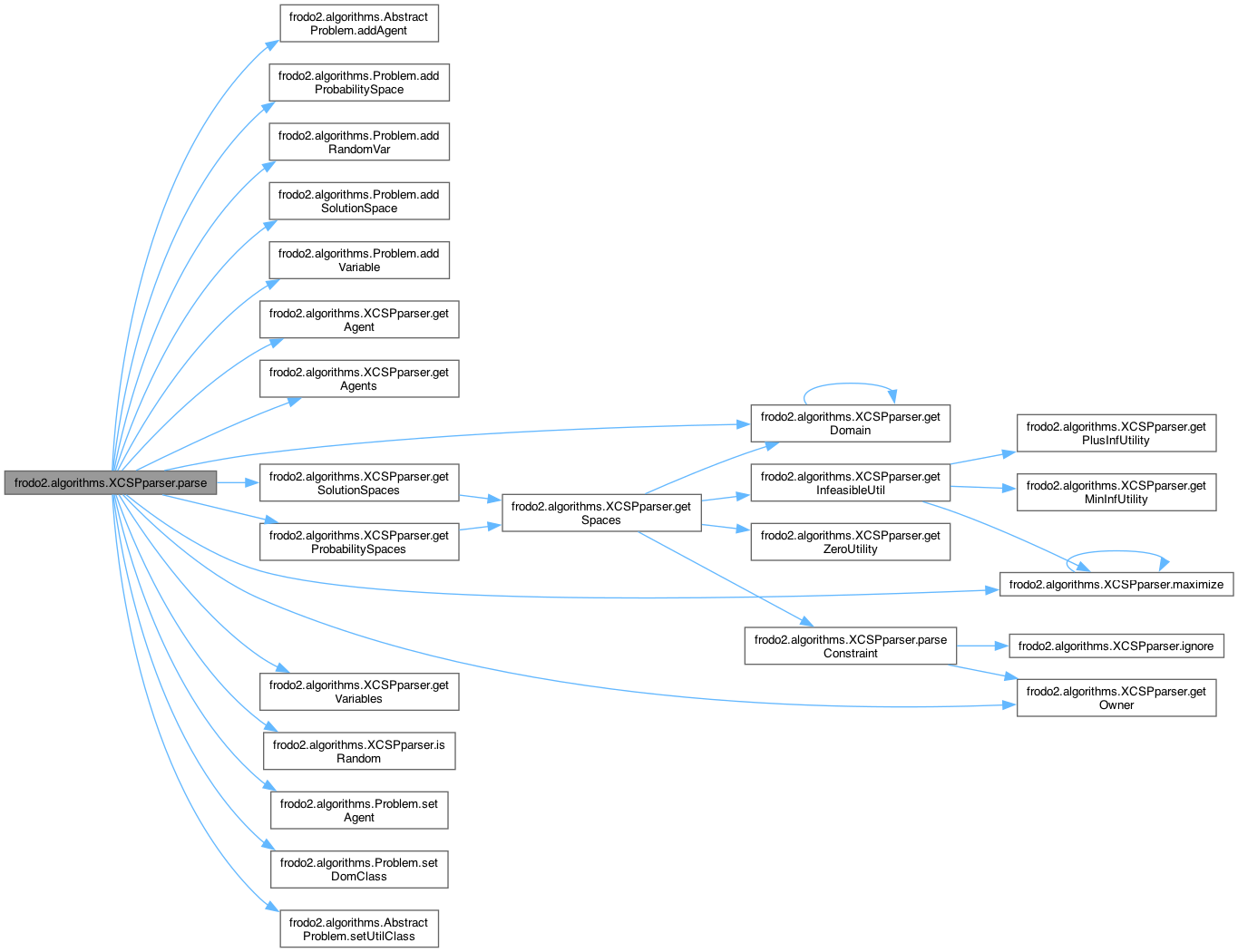
References frodo2.algorithms.AbstractProblem< V extends Addable< V >, U extends Addable< U > >.addAgent(), frodo2.algorithms.Problem< V extends Addable< V >, U extends Addable< U > >.addProbabilitySpace(), frodo2.algorithms.Problem< V extends Addable< V >, U extends Addable< U > >.addRandomVar(), frodo2.algorithms.Problem< V extends Addable< V >, U extends Addable< U > >.addSolutionSpace(), frodo2.algorithms.Problem< V extends Addable< V >, U extends Addable< U > >.addVariable(), domClass, getAgent(), getAgents(), getDomain(), getOwner(), getProbabilitySpaces(), getSolutionSpaces(), getVariables(), isRandom(), maximize(), frodo2.algorithms.Problem< V extends Addable< V >, U extends Addable< U > >.setAgent(), frodo2.algorithms.Problem< V extends Addable< V >, U extends Addable< U > >.setDomClass(), frodo2.algorithms.AbstractProblem< V extends Addable< V >, U extends Addable< U > >.setUtilClass(), and utilClass.
◆ parse() [2/7]
|
static |
Creates a JDOM Document out of the input XML file in XCSP format.
- Parameters
-
file the XML file
- Returns
- a JDOM Document resulting from the parsing of the input file
- Exceptions
-
JDOMException if a parsing error occurs while reading the file IOException if an I/O error occurs while accessing the file
- Note
- The input file will be checked against the XCSP schema file
Referenced by frodo2.algorithms.AbstractSolver< P extends ProblemInterface< V, U, V extends Addable< V >, U extends Addable< U >, S extends Solution< V, U >.AbstractSolver(), frodo2.gui.SimpleGUI.actionPerformed(), frodo2.algorithms.dpop.stochastic.test.E_DPOPagentTest< V extends Addable< V > >.checkOutput(), frodo2.algorithms.dpop.test.DPOPagentTest< V extends Addable< V >, U extends Addable< U > >.checkOutput(), frodo2.algorithms.dpop.count.SolutionCounter< V extends Addable< V >, U extends Addable< U > >.count(), frodo2.solutionSpaces.JaCoP.tests.JaCoPtests< V extends Addable< V > >.JaCoPtests(), frodo2.algorithms.AbstractDCOPsolver< V extends Addable< V >, U extends Addable< U >, S extends Solution< V, U >.main(), frodo2.algorithms.AgentFactory< V extends Addable< V >, U extends Addable< U > >.main(), main(), frodo2.algorithms.mpc_discsp.tests.MPC_DisWCSP4tests.MPC_DisWCSP4tests(), parse(), parse(), frodo2.algorithms.AgentFactory< V extends Addable< V >, U extends Addable< U > >.parseProblem(), frodo2.algorithms.dpop.privacy.test.SecureRerootingTest.randomTest(), frodo2.algorithms.dpop.privacy.test.VariableObfuscationTest< V extends Addable< V > >.randomTest(), frodo2.controller.ConfigurationManager.runExperiment(), frodo2.algorithms.adopt.test.ADOPTagentTest< V extends Addable< V >, U extends Addable< U > >.setUp(), frodo2.algorithms.adopt.test.testADOPT.setUp(), frodo2.algorithms.afb.test.AFBagentTest< V extends Addable< V >, U extends Addable< U > >.setUp(), frodo2.algorithms.asodpop.tests.ASODPOPagentTest< V extends Addable< V >, U extends Addable< U > >.setUp(), frodo2.algorithms.asodpop.tests.ASODPOPBinaryAgentTest< V extends Addable< V >, U extends Addable< U > >.setUp(), frodo2.algorithms.dpop.param.test.ParamDPOPtest< V extends Addable< V >, U extends Addable< U > >.setUp(), frodo2.algorithms.dpop.privacy.test.SecureCircularRoutingTest.setUp(), frodo2.algorithms.dpop.restart.test.TestSDPOP< V extends Addable< V >, U extends Addable< U > >.setUp(), frodo2.algorithms.dpop.stochastic.robust.test.Robust_E_DPOPagentTest< V extends Addable< V > >.setUp(), frodo2.algorithms.dpop.stochastic.test.E_DPOPagentTest< V extends Addable< V > >.setUp(), frodo2.algorithms.dpop.stochastic.test.LowestCommonAncestorsTest.setUp(), frodo2.algorithms.dpop.stochastic.test.SamplingPhaseTest.setUp(), frodo2.algorithms.dpop.test.DPOPagentTest< V extends Addable< V >, U extends Addable< U > >.setUp(), frodo2.algorithms.duct.tests.DUCTagentChildSearchTest.setUp(), frodo2.algorithms.duct.tests.DUCTagentChildTest.setUp(), frodo2.algorithms.duct.tests.DUCTagentPruningSearchTest.setUp(), frodo2.algorithms.duct.tests.DUCTagentPruningTest.setUp(), frodo2.algorithms.duct.tests.DUCTagentTest.setUp(), frodo2.algorithms.localSearch.dsa.tests.DSAagentTest< V extends Addable< V >, U extends Addable< U > >.setUp(), frodo2.algorithms.localSearch.mgm.mgm2.tests.MGM2agentTest< V extends Addable< V >, U extends Addable< U > >.setUp(), frodo2.algorithms.localSearch.mgm.tests.MGMagentTest< V extends Addable< V >, U extends Addable< U > >.setUp(), frodo2.algorithms.odpop.tests.ODPOPagentTest< V extends Addable< V >, U extends Addable< U > >.setUp(), frodo2.algorithms.odpop.tests.ODPOPagentTestBinaryDomains< V extends Addable< V >, U extends Addable< U > >.setUp(), frodo2.algorithms.odpop.tests.ODPOPagentTestFullDomain< V extends Addable< V >, U extends Addable< U > >.setUp(), frodo2.algorithms.synchbb.test.SynchBBagentTest< V extends Addable< V >, U extends Addable< U > >.setUp(), frodo2.algorithms.test.ProblemTest.setUp(), frodo2.algorithms.test.XCSPparserTest.setUp(), frodo2.algorithms.dpop.count.SolutionCounter< V extends Addable< V >, U extends Addable< U > >.SolutionCounter(), frodo2.controller.userIO.DistributedSolver< V extends Addable< V >, U extends Addable< U >, S extends Solution< V, U >.solve(), frodo2.gui.SimpleGUI.solveProblem(), frodo2.algorithms.adopt.test.testADOPT.test(), frodo2.algorithms.asodpop.tests.ASODPOPBinaryTest< V extends Addable< V >, U extends Addable< U > >.test(), frodo2.algorithms.asodpop.tests.ASODPOPTest< V extends Addable< V >, U extends Addable< U > >.test(), frodo2.algorithms.dpop.memory.tests.MB_DPOPagentTest.test(), frodo2.algorithms.dpop.privacy.test.P2_DPOPagentTest< V extends Addable< V >, E extends AddableLimited< AddableInteger, E >.test(), frodo2.algorithms.dpop.privacy.test.P3halves_DPOPagentTest< V extends Addable< V >, E extends AddableLimited< AddableInteger, E >.test(), frodo2.algorithms.maxsum.tests.MaxSumTests< V extends Addable< V >, U extends Addable< U > >.test(), frodo2.algorithms.varOrdering.dfs.tests.LocalRandVarsDFStest.test(), frodo2.solutionSpaces.vehiclerouting.test.VRPtests.test(), frodo2.algorithms.dpop.test.UTILpropagationTest< U extends Addable< U > >.testComputeDFS(), frodo2.algorithms.dpop.privacy.test.P_DPOPagentTest< V extends Addable< V > >.testP_DPOPvsDPOP(), frodo2.solutionSpaces.JaCoP.tests.JaCoPtests< V extends Addable< V > >.testProblemFromRepository(), frodo2.algorithms.adopt.test.testPreprocessing.testRandom(), frodo2.algorithms.asodpop.tests.ASODPOPagentTest< V extends Addable< V >, U extends Addable< U > >.testRandom(), frodo2.algorithms.asodpop.tests.ASODPOPBinaryAgentTest< V extends Addable< V >, U extends Addable< U > >.testRandom(), frodo2.algorithms.localSearch.dsa.tests.DSAagentTest< V extends Addable< V >, U extends Addable< U > >.testRandom(), frodo2.algorithms.localSearch.mgm.mgm2.tests.MGM2agentTest< V extends Addable< V >, U extends Addable< U > >.testRandom(), frodo2.algorithms.localSearch.mgm.tests.MGMagentTest< V extends Addable< V >, U extends Addable< U > >.testRandom(), frodo2.algorithms.odpop.tests.ODPOPagentTest< V extends Addable< V >, U extends Addable< U > >.testRandom(), frodo2.algorithms.odpop.tests.ODPOPagentTestBinaryDomains< V extends Addable< V >, U extends Addable< U > >.testRandom(), frodo2.algorithms.odpop.tests.ODPOPagentTestFullDomain< V extends Addable< V >, U extends Addable< U > >.testRandom(), and frodo2.algorithms.varOrdering.election.tests.VariableElectionTest< S extends Comparable< S > &Serializable >.testRandom().
◆ parse() [3/7]
|
static |
Creates a JDOM Document out of the input XML file (not necessarily in XCSP format).
- Parameters
-
file the XML file checkXCSP if true, checks that the input XCSP file is properly formatted
- Returns
- a JDOM Document resulting from the parsing of the input file
- Exceptions
-
JDOMException if a parsing error occurs while reading the file IOException if an I/O error occurs while accessing the file
◆ parse() [4/7]
|
static |
Creates a JDOM Document out of the input XML stream in XCSP format.
- Parameters
-
stream the XML stream
- Returns
- a JDOM Document resulting from the parsing of the input file
- Exceptions
-
JDOMException if a parsing error occurs while reading the file IOException if an I/O error occurs while accessing the file
- Note
- The input stream will be checked against the XCSP schema file
◆ parse() [5/7]
|
static |
Creates a JDOM Document out of the input XML stream (not necessarily in XCSP format).
- Parameters
-
stream the XML stream checkXCSP if true, checks that the input XCSP file is properly formatted
- Returns
- a JDOM Document resulting from the parsing of the input file
- Exceptions
-
JDOMException if a parsing error occurs while reading the file IOException if an I/O error occurs while accessing the file
◆ parse() [6/7]
|
static |
Creates a JDOM Document out of the input XML file path in XCSP format.
- Parameters
-
path the XML file path
- Returns
- a JDOM Document resulting from the parsing of the input file
- Exceptions
-
Exception if an error occurs
- Note
- The input file will be checked against the XCSP schema file
References parse().

◆ parse() [7/7]
|
static |
Creates a JDOM Document out of the input XML file path (not necessarily in XCSP format).
- Parameters
-
path the XML file path checkXCSP if true, checks that the input XCSP file is properly formatted
- Returns
- a JDOM Document resulting from the parsing of the input file
- Exceptions
-
Exception if an error occurs
References parse().

◆ parseConstraint()
|
protected |
Parses a constraint.
- Parameters
-
spaces the list of spaces to which the constraint should be added constraint the XCSP description of the constraint variablesHashMap the domain of each variable relationInfos relations, indexed by their names vars if null, returns all constraints; otherwise, returns only the constraints involving at least one of the variables in varsgetProbs if true, returns the probability spaces (ignoring withAnonymVars); else, returns the solution spaceswithAnonymVars whether constraints involving variables with unknown owners should be taken into account infeasibleUtil the infeasible utility forbiddenVars any space involving any of these variables will be ignored problem the problem instance that should be notified of constraint checks
References frodo2.algorithms.XCSPparser< V extends Addable< V >, U extends Addable< U > >.Relation< V extends Addable< V >, U extends Addable< U > >.defaultUtil, getOwner(), ignore(), frodo2.algorithms.XCSPparser< V extends Addable< V >, U extends Addable< U > >.Relation< V extends Addable< V >, U extends Addable< U > >.tuples, utilClass, and frodo2.algorithms.XCSPparser< V extends Addable< V >, U extends Addable< U > >.Relation< V extends Addable< V >, U extends Addable< U > >.utilities.
Referenced by getSpaces().

◆ removeSpace()
| boolean frodo2.algorithms.XCSPparser< V extends Addable< V >, U extends Addable< U > >.removeSpace | ( | String | name | ) |
Removes the space with the given name.
- Parameters
-
name the name of the space
- Returns
trueif the space was present and had been removed
References root.
◆ rescale()
| void frodo2.algorithms.XCSPparser< V extends Addable< V >, U extends Addable< U > >.rescale | ( | U | multiply, |
| U | add ) |
Rescales the problem.
- Parameters
-
multiply multiplies all costs/utilities by multiply add after multiplying all costs/utilities by multiply (if required), adds add
Reimplemented in frodo2.benchmarks.vehiclerouting.XCSPparserVRP< U extends Addable< U > >.
References root.
◆ reset()
| void frodo2.algorithms.XCSPparser< V extends Addable< V >, U extends Addable< U > >.reset | ( | ProblemInterface< V, U > | newProblem | ) |
Resets this problem to be the same as the input one.
- Parameters
-
newProblem the problem
References root, utilClass, valInstance, and XCSPparser().

◆ setDomain() [1/2]
|
private |
Sets the domain of a variable.
- Parameters
-
var the variable domain its new domain weights normalized weights for each value in the new domain (used only if the variable is random)
References getRelation(), isRandom(), root, and toString().
◆ setDomain() [2/2]
| void frodo2.algorithms.XCSPparser< V extends Addable< V >, U extends Addable< U > >.setDomain | ( | String | var, |
| V[] | dom ) |
Sets the domain of a variable in the problem.
If the input domain has values that appear more than once, it is reduced so as to only contain each value once. If the input variable is a random variable, the input domain is treated as a set of samples, and the probability law for the random variable is re-computed so as to reflect the frequency of each value in the sample set. If the variable is unknown, it adds it to the problem, assuming it is a random variable.
- Parameters
-
var the name of the variable dom the domain; if empty, does nothing
- Todo
- Test the case when the variable is unknown.
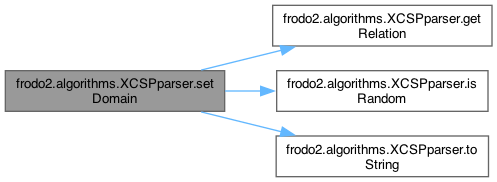
References setDomain().
Referenced by setDomain(), and setProbSpace().
◆ setDomClass()
| void frodo2.algorithms.XCSPparser< V extends Addable< V >, U extends Addable< U > >.setDomClass | ( | Class< V > | domClass | ) |
Sets the class to be used for variable values.
- Parameters
-
domClass the class for variable values
References domClass.
Referenced by getSubProblem(), frodo2.algorithms.adopt.test.ADOPTagentTest< V extends Addable< V >, U extends Addable< U > >.setUp(), frodo2.algorithms.afb.test.AFBagentTest< V extends Addable< V >, U extends Addable< U > >.setUp(), frodo2.algorithms.dpop.param.test.ParamDPOPtest< V extends Addable< V >, U extends Addable< U > >.setUp(), frodo2.algorithms.dpop.stochastic.robust.test.Robust_E_DPOPagentTest< V extends Addable< V > >.setUp(), frodo2.algorithms.dpop.stochastic.test.E_DPOPagentTest< V extends Addable< V > >.setUp(), frodo2.algorithms.dpop.test.DPOPagentTest< V extends Addable< V >, U extends Addable< U > >.setUp(), frodo2.algorithms.duct.tests.DUCTagentChildSearchTest.setUp(), frodo2.algorithms.duct.tests.DUCTagentChildTest.setUp(), frodo2.algorithms.duct.tests.DUCTagentPruningSearchTest.setUp(), frodo2.algorithms.duct.tests.DUCTagentPruningTest.setUp(), frodo2.algorithms.duct.tests.DUCTagentTest.setUp(), frodo2.algorithms.synchbb.test.SynchBBagentTest< V extends Addable< V >, U extends Addable< U > >.setUp(), frodo2.algorithms.asodpop.tests.ASODPOPagentTest< V extends Addable< V >, U extends Addable< U > >.testRandom(), frodo2.algorithms.asodpop.tests.ASODPOPBinaryAgentTest< V extends Addable< V >, U extends Addable< U > >.testRandom(), frodo2.algorithms.localSearch.dsa.tests.DSAagentTest< V extends Addable< V >, U extends Addable< U > >.testRandom(), frodo2.algorithms.localSearch.mgm.mgm2.tests.MGM2agentTest< V extends Addable< V >, U extends Addable< U > >.testRandom(), frodo2.algorithms.localSearch.mgm.tests.MGMagentTest< V extends Addable< V >, U extends Addable< U > >.testRandom(), frodo2.algorithms.odpop.tests.ODPOPagentTest< V extends Addable< V >, U extends Addable< U > >.testRandom(), frodo2.algorithms.odpop.tests.ODPOPagentTestBinaryDomains< V extends Addable< V >, U extends Addable< U > >.testRandom(), frodo2.algorithms.odpop.tests.ODPOPagentTestFullDomain< V extends Addable< V >, U extends Addable< U > >.testRandom(), and XCSPparser().
◆ setMaximize()
| void frodo2.algorithms.XCSPparser< V extends Addable< V >, U extends Addable< U > >.setMaximize | ( | boolean | maximize | ) |
Sets whether utility should be maximized, or cost minimized.
- Parameters
-
maximize trueiff this should be a maximization problem
References maximize(), and root.

◆ setNCCCs()
| void frodo2.algorithms.XCSPparser< V extends Addable< V >, U extends Addable< U > >.setNCCCs | ( | long | ncccs | ) |
Sets the NCCC count.
- Parameters
-
ncccs the NCCC count
◆ setOwner()
| boolean frodo2.algorithms.XCSPparser< V extends Addable< V >, U extends Addable< U > >.setOwner | ( | String | var, |
| String | owner ) |
Sets the owner agent for the input variable.
- Parameters
-
var the variable owner the owner
- Returns
falseif the owner was not changed because the variable does not exist
References getAgents(), and root.

◆ setProbSpace()
| void frodo2.algorithms.XCSPparser< V extends Addable< V >, U extends Addable< U > >.setProbSpace | ( | String | var, |
| Map< V, Double > | prob ) |
Adds to the problem a probability space for the input random variable.
- Parameters
-
var random variable prob weighted samples
References setDomain().

◆ setUtilClass()
| void frodo2.algorithms.XCSPparser< V extends Addable< V >, U extends Addable< U > >.setUtilClass | ( | Class< U > | utilClass | ) |
Sets the class to be used for utility values.
- Parameters
-
utilClass the class for utility values
Reimplemented in frodo2.benchmarks.vehiclerouting.XCSPparserVRP< U extends Addable< U > >.
References utilClass.
Referenced by getSubProblem(), frodo2.algorithms.adopt.test.ADOPTagentTest< V extends Addable< V >, U extends Addable< U > >.setUp(), frodo2.algorithms.afb.test.AFBagentTest< V extends Addable< V >, U extends Addable< U > >.setUp(), frodo2.algorithms.dpop.param.test.ParamDPOPtest< V extends Addable< V >, U extends Addable< U > >.setUp(), frodo2.algorithms.dpop.stochastic.robust.test.Robust_E_DPOPagentTest< V extends Addable< V > >.setUp(), frodo2.algorithms.dpop.stochastic.test.E_DPOPagentTest< V extends Addable< V > >.setUp(), frodo2.algorithms.dpop.stochastic.test.SamplingPhaseTest.setUp(), frodo2.algorithms.dpop.test.DPOPagentTest< V extends Addable< V >, U extends Addable< U > >.setUp(), frodo2.algorithms.duct.tests.DUCTagentChildSearchTest.setUp(), frodo2.algorithms.duct.tests.DUCTagentChildTest.setUp(), frodo2.algorithms.duct.tests.DUCTagentPruningSearchTest.setUp(), frodo2.algorithms.duct.tests.DUCTagentPruningTest.setUp(), frodo2.algorithms.duct.tests.DUCTagentTest.setUp(), frodo2.algorithms.duct.tests.NormalizeInfTest.setUp(), frodo2.algorithms.duct.tests.NormalizeTest.setUp(), frodo2.algorithms.odpop.tests.UTILpropagationTest< V extends Addable< V >, U extends Addable< U > >.setUp(), frodo2.algorithms.synchbb.test.SynchBBagentTest< V extends Addable< V >, U extends Addable< U > >.setUp(), frodo2.algorithms.dpop.privacy.test.P3halves_DPOPagentTest< V extends Addable< V >, E extends AddableLimited< AddableInteger, E >.test(), frodo2.algorithms.maxsum.tests.MaxSumTests< V extends Addable< V >, U extends Addable< U > >.test(), frodo2.algorithms.dpop.test.UTILpropagationTest< U extends Addable< U > >.testComputeDFS(), frodo2.algorithms.dpop.privacy.test.P_DPOPagentTest< V extends Addable< V > >.testP_DPOPvsDPOP(), frodo2.solutionSpaces.JaCoP.tests.JaCoPtests< V extends Addable< V > >.testProblemFromRepository(), frodo2.algorithms.asodpop.tests.ASODPOPagentTest< V extends Addable< V >, U extends Addable< U > >.testRandom(), frodo2.algorithms.asodpop.tests.ASODPOPBinaryAgentTest< V extends Addable< V >, U extends Addable< U > >.testRandom(), frodo2.algorithms.localSearch.dsa.tests.DSAagentTest< V extends Addable< V >, U extends Addable< U > >.testRandom(), frodo2.algorithms.localSearch.mgm.mgm2.tests.MGM2agentTest< V extends Addable< V >, U extends Addable< U > >.testRandom(), frodo2.algorithms.localSearch.mgm.tests.MGMagentTest< V extends Addable< V >, U extends Addable< U > >.testRandom(), frodo2.algorithms.odpop.tests.ODPOPagentTest< V extends Addable< V >, U extends Addable< U > >.testRandom(), frodo2.algorithms.odpop.tests.ODPOPagentTestBinaryDomains< V extends Addable< V >, U extends Addable< U > >.testRandom(), frodo2.algorithms.odpop.tests.ODPOPagentTestFullDomain< V extends Addable< V >, U extends Addable< U > >.testRandom(), frodo2.algorithms.varOrdering.election.tests.VariableElectionTest< S extends Comparable< S > &Serializable >.testRandom(), and XCSPparser().
◆ switchMaxMin()
| Document frodo2.algorithms.XCSPparser< V extends Addable< V >, U extends Addable< U > >.switchMaxMin | ( | int | shiftInt | ) |
Change the problem from a maximisation problem to a minimisation problem.
- Parameters
-
shiftInt the amount with which to shift all numbers to ensure all numbers having the same sign
- Returns
- A Document with the same problem, but now represented as a minimisation problem
- Todo
- Compute the shift instead of taking it as an argument.
Reimplemented in frodo2.solutionSpaces.JaCoP.JaCoPxcspParser< V extends Addable< V > >.
References maximize(), root, and utilClass.
Referenced by frodo2.benchmarks.auctions.main.CATSToXCSP.toXCSP().

◆ toDOT() [1/3]
| String frodo2.algorithms.XCSPparser< V extends Addable< V >, U extends Addable< U > >.toDOT | ( | ) |
- Returns
- a DOT-formatted representation of the problem
References root, and XCSPparser().

◆ toDOT() [2/3]
|
static |
Returns the constraint graph in DOT format.
- Parameters
-
doc the XCSP instance document
- Returns
- a String representation of the constraint graph in DOT format
References toDOT().
Referenced by frodo2.gui.SimpleGUI.actionPerformed(), main(), toDOT(), and XCSPparser().
◆ toDOT() [3/3]
|
static |
Returns the constraint graph in DOT format.
- Parameters
-
root the XCSP instance element
- Returns
- a String representation of the constraint graph in DOT format
References getAgents(), getNbrVars(), getNeighborVars(), getOwner(), getVariables(), root, and XCSPparser().
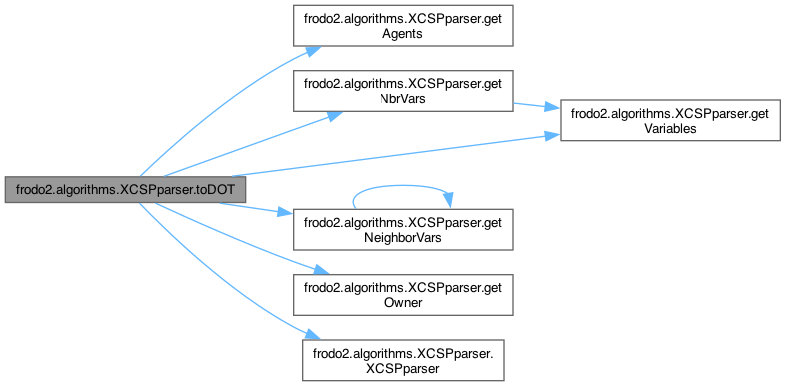
◆ toString() [1/3]
| String frodo2.algorithms.XCSPparser< V extends Addable< V >, U extends Addable< U > >.toString | ( | ) |
- See also
- java.lang.Object#toString()
References getAgent(), root, and XCSPparser().
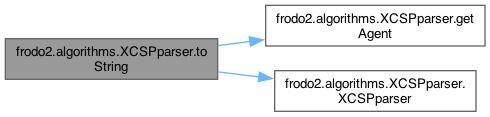
◆ toString() [2/3]
|
static |
Returns a human-friendly String representation of the input JDOM Document.
- Parameters
-
doc the JDOM Document
- Returns
- a String representation of the input Document
Referenced by frodo2.algorithms.AgentFactory< V extends Addable< V >, U extends Addable< U > >.main(), setDomain(), and frodo2.algorithms.MASparser< V extends Addable< V >, U extends Addable< U > >.toString().
◆ toString() [3/3]
|
static |
Returns a human-friendly String representation of the input JDOM Element.
- Parameters
-
root the JDOM Element
- Returns
- a String representation of the input Element
References root.
◆ usage()
|
staticprivate |
Member Data Documentation
◆ countNCCCs
|
protected |
Whether to count constraint checks.
Referenced by frodo2.solutionSpaces.JaCoP.JaCoPxcspParser< V extends Addable< V > >.JaCoPxcspParser(), frodo2.benchmarks.vehiclerouting.XCSPparserVRP< U extends Addable< U > >.newInstance(), frodo2.solutionSpaces.JaCoP.JaCoPxcspParser< V extends Addable< V > >.newInstance(), XCSPparser(), XCSPparser(), XCSPparser(), XCSPparser(), XCSPparser(), XCSPparser(), XCSPparser(), XCSPparser(), and frodo2.benchmarks.vehiclerouting.XCSPparserVRP< U extends Addable< U > >.XCSPparserVRP().
◆ domClass
|
private |
The class to be used for variable values.
Referenced by getDomClass(), getSubProblem(), parse(), setDomClass(), and XCSPparser().
◆ extendedRandNeighborhoods
|
protected |
If true, neighborhood relationships between decision variables are extended through random variables.
In other words, for a given decision variable x, its neighborhood consists of:
- the decision variables that share constraints with x (as usual),
- the decision variables that are direct neighbors of any random variable that can be reached from x by a path that involves only random variables.
Referenced by frodo2.solutionSpaces.JaCoP.JaCoPxcspParser< V extends Addable< V > >.getSubProblem(), frodo2.solutionSpaces.JaCoP.JaCoPxcspParser< V extends Addable< V > >.parse(), XCSPparser(), XCSPparser(), XCSPparser(), XCSPparser(), XCSPparser(), and frodo2.benchmarks.vehiclerouting.XCSPparserVRP< U extends Addable< U > >.XCSPparserVRP().
◆ mpc
|
protected |
Whether to behave in MPC mode.
In MPC mode:
- each agent knows the identities of all agents;
- all variables are known to all agents.
Referenced by XCSPparser(), and frodo2.benchmarks.vehiclerouting.XCSPparserVRP< U extends Addable< U > >.XCSPparserVRP().
◆ ncccCount
|
private |
The NCCC count.
◆ publicAgents
|
protected |
Whether each agent knows the identities of all agents.
Referenced by frodo2.solutionSpaces.JaCoP.JaCoPxcspParser< V extends Addable< V > >.getSubProblem(), frodo2.solutionSpaces.JaCoP.JaCoPxcspParser< V extends Addable< V > >.parse(), XCSPparser(), and XCSPparser().
◆ root
|
protected |
JDOM Element in XCSP format.
Referenced by addSolutionSpace(), addVariable(), addVariable(), checkUniqueConstraintNames(), frodo2.solutionSpaces.JaCoP.JaCoPxcspParser< V extends Addable< V > >.createStore(), foundUndefinedRelations(), getAgent(), getAgentNeighbors(), getAgents(), getDomain(), getDomainSize(), getExtVars(), getInfeasibleUtil(), getNbrVars(), getNeighborVars(), getOwner(), getOwners(), getScope(), getSpaces(), frodo2.solutionSpaces.JaCoP.JaCoPxcspParser< V extends Addable< V > >.getSpaces(), getSubProblem(), frodo2.solutionSpaces.JaCoP.JaCoPxcspParser< V extends Addable< V > >.getSubProblem(), getVariables(), getVariables(), groundVars(), isRandom(), frodo2.solutionSpaces.JaCoP.JaCoPxcspParser< V extends Addable< V > >.JaCoPxcspParser(), main(), maximize(), removeSpace(), rescale(), frodo2.solutionSpaces.JaCoP.JaCoPxcspParser< V extends Addable< V > >.rescale(), reset(), setDomain(), setMaximize(), setOwner(), switchMaxMin(), toDOT(), toDOT(), toString(), toString(), XCSPparser(), XCSPparser(), XCSPparser(), XCSPparser(), and XCSPparser().
◆ spacesToIgnoreNcccs
|
protected |
a set of spaces for which ncccs should be ignored
Referenced by frodo2.solutionSpaces.JaCoP.JaCoPxcspParser< V extends Addable< V > >.newInstance(), XCSPparser(), XCSPparser(), and frodo2.benchmarks.vehiclerouting.XCSPparserVRP< U extends Addable< U > >.XCSPparserVRP().
◆ utilClass
|
protected |
The class to be used for utility values.
Referenced by getMinInfUtility(), getPlusInfUtility(), getSpaces(), getSubProblem(), getZeroUtility(), parse(), frodo2.solutionSpaces.JaCoP.JaCoPxcspParser< V extends Addable< V > >.parse(), parseConstraint(), reset(), setUtilClass(), frodo2.benchmarks.vehiclerouting.XCSPparserVRP< U extends Addable< U > >.setUtilClass(), frodo2.solutionSpaces.JaCoP.JaCoPxcspParser< V extends Addable< V > >.setUtilClass(), and switchMaxMin().
◆ valInstance
|
protected |
An instance of V.
Referenced by getDomain(), getSpaces(), and reset().
The documentation for this class was generated from the following file:
- src/frodo2/algorithms/XCSPparser.java
