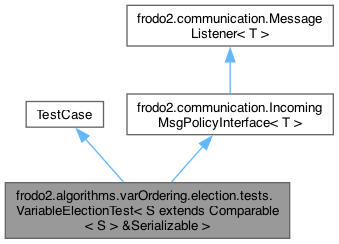
JUnit test for the class VariableElection. More...
Public Member Functions | |
| VariableElectionTest (boolean useTCP, boolean useXML, Class< ? extends ScoringHeuristic<?> > heuristic, Class< ? extends ScoringHeuristic<?> > tiebreaking) | |
| Constructor that instantiates a test only for the input method. | |
| void | testRandom () throws IOException, NoSuchMethodException, IllegalArgumentException, InstantiationException, IllegalAccessException, InvocationTargetException |
| Tests the variable election protocol on a random graph. | |
| Collection< MessageType > | getMsgTypes () |
| void | notifyIn (Message msg) |
| Keeps track of the output of the leader election protocol sent by each variable. | |
| void | setQueue (Queue queue) |
| Does nothing in this case. | |
| Public Member Functions inherited from frodo2.communication.IncomingMsgPolicyInterface< T > | |
| default void | notifyIn (Message msg, Object toAgent) |
| Notifies the listener of an incoming message. | |
Static Public Member Functions | |
| static TestSuite | suite () |
Protected Member Functions | |
| void | setUp () |
| void | tearDown () throws Exception |
| Ends all queues. | |
| void | checkOutputs (Class<?> heuristic, Map< String, S > allUniqueIDs) |
| Checks that the outputs of the module are consistent with the correct outputs for the given heuristic. | |
| void | initiateParamAndListener (XCSPparser< AddableInteger, AddableReal > parser, Class< ? extends ScoringHeuristic<?> > heuristic, Class< ? extends ScoringHeuristic<?> > tiebreaking, int diameter) throws NoSuchMethodException, IllegalArgumentException, InstantiationException, IllegalAccessException, InvocationTargetException |
| Initiate the parameter and the listener by reflection. | |
| VariableElection<?> | getNewInstance (Constructor<?> constr, Object[] args) throws IllegalArgumentException, InstantiationException, IllegalAccessException, InvocationTargetException |
Protected Attributes | |
| Map< String, MessageLEoutput< S > > | outputs |
| For each variable, the output of VariableElection. | |
| int | remainingOutputs |
| Current number of variables that have not yet sent their output of the leader election protocol. | |
| final ReentrantLock | finished_lock = new ReentrantLock () |
| Used to make the test thread wait. | |
| final Condition | finished = finished_lock.newCondition() |
| Used to wake up the test thread when all agents have finished. | |
| Map< String, Queue > | queues |
| List of queues, indexed by agent name. | |
| RandGraphFactory.Graph | graph |
| Random graph used to generate a constraint graph. | |
| Map< String, QueueOutputPipeInterface > | pipes |
| One output pipe used to send messages to each queue, indexed by the queue's agent name. | |
| boolean | useTCP |
true whether TCP pipes should be used instead of QueueIOPipes | |
Private Attributes | |
| final int | maxNbrVars = 12 |
| Maximum number of variables in the random graph. | |
| final int | maxNbrEdges = 30 |
| Maximum number of edges in the random graph. | |
| final int | maxNbrAgents = 4 |
| Maximum number of agents. | |
| boolean | useXML |
| Whether we should use the VariableElection constructor that takes in XML elements. | |
| Class< ? extends ScoringHeuristic<?> > | heuristic |
| The ScoringHeuristic. | |
| Class< ? extends ScoringHeuristic<?> > | tiebreaking |
| The tie-breaking heuristic. | |
Detailed Description
JUnit test for the class VariableElection.
- Parameters
-
<S> type used for scores
- Bug
- Even if all unit tests pass, sometimes a SocketException is thrown. This is because, as soon as a variable receives a MaxIDmsg with an ID higher than its own, it already knows that it is not the leader, and already sends an output message saying it is not the leader. But then it must keep processing MessageMaxIDs until the protocol finishes. Since VariableElectionTest only listens to output messages, it sometimes starts closing queues while MessageMaxIDs are still in the process of being delivered. Solution to fix this: make VariableElectionTest also listen to MessageMaxIDs, and properly compute how many of these messages it must wait for before it can close the queues.
Constructor & Destructor Documentation
◆ VariableElectionTest()
| frodo2.algorithms.varOrdering.election.tests.VariableElectionTest< S extends Comparable< S > &Serializable >.VariableElectionTest | ( | boolean | useTCP, |
| boolean | useXML, | ||
| Class< ? extends ScoringHeuristic<?> > | heuristic, | ||
| Class< ? extends ScoringHeuristic<?> > | tiebreaking ) |
Constructor that instantiates a test only for the input method.
- Parameters
-
useTCP truewhether TCP pipes should be used instead of QueueIOPipesuseXML Whether we should use the VariableElection constructor that takes in XML elements heuristic The ScoringHeuristic tiebreaking The tie-breaking heuristic
References heuristic, tiebreaking, useTCP, and useXML.
Referenced by suite().
Member Function Documentation
◆ checkOutputs()
|
protected |
Checks that the outputs of the module are consistent with the correct outputs for the given heuristic.
- Parameters
-
heuristic the heuristic used allUniqueIDs the unique IDs
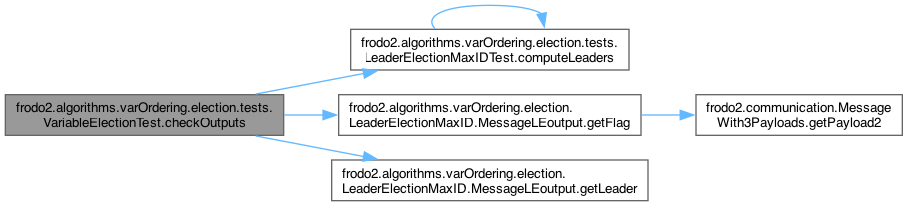
References frodo2.algorithms.varOrdering.election.tests.LeaderElectionMaxIDTest< S extends Comparable< S > >.computeLeaders(), frodo2.algorithms.varOrdering.election.LeaderElectionMaxID< T extends Comparable< T > &Serializable >.MessageLEoutput< T extends Comparable< T > &Serializable >.getFlag(), frodo2.algorithms.varOrdering.election.LeaderElectionMaxID< T extends Comparable< T > &Serializable >.MessageLEoutput< T extends Comparable< T > &Serializable >.getLeader(), graph, heuristic, and outputs.
Referenced by testRandom().
◆ getMsgTypes()
| Collection< MessageType > frodo2.algorithms.varOrdering.election.tests.VariableElectionTest< S extends Comparable< S > &Serializable >.getMsgTypes | ( | ) |
It listens to the output of the leader election protocol.
Implements frodo2.communication.MessageListener< T >.
◆ getNewInstance()
|
protected |
- Parameters
-
constr a constructor of VariableElection type args the argument that will fit in public constructor of VariableElection: a ProblemInterface and a JDOM Element
- Returns
- a new Instance of VariableElection
- Exceptions
-
InvocationTargetException thrown if the VariableElection constructor throws an exception IllegalAccessException thrown if the VariableElection class does not have a public constructor that takes in a ProblemInterface and a JDOM Element InstantiationException would be thrown if VariableElection were abstract IllegalArgumentException if the VariableElection constructor does not take the proper arguments
◆ initiateParamAndListener()
|
protected |
Initiate the parameter and the listener by reflection.
- Parameters
-
parser the problem heuristic a ScoringHeuristic tiebreaking the tie-breaking ScoringHeuristic diameter the diameter of the problem
- Exceptions
-
NoSuchMethodException thrown if the VariableElection class does not have a public constructor that takes in a ProblemInterface and a JDOM Element InvocationTargetException thrown if the VariableElection constructor throws an exception IllegalAccessException thrown if the VariableElection class does not have a public constructor that takes in a ProblemInterface and a JDOM Element InstantiationException would be thrown if VariableElection were abstract IllegalArgumentException if the VariableElection constructor does not take the proper arguments
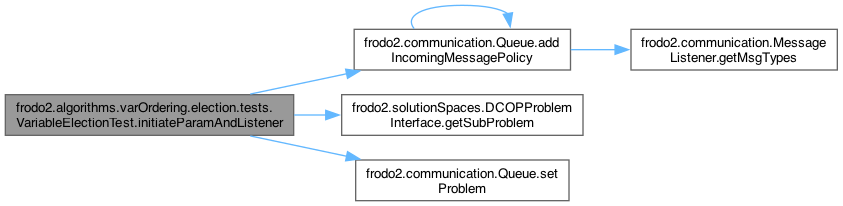
References frodo2.communication.Queue.addIncomingMessagePolicy(), frodo2.solutionSpaces.DCOPProblemInterface< V extends Addable< V >, U extends Addable< U > >.getSubProblem(), heuristic, queues, frodo2.communication.Queue.setProblem(), and tiebreaking.
Referenced by testRandom().
◆ notifyIn()
| void frodo2.algorithms.varOrdering.election.tests.VariableElectionTest< S extends Comparable< S > &Serializable >.notifyIn | ( | Message | msg | ) |
Keeps track of the output of the leader election protocol sent by each variable.
Implements frodo2.communication.IncomingMsgPolicyInterface< T >.
References frodo2.communication.MessageType.equals(), notifyIn(), and frodo2.algorithms.varOrdering.election.LeaderElectionMaxID< T extends Comparable< T > &Serializable >.OUTPUT_MSG_TYPE.
Referenced by notifyIn().

◆ setQueue()
| void frodo2.algorithms.varOrdering.election.tests.VariableElectionTest< S extends Comparable< S > &Serializable >.setQueue | ( | Queue | queue | ) |
Does nothing in this case.
- Parameters
-
queue the queue
Implements frodo2.communication.MessageListener< T >.
◆ setUp()
|
protected |
- See also
- junit.framework.TestCase#setUp()
References frodo2.algorithms.RandGraphFactory.getRandGraph(), graph, maxNbrAgents, maxNbrEdges, and maxNbrVars.

◆ suite()
|
static |
- Returns
- the test suite for this test
References VariableElectionTest().
Referenced by frodo2.algorithms.varOrdering.election.tests.AllTestsElection.suite().

◆ tearDown()
|
protected |
◆ testRandom()
| void frodo2.algorithms.varOrdering.election.tests.VariableElectionTest< S extends Comparable< S > &Serializable >.testRandom | ( | ) | throws IOException, NoSuchMethodException, IllegalArgumentException, InstantiationException, IllegalAccessException, InvocationTargetException |
Tests the variable election protocol on a random graph.
- Exceptions
-
IOException thrown if the method fails to create pipes NoSuchMethodException thrown if the VariableElection class does not have a public constructor that takes in a ProblemInterface and a JDOM Element InvocationTargetException thrown if the VariableElection constructor throws an exception IllegalAccessException thrown if the VariableElection class does not have a public constructor that takes in a ProblemInterface and a JDOM Element InstantiationException would be thrown if VariableElection were abstract IllegalArgumentException if the VariableElection constructor does not take the proper arguments
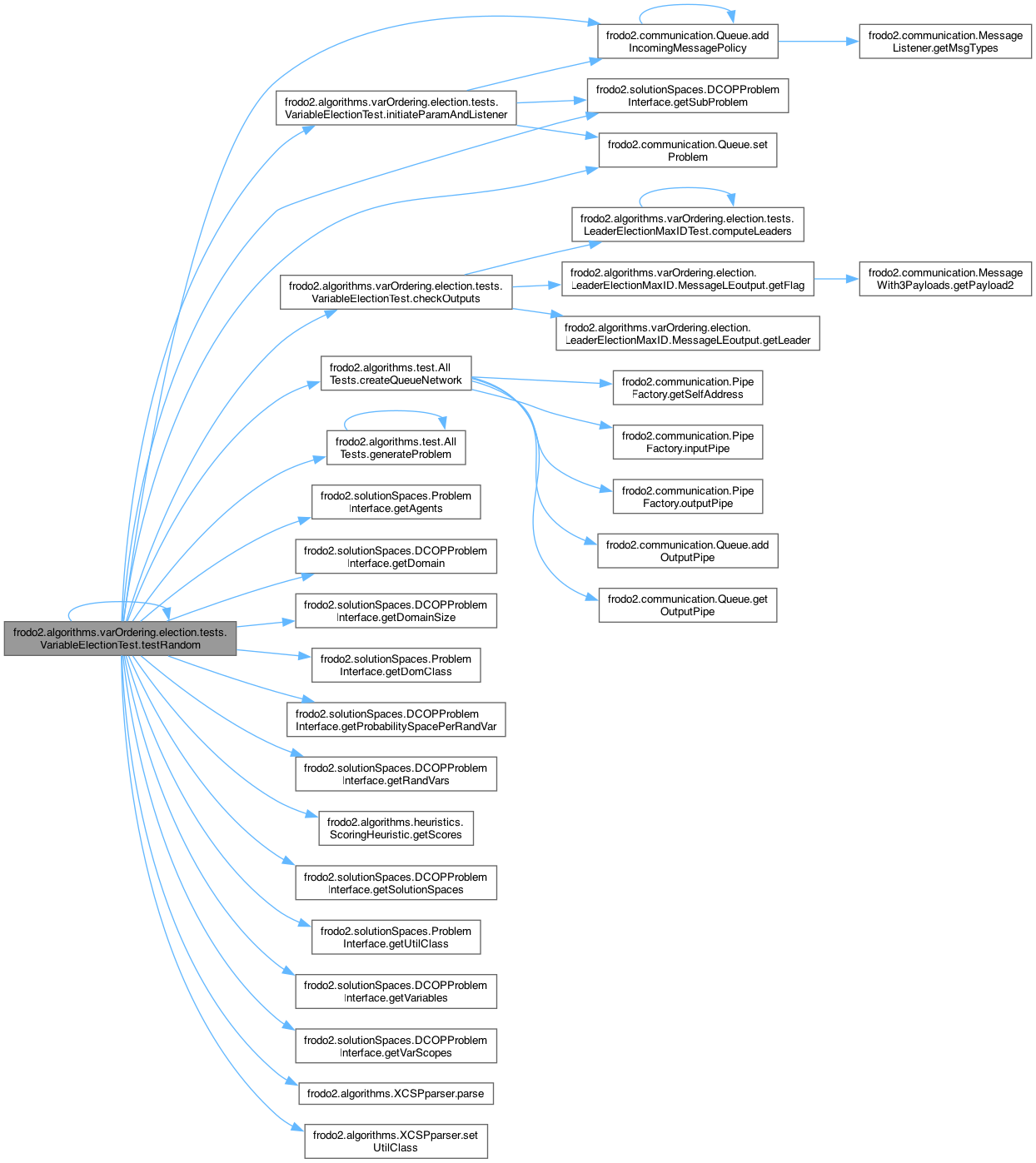
References frodo2.communication.Queue.addIncomingMessagePolicy(), checkOutputs(), frodo2.algorithms.test.AllTests.createQueueNetwork(), frodo2.algorithms.test.AllTests.generateProblem(), frodo2.solutionSpaces.ProblemInterface< V extends Addable< V >, U extends Addable< U > >.getAgents(), frodo2.solutionSpaces.DCOPProblemInterface< V extends Addable< V >, U extends Addable< U > >.getDomain(), frodo2.solutionSpaces.DCOPProblemInterface< V extends Addable< V >, U extends Addable< U > >.getDomainSize(), frodo2.solutionSpaces.ProblemInterface< V extends Addable< V >, U extends Addable< U > >.getDomClass(), frodo2.solutionSpaces.DCOPProblemInterface< V extends Addable< V >, U extends Addable< U > >.getProbabilitySpacePerRandVar(), frodo2.solutionSpaces.DCOPProblemInterface< V extends Addable< V >, U extends Addable< U > >.getRandVars(), frodo2.algorithms.heuristics.ScoringHeuristic< S extends Comparable< S > &Serializable >.getScores(), frodo2.solutionSpaces.DCOPProblemInterface< V extends Addable< V >, U extends Addable< U > >.getSolutionSpaces(), frodo2.solutionSpaces.DCOPProblemInterface< V extends Addable< V >, U extends Addable< U > >.getSubProblem(), frodo2.solutionSpaces.ProblemInterface< V extends Addable< V >, U extends Addable< U > >.getUtilClass(), frodo2.solutionSpaces.DCOPProblemInterface< V extends Addable< V >, U extends Addable< U > >.getVariables(), frodo2.solutionSpaces.DCOPProblemInterface< V extends Addable< V >, U extends Addable< U > >.getVarScopes(), graph, heuristic, initiateParamAndListener(), outputs, frodo2.algorithms.XCSPparser< V extends Addable< V >, U extends Addable< U > >.parse(), pipes, queues, frodo2.communication.Queue.setProblem(), frodo2.algorithms.XCSPparser< V extends Addable< V >, U extends Addable< U > >.setUtilClass(), frodo2.algorithms.AgentInterface< V extends Addable< V > >.START_AGENT, testRandom(), useTCP, and useXML.
Referenced by testRandom().
Member Data Documentation
◆ finished
|
protected |
Used to wake up the test thread when all agents have finished.
◆ finished_lock
|
protected |
Used to make the test thread wait.
◆ graph
|
protected |
Random graph used to generate a constraint graph.
Referenced by checkOutputs(), setUp(), tearDown(), and testRandom().
◆ heuristic
|
private |
The ScoringHeuristic.
Referenced by checkOutputs(), initiateParamAndListener(), testRandom(), and VariableElectionTest().
◆ maxNbrAgents
|
private |
Maximum number of agents.
Referenced by setUp().
◆ maxNbrEdges
|
private |
Maximum number of edges in the random graph.
Referenced by setUp().
◆ maxNbrVars
|
private |
◆ outputs
|
protected |
For each variable, the output of VariableElection.
Referenced by checkOutputs(), tearDown(), and testRandom().
◆ pipes
|
protected |
One output pipe used to send messages to each queue, indexed by the queue's agent name.
Referenced by tearDown(), and testRandom().
◆ queues
|
protected |
List of queues, indexed by agent name.
Referenced by initiateParamAndListener(), tearDown(), and testRandom().
◆ remainingOutputs
|
protected |
Current number of variables that have not yet sent their output of the leader election protocol.
◆ tiebreaking
|
private |
The tie-breaking heuristic.
Referenced by initiateParamAndListener(), and VariableElectionTest().
◆ useTCP
|
protected |
true whether TCP pipes should be used instead of QueueIOPipes
Referenced by testRandom(), and VariableElectionTest().
◆ useXML
|
private |
Whether we should use the VariableElection constructor that takes in XML elements.
Referenced by testRandom(), and VariableElectionTest().
The documentation for this class was generated from the following file:
- src/frodo2/algorithms/varOrdering/election/tests/VariableElectionTest.java
