Protocol to elect a variable. More...
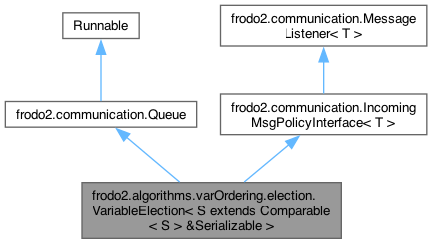
Public Member Functions | |
| VariableElection (DCOPProblemInterface<?, ?> problem, ScoringHeuristic< S > heuristic, int nbrSteps) | |
| Constructor. | |
| VariableElection (DCOPProblemInterface<?, ?> problem, Element parameters) throws Exception | |
| Constructor from XML descriptions. | |
| Collection< MessageType > | getMsgTypes () |
| Listens to messages of types LeaderElectionMaxID.START_MSG_TYPE and LeaderElectionMaxID.LE_MSG_TYPE. | |
| void | notifyIn (Message msg) |
| The actual algorithm. | |
| void | setQueue (Queue queue) |
| void | sendMessageToSelf (Message msg) |
| Method called by the LeaderElectionMaxID listeners to send their outputs. | |
| Public Member Functions inherited from frodo2.communication.Queue | |
| Queue (boolean measureMsgs) | |
| Constructor. | |
| Queue (boolean measureMsgs, boolean init) | |
| Constructor. | |
| void | toBeClosedUponKill (QueueInputPipeInterface input) |
| Reminds the queue to close the given pipe when it is killed. | |
| void | removeInputPipe (QueueInputPipeInterface input) |
| Removes the given input pipe from the list of input pipes. | |
| void | addOutputPipe (Object recipient, QueueOutputPipeInterface output) |
| Adds an output pipe to this queue. | |
| QueueOutputPipeInterface | getOutputPipe (Object recipient) |
| Returns the output pipe corresponding to the given recipient. | |
| void | removeOutputPipe (Object recipient) |
| Removes the output pipe corresponding to the given recipient. | |
| QueueIOPipe | addOutputQueue (Object recipient, Queue queue) |
| Adds a new output pipe to the provided queue. | |
| void | addIncomingMessagePolicy (IncomingMsgPolicyInterface< MessageType > policy) |
| Adds a listener to be notified of new incoming messages. | |
| void | addIncomingMessagePolicy (Collection< MessageType > msgTypes, IncomingMsgPolicyInterface< MessageType > policy) |
| Adds a listener to be notified of new incoming messages. | |
| void | addIncomingMessagePolicy (MessageType type, IncomingMsgPolicyInterface< MessageType > policy) |
| Adds a listener to be notified of new incoming messages of type type. | |
| void | addOutgoingMessagePolicy (OutgoingMsgPolicyInterface< MessageType > policy) |
| Adds a listener to be notified of new outgoing messages. | |
| void | addOutgoingMessagePolicy (Collection< MessageType > msgTypes, OutgoingMsgPolicyInterface< MessageType > policy) |
| Adds a listener to be notified of new outgoing messages. | |
| void | addOutgoingMessagePolicy (MessageType type, OutgoingMsgPolicyInterface< MessageType > policy) |
| Adds a listener to be notified of new outgoing messages of type type. | |
| void | addToInbox (MessageWrapper msg) |
| Adds the input message to this queue's inbox. | |
| void | sendMessage (Object to, Message msg) |
| Sends a message to a specified recipient. | |
| void | sendMessage (Object to, MessageWrapper msgWrap) |
| Send a message that has already been wrapped. | |
| void | end () |
| Kills the queue, making it unusable. | |
| void | run () |
| Continuously processes all messages in the inbox. | |
| void | deleteIncomingMessagePolicy (IncomingMsgPolicyInterface< MessageType > policy) |
| Completely removes the input policy from all lists of listeners. | |
| void | deleteStatsReporters () |
| Delete all StatsReporters. | |
| void | deleteOutgoingMessagePolicy (OutgoingMsgPolicyInterface< MessageType > policy) |
| Completely removes the outgoing message policy from all lists of listeners. | |
| void | cleanQueue () |
| Removes all messages from the inbox. | |
| void | setProblem (ProblemInterface<?, ?> problem) |
| Sets the problem that is queried for NCCCs. | |
| void | updateNCCCs (long msgNCCCs) |
| Updates the queue's NCCC counter to the input count if the input is greater. | |
| long | getCurrentTime () |
| int | getInboxSize () |
| MessageWrapper | getCurrentMessageWrapper () |
| HashMap< MessageType, Integer > | getMsgNbrs () |
| HashMap< Object, Integer > | getMsgNbrsSent () |
| HashMap< MessageType, Long > | getMsgSizes () |
| HashMap< Object, Long > | getMsgSizesSent () |
| HashMap< MessageType, Long > | getMaxMsgSizes () |
| void | resetStats () |
| Resets the metrics statistics. | |
| void | resetMsgSizeMonitor () |
| Closes the MsgSizeMonitor and creates a new one. | |
| Public Member Functions inherited from frodo2.communication.IncomingMsgPolicyInterface< T > | |
| default void | notifyIn (Message msg, Object toAgent) |
| Notifies the listener of an incoming message. | |
Static Public Attributes | |
| static MessageType | START_MSG_TYPE = AgentInterface.START_AGENT |
| The type of the message telling the module to start. | |
| static MessageType | FINISH_MSG_TYPE = AgentInterface.AGENT_FINISHED |
| The type of the message telling the agent finished. | |
Protected Member Functions | |
| VariableElection (DCOPProblemInterface<?, ?> problem) | |
| Incomplete constructor to be used by overriding classes. | |
| LeaderElectionMaxID< S > | newListener (String var, S score, Collection< String > neighbors) |
| Instantiates a new LeaderElectionMaxID. | |
| Protected Member Functions inherited from frodo2.communication.Queue | |
| Queue () | |
| Empty constructor that does absolutely nothing. | |
| void | notifyInListeners (Message msg, Object toAgent) |
| Notifies the incoming message listeners of a message. | |
| boolean | notifyOutListeners (Object fromAgent, Message msg, Collection<? extends Object > toAgents) |
| Notifies the outgoing message listeners of a message. | |
| void | recordStats (Object to, Message msg) |
| Records statistics about the input message. | |
Protected Attributes | |
| int | nbrSteps |
| The number of steps the protocol should run before it terminates. | |
| ScoringHeuristic< S > | heuristic |
| The heuristic. | |
| Protected Attributes inherited from frodo2.communication.Queue | |
| Set< QueueInputPipeInterface > | inputs |
| List of input pipes. | |
| HashMap< Object, QueueOutputPipeInterface > | outputs |
| Map associating an output pipe to each destination ID. | |
| MsgSizeMonitor | monitor |
| A monitor used to measure the sizes of the messages. | |
| HashMap< MessageType, ArrayList< IncomingMsgPolicyInterface< MessageType > > > | inPolicies |
| A list of listeners notified of incoming objects. | |
| HashMap< MessageType, ArrayList< OutgoingMsgPolicyInterface< MessageType > > > | outPolicies |
| A list of listeners notified of outgoing messages. | |
| ProblemInterface<?, ?> | problem |
| The problem used to obtain the current NCCC count. | |
| final boolean | measureMsgs |
| Whether to measure the number of messages and the total amount of information sent. | |
| HashMap< MessageType, Integer > | msgNbrs |
| For each message type, the number of messages sent of that type. | |
| HashMap< MessageType, Long > | msgSizes |
| For each message type, the total amount of information sent in messages of that type, in bytes. | |
| HashMap< MessageType, Long > | maxMsgSizes |
| For each message type, the size (in bytes) of the largest message of that type. | |
| MessageWrapper | msgWrap |
| The last wrapped message to have been received. | |
Package Functions | |
| public< R extends Object > void | sendMessageToMulti (Collection< R > recipients, Message msg) |
| Method called by the LeaderElectionMaxID listeners in order to send a message to specified variables. | |
| Package Functions inherited from frodo2.communication.Queue | |
| public< T extends Object > void | sendMessageToMulti (Collection< T > recipients, Message msg) |
| Sends a message to all specified recipients. | |
Private Member Functions | |
| void | init () |
| Parses the problem. | |
| void | reset () |
| Resets all problem-dependent fields (except the problem itself). | |
Private Attributes | |
| Queue | queue |
| The queue on which it should call sendMessage(). | |
| DCOPProblemInterface<?, ?> | problem |
| The problem. | |
| boolean | started = false |
| Whether the execution of the algorithm has started. | |
| Map< String, ArrayList< LeaderElectionMaxID< S > > > | neighborhoods |
| For each variable (internal or external), the list of internal variables connected to it. | |
| Map< String, String > | owners = new HashMap<String, String> () |
| For each known variable, the name of the agent that owns it. | |
| Collection< LeaderElectionMaxID< S > > | listeners |
| The LeaderElectionMaxID listeners corresponding to this agent's variables. | |
Additional Inherited Members | |
| Static Public Member Functions inherited from frodo2.communication.Queue | |
| static String | networkToDOT (Queue[] queues) |
| Generates a String representation in DOT format of a network of queues. | |
Detailed Description
Protocol to elect a variable.
Contrary to LeaderElectionMaxID, this protocol elects a variable rather than an agent. The advantage is that it works when agents' subproblems have disconnected components. The implementation actually uses LeaderElectionMaxID, by treating each variable as an agent.
- Parameters
-
<S> the type used for the variables' scores
- Note
- S must properly override equals(Object) and hashCode().
Constructor & Destructor Documentation
◆ VariableElection() [1/3]
| frodo2.algorithms.varOrdering.election.VariableElection< S extends Comparable< S > &Serializable >.VariableElection | ( | DCOPProblemInterface<?, ?> | problem, |
| ScoringHeuristic< S > | heuristic, | ||
| int | nbrSteps ) |
Constructor.
- Parameters
-
problem the problem heuristic the heuristic nbrSteps number of steps the protocol should run before it terminates
- Warning
- nbrSteps must be an upper bound on the diameter of the largest component in the constraint graph for the algorithm to work properly.
References heuristic, nbrSteps, and problem.
Referenced by VariableElection().
◆ VariableElection() [2/3]
| frodo2.algorithms.varOrdering.election.VariableElection< S extends Comparable< S > &Serializable >.VariableElection | ( | DCOPProblemInterface<?, ?> | problem, |
| Element | parameters ) throws Exception |
Constructor from XML descriptions.
- Parameters
-
problem description of the problem parameters description of the parameters of this protocol
- Exceptions
-
Exception if an error occurs
- Warning
- nbrSteps must be an upper bound on the total number of variables for the algorithm to work properly.
References problem, and VariableElection().

◆ VariableElection() [3/3]
|
protected |
Incomplete constructor to be used by overriding classes.
- Parameters
-
problem the agent's problem
References problem.
Member Function Documentation
◆ getMsgTypes()
| Collection< MessageType > frodo2.algorithms.varOrdering.election.VariableElection< S extends Comparable< S > &Serializable >.getMsgTypes | ( | ) |
Listens to messages of types LeaderElectionMaxID.START_MSG_TYPE and LeaderElectionMaxID.LE_MSG_TYPE.
Implements frodo2.communication.MessageListener< T >.
References FINISH_MSG_TYPE, frodo2.algorithms.varOrdering.election.LeaderElectionMaxID< T extends Comparable< T > &Serializable >.LE_MSG_TYPE, and START_MSG_TYPE.
◆ init()
|
private |
Parses the problem.
Reimplemented from frodo2.communication.Queue.
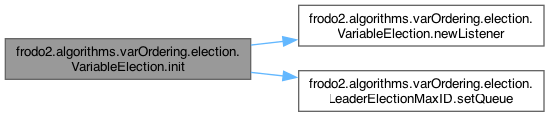
References heuristic, listeners, neighborhoods, newListener(), problem, and frodo2.algorithms.varOrdering.election.LeaderElectionMaxID< T extends Comparable< T > &Serializable >.setQueue().
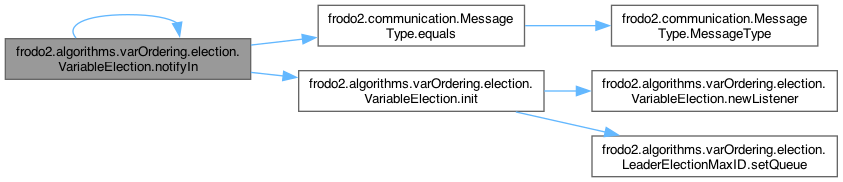
Referenced by notifyIn().
◆ newListener()
|
protected |
Instantiates a new LeaderElectionMaxID.
- Parameters
-
var the variable score the score neighbors the variable's neighbors
- Returns
- a new LeaderElectionMaxID
References nbrSteps.
Referenced by init().
◆ notifyIn()
| void frodo2.algorithms.varOrdering.election.VariableElection< S extends Comparable< S > &Serializable >.notifyIn | ( | Message | msg | ) |
The actual algorithm.
Listens to messages sent by LeaderElectionMaxID listeners, and notifies this agent's own LeaderElectionMaxID listeners.
- Parameters
-
msg the message that was just received
Implements frodo2.communication.IncomingMsgPolicyInterface< T >.
References frodo2.communication.MessageType.equals(), FINISH_MSG_TYPE, init(), notifyIn(), and START_MSG_TYPE.
Referenced by notifyIn().
◆ reset()
|
private |
Resets all problem-dependent fields (except the problem itself).
◆ sendMessageToMulti()
|
package |
Method called by the LeaderElectionMaxID listeners in order to send a message to specified variables.
If multiple variables are owned by the same agent, the message is only sent once to that agent.
- See also
- Queue#sendMessageToMulti(Collection, Message)
◆ sendMessageToSelf()
| void frodo2.algorithms.varOrdering.election.VariableElection< S extends Comparable< S > &Serializable >.sendMessageToSelf | ( | Message | msg | ) |
Method called by the LeaderElectionMaxID listeners to send their outputs.
- See also
- Queue.sendMessageToSelf(Message)
Reimplemented from frodo2.communication.Queue.
References queue.
◆ setQueue()
| void frodo2.algorithms.varOrdering.election.VariableElection< S extends Comparable< S > &Serializable >.setQueue | ( | Queue | queue | ) |
Implements frodo2.communication.MessageListener< T >.
References frodo2.communication.Queue.Queue(), queue, and setQueue().
Referenced by setQueue().

Member Data Documentation
◆ FINISH_MSG_TYPE
|
static |
The type of the message telling the agent finished.
Referenced by getMsgTypes(), and notifyIn().
◆ heuristic
|
protected |
The heuristic.
Referenced by init(), and VariableElection().
◆ listeners
|
private |
The LeaderElectionMaxID listeners corresponding to this agent's variables.
Referenced by init().
◆ nbrSteps
|
protected |
The number of steps the protocol should run before it terminates.
Referenced by newListener(), and VariableElection().
◆ neighborhoods
|
private |
For each variable (internal or external), the list of internal variables connected to it.
Referenced by init().
◆ owners
|
private |
For each known variable, the name of the agent that owns it.
Referenced by sendMessageToMulti().
◆ problem
|
private |
The problem.
Referenced by init(), VariableElection(), VariableElection(), and VariableElection().
◆ queue
|
private |
The queue on which it should call sendMessage().
Referenced by sendMessageToMulti(), sendMessageToSelf(), and setQueue().
◆ START_MSG_TYPE
|
static |
The type of the message telling the module to start.
Referenced by getMsgTypes(), and notifyIn().
◆ started
|
private |
Whether the execution of the algorithm has started.
The documentation for this class was generated from the following file:
- src/frodo2/algorithms/varOrdering/election/VariableElection.java
