This distributed leader election protocol chooses a leader agent as the one with highest unique ID. More...
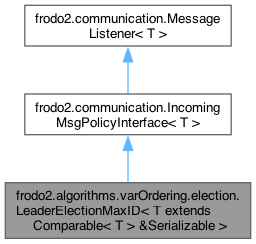
Classes | |
| class | MessageLEoutput |
| Message class used for the output of the protocol. More... | |
Public Member Functions | |
| Collection< MessageType > | getMsgTypes () |
| void | setQueue (Queue queue) |
| LeaderElectionMaxID (String comID, T myID, Collection< String > neighbors, int nbrSteps) | |
| Constructor. | |
| LeaderElectionMaxID (DCOPProblemInterface<?, ?> problem, Element params) | |
| Constructor. | |
| void | notifyIn (Message msg) |
| The actual algorithm. | |
| Public Member Functions inherited from frodo2.communication.IncomingMsgPolicyInterface< T > | |
| default void | notifyIn (Message msg, Object toAgent) |
| Notifies the listener of an incoming message. | |
Static Public Attributes | |
| static MessageType | START_MSG_TYPE = new MessageType ("VarOrdering", "LeaderElectionMaxID", "Start") |
| The type of the message used to tell the protocol to start. | |
| static final MessageType | LE_MSG_TYPE = new MessageType ("VarOrdering", "LeaderElectionMaxID", "ELECT") |
| The type of the messages used to carry agent IDs. | |
| static final MessageType | OUTPUT_MSG_TYPE = new MessageType ("VarOrdering", "LeaderElectionMaxID", "Output") |
| The type of the output message. | |
Protected Member Functions | |
| T | getMaxID () |
Protected Attributes | |
| T | myID |
| This agent's ID. | |
| T | maxID |
| Current computed maximum ID. | |
| int | stepCountdown = 0 |
| Index of the current step in the protocol, decremented until it reaches 0. | |
Private Attributes | |
| MaxIDmsg< T > | lastSentMsg |
| The last MaxIDmsg sent. | |
| final int | nbrNeighbors |
| The number of neighbors of the agent. | |
| HashSet< String > | thisStepSenders |
| IDs of the agents from which we have received messages since the beginning of the current step. | |
| HashMap< String, T > | nextStepIDs = new HashMap<String, T> () |
| Messages belonging to the next step that have already been received. | |
| Queue | queue |
| The queue on which it should call sendMessage(). | |
| final String | comID |
| Communication ID. | |
| Collection< String > | neighbors |
| The neighbors of this agent. | |
| boolean | started = false |
| Whether this agent has already received the message that tells it to start the protocol. | |
| final AgentScoringHeuristic< T > | heuristic |
| The heuristic. | |
Detailed Description
This distributed leader election protocol chooses a leader agent as the one with highest unique ID.
- Parameters
-
<T> the type used for agent IDs
- Warning
- This protocol elects an agent, not a variable. Therefore, we should assume that all agents own non-disconnected subproblems, otherwise we take the risk of having a component of the global constraint graph without a leader...
Constructor & Destructor Documentation
◆ LeaderElectionMaxID() [1/2]
| frodo2.algorithms.varOrdering.election.LeaderElectionMaxID< T extends Comparable< T > &Serializable >.LeaderElectionMaxID | ( | String | comID, |
| T | myID, | ||
| Collection< String > | neighbors, | ||
| int | nbrSteps ) |
Constructor.
- Parameters
-
comID communication ID used to identify this agent as the sender of messages myID ID that uniquely identifies this agent neighbors the neighbors of this agent nbrSteps Number of steps the protocol should run before it terminates
- Note
- nbrSteps must be an upper bound on the total number of agents for the algorithm to work properly.
References comID, myID, nbrNeighbors, neighbors, and thisStepSenders.
Referenced by LeaderElectionMaxID().
◆ LeaderElectionMaxID() [2/2]
| frodo2.algorithms.varOrdering.election.LeaderElectionMaxID< T extends Comparable< T > &Serializable >.LeaderElectionMaxID | ( | DCOPProblemInterface<?, ?> | problem, |
| Element | params ) |
Constructor.
- Parameters
-
problem the agent's subproblem params this module's parameters
References LeaderElectionMaxID(), and nbrNeighbors.

Member Function Documentation
◆ getMaxID()
|
protected |
- Returns
- the current maxID
References maxID.
◆ getMsgTypes()
| Collection< MessageType > frodo2.algorithms.varOrdering.election.LeaderElectionMaxID< T extends Comparable< T > &Serializable >.getMsgTypes | ( | ) |
Implements frodo2.communication.MessageListener< T >.
References LE_MSG_TYPE, and START_MSG_TYPE.
◆ notifyIn()
| void frodo2.algorithms.varOrdering.election.LeaderElectionMaxID< T extends Comparable< T > &Serializable >.notifyIn | ( | Message | msg | ) |
The actual algorithm.
The algorithm is triggered by the reception of a message of type either this.startMsgType or this.LEmsgType. At each step, the protocol computes the max of its ID and of the IDs in all received messages, and forwards it. After a specified number of steps, the algorithm terminates, and returns a message of type this.outputMsgType if its ID matches the last computed max ID (it is then the leader).
- Parameters
-
msg the message that was just received
Implements frodo2.communication.IncomingMsgPolicyInterface< T >.
References frodo2.communication.MessageType.equals(), frodo2.algorithms.heuristics.AgentScoringHeuristic< S extends Comparable< S > &Serializable >.getScore(), notifyIn(), and START_MSG_TYPE.
Referenced by notifyIn().

◆ setQueue()
| void frodo2.algorithms.varOrdering.election.LeaderElectionMaxID< T extends Comparable< T > &Serializable >.setQueue | ( | Queue | queue | ) |
Member Data Documentation
◆ comID
|
private |
Communication ID.
This is used to identify the agent as the sender of messages. It can be different from myID.
Referenced by LeaderElectionMaxID().
◆ heuristic
|
private |
The heuristic.
◆ lastSentMsg
|
private |
The last MaxIDmsg sent.
◆ LE_MSG_TYPE
|
static |
The type of the messages used to carry agent IDs.
Referenced by getMsgTypes(), frodo2.algorithms.varOrdering.election.tests.LeaderElectionMaxIDTest< S extends Comparable< S > >.getMsgTypes(), frodo2.algorithms.varOrdering.election.tests.VarElectionMessengerTest.IdIncreasingVerifyer.getMsgTypes(), frodo2.algorithms.varOrdering.election.VariableElection< S extends Comparable< S > &Serializable >.getMsgTypes(), frodo2.algorithms.varOrdering.election.MaxIDmsg< T extends Comparable< T > &Serializable >.MaxIDmsg(), frodo2.algorithms.varOrdering.election.tests.VarElectionMessengerTest.IdIncreasingVerifyer.notifyIn(), frodo2.algorithms.varOrdering.election.MaxIDmsg< T extends Comparable< T > &Serializable >.readExternal(), and frodo2.algorithms.varOrdering.election.MaxIDmsg< T extends Comparable< T > &Serializable >.toString().
◆ maxID
|
protected |
Current computed maximum ID.
Referenced by getMaxID().
◆ myID
|
protected |
This agent's ID.
Referenced by LeaderElectionMaxID().
◆ nbrNeighbors
|
private |
The number of neighbors of the agent.
Referenced by LeaderElectionMaxID(), and LeaderElectionMaxID().
◆ neighbors
|
private |
The neighbors of this agent.
Referenced by LeaderElectionMaxID().
◆ nextStepIDs
|
private |
Messages belonging to the next step that have already been received.
Maps a sender ID to the maxID value it sent.
◆ OUTPUT_MSG_TYPE
|
static |
The type of the output message.
Referenced by frodo2.algorithms.dpop.privacy.P2_DPOPsolver< V extends Addable< V >, U extends Addable< U > >.clear(), frodo2.algorithms.dpop.privacy.P3halves_DPOPsolver< V extends Addable< V > >.clear(), frodo2.algorithms.varOrdering.election.tests.LeaderElectionMaxIDTest< S extends Comparable< S > >.getMsgTypes(), frodo2.algorithms.varOrdering.election.tests.VariableElectionTest< S extends Comparable< S > &Serializable >.getMsgTypes(), frodo2.algorithms.varOrdering.linear.LinearOrdering< V extends Addable< V >, U extends Addable< U > >.getMsgTypes(), frodo2.algorithms.varOrdering.election.LeaderElectionMaxID< T extends Comparable< T > &Serializable >.MessageLEoutput< T extends Comparable< T > &Serializable >.MessageLEoutput(), frodo2.algorithms.varOrdering.election.tests.LeaderElectionMaxIDTest< S extends Comparable< S > >.notifyIn(), frodo2.algorithms.varOrdering.election.tests.VariableElectionTest< S extends Comparable< S > &Serializable >.notifyIn(), and frodo2.algorithms.varOrdering.linear.LinearOrdering< V extends Addable< V >, U extends Addable< U > >.notifyIn().
◆ queue
|
private |
The queue on which it should call sendMessage().
Referenced by setQueue().
◆ START_MSG_TYPE
|
static |
The type of the message used to tell the protocol to start.
Referenced by getMsgTypes(), notifyIn(), and frodo2.algorithms.varOrdering.election.tests.LeaderElectionMaxIDTest< S extends Comparable< S > >.testRandom().
◆ started
|
private |
Whether this agent has already received the message that tells it to start the protocol.
◆ stepCountdown
|
protected |
Index of the current step in the protocol, decremented until it reaches 0.
◆ thisStepSenders
|
private |
IDs of the agents from which we have received messages since the beginning of the current step.
Referenced by LeaderElectionMaxID().
The documentation for this class was generated from the following file:
- src/frodo2/algorithms/varOrdering/election/LeaderElectionMaxID.java
