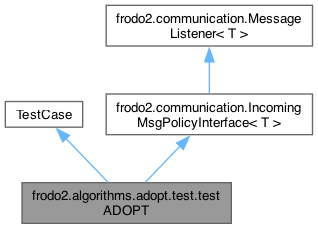
This class is used to test the workings of the ADOPT listener. More...
Public Member Functions | |
| testADOPT (Class< ? extends Addable<?> > utilClass, String version, boolean useTCP, boolean useXML) | |
| Constructor that instantiates a test only for the input method. | |
| void | test () throws Exception |
| Runs a random test. | |
| Collection< MessageType > | getMsgTypes () |
| void | notifyIn (Message msg) |
| void | setQueue (Queue queue) |
| Public Member Functions inherited from frodo2.communication.IncomingMsgPolicyInterface< T > | |
| default void | notifyIn (Message msg, Object toAgent) |
| Notifies the listener of an incoming message. | |
Static Public Member Functions | |
| static TestSuite | suite () |
| static< U extends Addable< U > Map< String, UtilitySolutionSpace< AddableInteger, U > > | startADOPT (RandGraphFactory.Graph graph, Map< String, DFSview< AddableInteger, U > > dfs, Map< String, Queue > queues, List< ? extends UtilitySolutionSpace< AddableInteger, U > > constraints, XCSPparser< AddableInteger, U > parser) |
| Sends messages to the queues to initiate ADOPT. | |
Protected Member Functions | |
| void | setUp () throws Exception |
| void | tearDown () throws Exception |
Package Attributes | |
| Queue | myQueue |
| The queue to which this class is registered as a listener. | |
Private Member Functions | |
| Hypercube< AddableInteger, AddableInteger > | simulateUTIL (String var) |
| Simulates UTIL propagation on the subtree rooted at the input variable, while checking separators. | |
Private Attributes | |
| final int | maxNbrVars = 7 |
| Maximum number of variables in the random graph. | |
| final int | maxNbrEdges = 25 |
| Maximum number of edges in the random graph. | |
| final int | maxNbrAgents = 7 |
| Maximum number of agents. | |
| int | nbrMsgsRemaining |
| The number of output messages remaining to be received. | |
| final ReentrantLock | finished_lock = new ReentrantLock () |
| Used to make the test thread wait. | |
| final Condition | finished = finished_lock.newCondition() |
| Used to wake up the test thread when all agents have finished. | |
| Map< String, Queue > | queues |
| List of queues, indexed by agent name. | |
| Element | parameters |
| The parameters for adopt. | |
| RandGraphFactory.Graph | graph |
| Random graph used to generate a constraint graph. | |
| Map< String, DFSview< AddableInteger, AddableInteger > > | dfs |
| The DFS corresponding to the random graph. | |
| Map< String, UtilitySolutionSpace< AddableInteger, AddableInteger > > | hypercubes |
| For each variable, the constraint it is responsible for enforcing. | |
| XCSPparser< AddableInteger, AddableInteger > | parser |
| The parser. | |
| Class<? extends Addable<?> > | utilClass |
| The class of utility values. | |
| String | version |
| The version of ADOPT. | |
| boolean | useTCP |
| Whether to use TCP pipes or shared memory pipes. | |
| boolean | useXML |
| Whether to use the XML-based constructor. | |
Detailed Description
This class is used to test the workings of the ADOPT listener.
Constructor & Destructor Documentation
◆ testADOPT()
| frodo2.algorithms.adopt.test.testADOPT.testADOPT | ( | Class< ? extends Addable<?> > | utilClass, |
| String | version, | ||
| boolean | useTCP, | ||
| boolean | useXML ) |
Constructor that instantiates a test only for the input method.
- Parameters
-
utilClass the class of utility values version the version of ADOPT useTCP whether to use TCP pipes or shared memory pipes useXML whether to use the XML-based constructor
References useTCP, useXML, utilClass, and version.
Referenced by suite().
Member Function Documentation
◆ getMsgTypes()
| Collection< MessageType > frodo2.algorithms.adopt.test.testADOPT.getMsgTypes | ( | ) |
◆ notifyIn()
| void frodo2.algorithms.adopt.test.testADOPT.notifyIn | ( | Message | msg | ) |
Implements frodo2.communication.IncomingMsgPolicyInterface< T >.
References nbrMsgsRemaining.
◆ setQueue()
| void frodo2.algorithms.adopt.test.testADOPT.setQueue | ( | Queue | queue | ) |
Implements frodo2.communication.MessageListener< T >.
◆ setUp()
|
protected |
- See also
- junit.framework.TestCase#setUp()
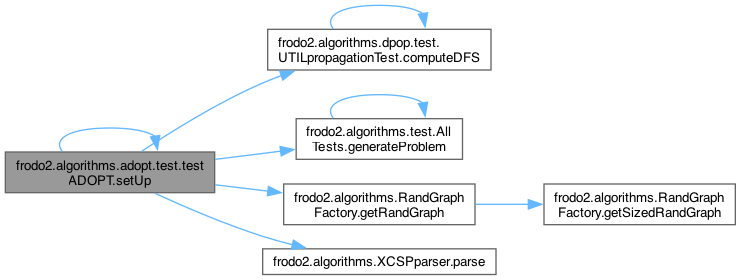
References frodo2.algorithms.dpop.test.UTILpropagationTest< U extends Addable< U > >.computeDFS(), dfs, frodo2.algorithms.test.AllTests.generateProblem(), frodo2.algorithms.RandGraphFactory.getRandGraph(), graph, maxNbrAgents, maxNbrEdges, maxNbrVars, parameters, frodo2.algorithms.XCSPparser< V extends Addable< V >, U extends Addable< U > >.parse(), parser, and setUp().
Referenced by setUp().
◆ simulateUTIL()
|
private |
Simulates UTIL propagation on the subtree rooted at the input variable, while checking separators.
- Parameters
-
var root variable
- Returns
- the UTIL message that the input variable sends to its parent (if any)
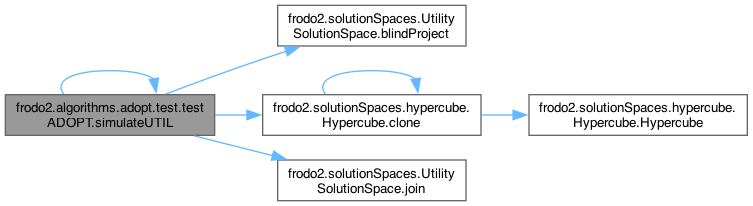
References frodo2.solutionSpaces.UtilitySolutionSpace< V extends Addable< V >, U extends Addable< U > >.blindProject(), frodo2.solutionSpaces.hypercube.Hypercube< V extends Addable< V >, U extends Addable< U > >.clone(), dfs, hypercubes, frodo2.solutionSpaces.UtilitySolutionSpace< V extends Addable< V >, U extends Addable< U > >.join(), frodo2.solutionSpaces.AddableInteger.PlusInfinity.PLUS_INF, and simulateUTIL().
Referenced by simulateUTIL(), and test().
◆ startADOPT()
|
static |
Sends messages to the queues to initiate ADOPT.
- Parameters
-
<U> the type used for utility values graph the constraint graph dfs the corresponding DFS (for each node in the graph, the relationships of this node) queues the array of queues, indexed by the names of the clusters in the graph constraints the hypercubes in the problem definition parser the parser for the random problem
- Returns
- for each variable, the constraint it is responsible for enforcing
References dfs, frodo2.algorithms.varOrdering.dfs.DFSgeneration< V extends Addable< V >, U extends Addable< U > >.DFSview< V extends Addable< V >, U extends Addable< U > >.getAllPseudoChildren(), frodo2.algorithms.varOrdering.dfs.DFSgeneration< V extends Addable< V >, U extends Addable< U > >.DFSview< V extends Addable< V >, U extends Addable< U > >.getChildren(), graph, hypercubes, frodo2.solutionSpaces.UtilitySolutionSpace< V extends Addable< V >, U extends Addable< U > >.join(), parser, queues, frodo2.communication.Queue.sendMessageToSelf(), frodo2.algorithms.varOrdering.dfs.DFSgeneration< V extends Addable< V >, U extends Addable< U > >.DFSview< V extends Addable< V >, U extends Addable< U > >.setSpaces(), and frodo2.algorithms.AgentInterface< V extends Addable< V > >.START_AGENT.
Referenced by test().

◆ suite()
|
static |
- Returns
- the test suite for this test
References testADOPT().
Referenced by frodo2.algorithms.adopt.test.AllTestsADOPT.suite().

◆ tearDown()
|
protected |
◆ test()
| void frodo2.algorithms.adopt.test.testADOPT.test | ( | ) | throws Exception |
Runs a random test.
- Exceptions
-
Exception if an error occurs
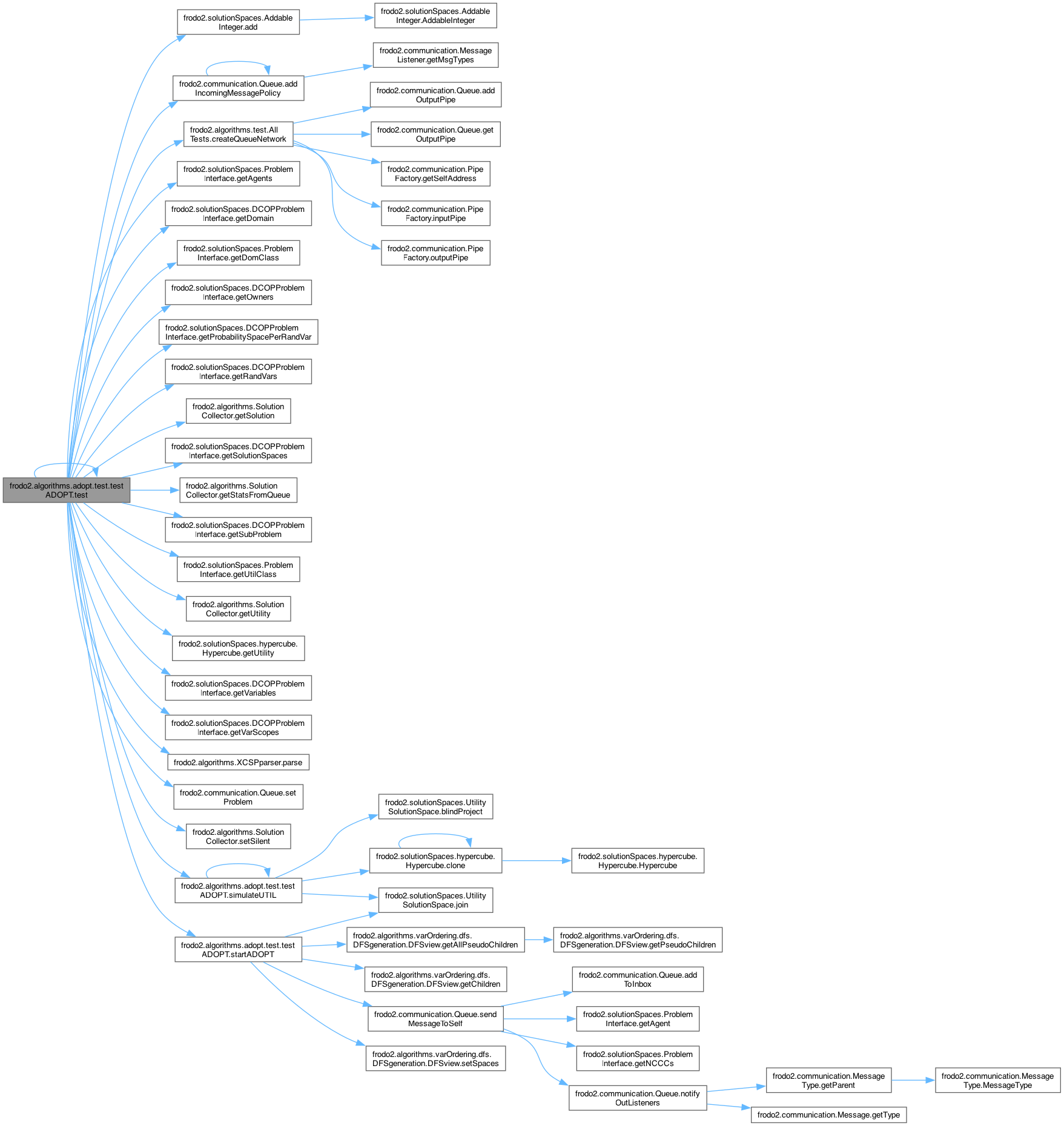
References frodo2.solutionSpaces.AddableInteger.add(), frodo2.communication.Queue.addIncomingMessagePolicy(), frodo2.algorithms.test.AllTests.createQueueNetwork(), dfs, frodo2.solutionSpaces.ProblemInterface< V extends Addable< V >, U extends Addable< U > >.getAgents(), frodo2.solutionSpaces.DCOPProblemInterface< V extends Addable< V >, U extends Addable< U > >.getDomain(), frodo2.solutionSpaces.ProblemInterface< V extends Addable< V >, U extends Addable< U > >.getDomClass(), frodo2.solutionSpaces.DCOPProblemInterface< V extends Addable< V >, U extends Addable< U > >.getOwners(), frodo2.solutionSpaces.DCOPProblemInterface< V extends Addable< V >, U extends Addable< U > >.getProbabilitySpacePerRandVar(), frodo2.solutionSpaces.DCOPProblemInterface< V extends Addable< V >, U extends Addable< U > >.getRandVars(), frodo2.algorithms.SolutionCollector< V extends Addable< V >, U extends Addable< U > >.getSolution(), frodo2.solutionSpaces.DCOPProblemInterface< V extends Addable< V >, U extends Addable< U > >.getSolutionSpaces(), frodo2.algorithms.SolutionCollector< V extends Addable< V >, U extends Addable< U > >.getStatsFromQueue(), frodo2.solutionSpaces.DCOPProblemInterface< V extends Addable< V >, U extends Addable< U > >.getSubProblem(), frodo2.solutionSpaces.ProblemInterface< V extends Addable< V >, U extends Addable< U > >.getUtilClass(), frodo2.algorithms.SolutionCollector< V extends Addable< V >, U extends Addable< U > >.getUtility(), frodo2.solutionSpaces.hypercube.Hypercube< V extends Addable< V >, U extends Addable< U > >.getUtility(), frodo2.solutionSpaces.DCOPProblemInterface< V extends Addable< V >, U extends Addable< U > >.getVariables(), frodo2.solutionSpaces.DCOPProblemInterface< V extends Addable< V >, U extends Addable< U > >.getVarScopes(), graph, hypercubes, myQueue, nbrMsgsRemaining, parameters, frodo2.algorithms.XCSPparser< V extends Addable< V >, U extends Addable< U > >.parse(), parser, queues, frodo2.communication.Queue.setProblem(), frodo2.algorithms.SolutionCollector< V extends Addable< V >, U extends Addable< U > >.setSilent(), simulateUTIL(), startADOPT(), frodo2.algorithms.AgentInterface< V extends Addable< V > >.STATS_MONITOR, test(), useTCP, useXML, and version.
Referenced by test().
Member Data Documentation
◆ dfs
|
private |
The DFS corresponding to the random graph.
Referenced by setUp(), simulateUTIL(), startADOPT(), tearDown(), and test().
◆ finished
|
private |
Used to wake up the test thread when all agents have finished.
◆ finished_lock
|
private |
Used to make the test thread wait.
◆ graph
|
private |
Random graph used to generate a constraint graph.
Referenced by setUp(), startADOPT(), tearDown(), and test().
◆ hypercubes
|
private |
For each variable, the constraint it is responsible for enforcing.
Referenced by simulateUTIL(), startADOPT(), and test().
◆ maxNbrAgents
|
private |
Maximum number of agents.
Referenced by setUp().
◆ maxNbrEdges
|
private |
Maximum number of edges in the random graph.
Referenced by setUp().
◆ maxNbrVars
|
private |
◆ myQueue
|
package |
The queue to which this class is registered as a listener.
Referenced by test().
◆ nbrMsgsRemaining
|
private |
The number of output messages remaining to be received.
Referenced by notifyIn(), and test().
◆ parameters
|
private |
◆ parser
|
private |
The parser.
Referenced by setUp(), startADOPT(), and test().
◆ queues
|
private |
List of queues, indexed by agent name.
Referenced by startADOPT(), tearDown(), and test().
◆ useTCP
|
private |
Whether to use TCP pipes or shared memory pipes.
Referenced by test(), and testADOPT().
◆ useXML
|
private |
Whether to use the XML-based constructor.
Referenced by test(), and testADOPT().
◆ utilClass
|
private |
The class of utility values.
Referenced by testADOPT().
◆ version
|
private |
The version of ADOPT.
Referenced by test(), and testADOPT().
The documentation for this class was generated from the following file:
- src/frodo2/algorithms/adopt/test/testADOPT.java
