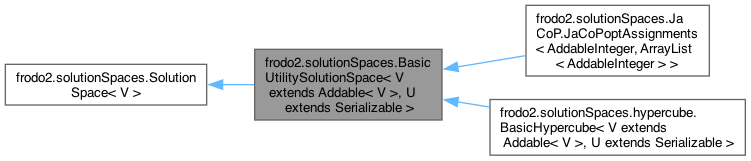
This interface defines common functionalities in all utility solution spaces. More...
Classes | |
| interface | SparseIterator |
| A BasicUtilitySolutionSpace iterator that skips infeasible solutions. More... | |
| interface | Iterator |
| A BasicUtilitySolutionSpace iterator that doest NOT skip infeasible solutions. More... | |
Public Member Functions | |
| BasicUtilitySolutionSpace< V, U > | clone () |
| BasicUtilitySolutionSpace< V, U > | resolve () |
| BasicUtilitySolutionSpace< V, U > | resolve (boolean sparse) |
| String | prettyPrint (U ignoredUtil) |
| A human-friendly version of toString(). | |
| U | getUtility (V[] variables_values) |
| Returns an object representing the utility value corresponding to the provided variables values representing a solution. | |
| U | getUtility (String[] variables_names, V[] variables_values) |
| Returns an object representing the utility value corresponding to the provided variables values representing a solution. | |
| U | getUtility (Map< String, V > assignments) |
| Returns the utility corresponding to the input assignments. | |
| U | getUtility (long index) |
| Returns the utility value corresponding to the solution at the provided index. | |
| Class< U > | getClassOfU () |
| boolean | setUtility (V[] variables_values, U utility) |
| Sets the utility value corresponding to a given assignment to variables. | |
| void | setUtility (long index, U utility) |
| Sets the utility value for the solution at the provided index. | |
| void | setDefaultUtility (U utility) |
| Sets the default utility value. | |
| U | getDefaultUtility () |
| void | setInfeasibleUtility (U utility) |
| Sets the utility associated with infeasible solutions. | |
| void | augment (V[] variables_values, U utility_value) |
| Augments this BasicUtilitySolutionSpace with a new combination of variables values associated with a given utility. | |
| boolean | equivalent (BasicUtilitySolutionSpace< V, U > space) |
| Returns whether the input BasicUtilitySolutionSpace represents the same space as this BasicUtilitySolutionSpace. | |
| boolean | isIncludedIn (BasicUtilitySolutionSpace< V, U > space) |
| Checks if this BasicUtilitySolutionSpace is included in the provided BasicUtilitySolutionSpace. | |
| BasicUtilitySolutionSpace< V, U > | changeVariablesOrder (String[] variables_order) |
| Returns a new BasicUtilitySolutionSpace by changing the order of the variables of this BasicUtilitySolutionSpace. | |
| BasicUtilitySolutionSpace< V, U > | slice (String[] variables_names, V[][] sub_domains) |
| Returns a slice of this BasicUtilitySolutionSpace. | |
| BasicUtilitySolutionSpace< V, U > | slice (String[] variables_names, V[] values) |
| Returns a slice of this BasicUtilitySolutionSpace. | |
| BasicUtilitySolutionSpace< V, U > | slice (String var, V[] subDomain) |
| Slices this SolutionSpace over a single variable. | |
| BasicUtilitySolutionSpace< V, U > | slice (String var, V val) |
| Slices this BasicUtilitySolutionSpace over a single variable-value assignment. | |
| BasicUtilitySolutionSpace< V, U > | slice (V[] variables_values) |
| Returns a slice of this solution space. | |
| BasicUtilitySolutionSpace< V, U > | compose (String[] vars, BasicUtilitySolutionSpace< V, ArrayList< V > > substitution) |
| Substitutes some of the variables in this utility space with functions. | |
| SparseIterator< V, U > | sparseIter () |
| SparseIterator< V, U > | sparseIter (String[] order) |
| SparseIterator< V, U > | sparseIter (String[] variables, V[][] domains) |
| Returns a sparse iterator. | |
| SparseIterator< V, U > | sparseIter (String[] variables, V[][] domains, V[] assignment) |
| Returns a sparse iterator. | |
| Iterator< V, U > | iterator () |
| Iterator< V, U > | iterator (String[] order) |
| Iterator< V, U > | iterator (String[] variables, V[][] domains) |
| Returns an iterator. | |
| Iterator< V, U > | iterator (String[] variables, V[][] domains, V[] assignment) |
| Returns an iterator. | |
| Public Member Functions inherited from frodo2.solutionSpaces.SolutionSpace< V > | |
| void | setProblem (ProblemInterface< V, ?> problem) |
| Sets the problem that should be notified of constraint checks. | |
| boolean | countsCCs () |
| String | getName () |
| void | setName (String name) |
| Sets the name of this space. | |
| String | getRelationName () |
| void | setRelationName (String name) |
| Sets the name of the underlying relation for this space. | |
| String | getOwner () |
| void | setOwner (String owner) |
| Sets the owner. | |
| long | getNumberOfSolutions () |
| Returns the number of solutions in the SolutionSpace. | |
| String[] | getVariables () |
| Returns the internal order of variables used within the SolutionSpace. | |
| int | getNumberOfVariables () |
| Returns the number of variables in the SolutionSpace. | |
| String | getVariable (int index) |
| Returns the variable corresponding to the provided index. | |
| void | renameVariable (String oldName, String newName) |
| Renames a variable. | |
| SolutionSpace< V > | renameAllVars (String[] newVarNames) |
| Creates a shallow clone of this space, with different variable names. | |
| int | getIndex (String variable) |
| Returns the index of the input variable in this SolutionSpace. | |
| V[][] | getDomains () |
| Returns the array containing the domains of the variables. | |
| V[] | getDomain (String variable) |
| Returns an array of all possible values that the variable provided as a parameter can take in this SolutionSpace. | |
| void | setDomain (String var, V[] dom) |
| Sets the domain of a variable. | |
| void | augment (V[] variables_values) |
| Augments the SolutionSpace with a new combination of variable values which constitutes a new solution. | |
| SolutionSpace< V > | slice (String[] variables_names, V[][] sub_domains) |
| Returns a slice of this SolutionSpace. | |
| boolean | knows (Class<?> spaceClass) |
| Returns whether this space knows how to handle other spaces of the input class. | |
| SolutionSpace< V > | join (SolutionSpace< V > space, String[] total_variables) |
| Returns a SolutionSpace object obtained by joining this SolutionSpace object with the one provided as a parameter. | |
| boolean | equals (Object o) |
| Checks for equality. | |
| SolutionSpace< V > | clone () |
| SolutionSpace< V > | resolve () |
| SparseIterator< V > | sparseIter () |
| Iterator< V > | iterator () |
Detailed Description
This interface defines common functionalities in all utility solution spaces.
A utility solution space is a solution space in which each solution has an associated value, called "utility".
- Parameters
-
<V> the type used for variable values <U> the type used for utility values
Member Function Documentation
◆ augment()
| void frodo2.solutionSpaces.BasicUtilitySolutionSpace< V extends Addable< V >, U extends Serializable >.augment | ( | V[] | variables_values, |
| U | utility_value ) |
Augments this BasicUtilitySolutionSpace with a new combination of variables values associated with a given utility.
- Note
- If the corresponding assignment already exists in BasicUtilitySolutionSpace, this method will only modify the corresponding utility value.
- Parameters
-
variables_values assignments to the variables utility_value corresponding utility value
Implemented in frodo2.solutionSpaces.hypercube.BasicHypercube< V extends Addable< V >, U extends Serializable >.
◆ changeVariablesOrder()
| BasicUtilitySolutionSpace< V, U > frodo2.solutionSpaces.BasicUtilitySolutionSpace< V extends Addable< V >, U extends Serializable >.changeVariablesOrder | ( | String[] | variables_order | ) |
Returns a new BasicUtilitySolutionSpace by changing the order of the variables of this BasicUtilitySolutionSpace.
- Parameters
-
variables_order the new order of the variables
- Returns
- BasicUtilitySolutionSpace object obtained by changing the order of the variables
- Warning
- The input variable order must contain only and all the variables that belong to this BasicUtilitySolutionSpace.
Implemented in frodo2.solutionSpaces.hypercube.BasicHypercube< V extends Addable< V >, U extends Serializable >, and frodo2.solutionSpaces.JaCoP.JaCoPoptAssignments.
Referenced by frodo2.algorithms.dpop.stochastic.test.ExpectedUTILtest.Listener.checkOutput(), and frodo2.solutionSpaces.hypercube.tests.HypercubeTest.testCompose().
◆ clone()
| BasicUtilitySolutionSpace< V, U > frodo2.solutionSpaces.BasicUtilitySolutionSpace< V extends Addable< V >, U extends Serializable >.clone | ( | ) |
◆ compose()
| BasicUtilitySolutionSpace< V, U > frodo2.solutionSpaces.BasicUtilitySolutionSpace< V extends Addable< V >, U extends Serializable >.compose | ( | String[] | vars, |
| BasicUtilitySolutionSpace< V, ArrayList< V > > | substitution ) |
Substitutes some of the variables in this utility space with functions.
This operation is indeed a composition of spaces: if f is this utility space, and g is the input space, then this operation computes f o g.
- Parameters
-
vars the variables to be substituted substitution the new values for the substituted variables, as a function of some other variables
- Returns
- a new utility space corresponding to this space, but with the variables in vars substituted according to substitution
Implemented in frodo2.solutionSpaces.hypercube.BasicHypercube< V extends Addable< V >, U extends Serializable >.
Referenced by frodo2.algorithms.dpop.param.ParamVALUE< Val extends Addable< Val > >.computeOptValAndSendVALUEmsgs().
◆ equivalent()
| boolean frodo2.solutionSpaces.BasicUtilitySolutionSpace< V extends Addable< V >, U extends Serializable >.equivalent | ( | BasicUtilitySolutionSpace< V, U > | space | ) |
Returns whether the input BasicUtilitySolutionSpace represents the same space as this BasicUtilitySolutionSpace.
- Note
- This method uses == for testing the equality of utilities.
- Parameters
-
space the BasicUtilitySolutionSpace to be tested for equivalence
- Returns
- whether the input BasicUtilitySolutionSpace is equivalent to this one
- Todo
- Move this to UtilitySolutionSpace? Utilities in a BasicUtilitySolutionSpace are not expected to be comparable.
Implemented in frodo2.solutionSpaces.hypercube.BasicHypercube< V extends Addable< V >, U extends Serializable >.
◆ getClassOfU()
| Class< U > frodo2.solutionSpaces.BasicUtilitySolutionSpace< V extends Addable< V >, U extends Serializable >.getClassOfU | ( | ) |
- Returns
- the class used for utility values
Implemented in frodo2.solutionSpaces.hypercube.BasicHypercube< V extends Addable< V >, U extends Serializable >, and frodo2.solutionSpaces.JaCoP.JaCoPoptAssignments.
◆ getDefaultUtility()
| U frodo2.solutionSpaces.BasicUtilitySolutionSpace< V extends Addable< V >, U extends Serializable >.getDefaultUtility | ( | ) |
- Returns
- the default utility value
Implemented in frodo2.solutionSpaces.hypercube.BasicHypercube< V extends Addable< V >, U extends Serializable >, and frodo2.solutionSpaces.JaCoP.JaCoPoptAssignments.
◆ getUtility() [1/4]
| U frodo2.solutionSpaces.BasicUtilitySolutionSpace< V extends Addable< V >, U extends Serializable >.getUtility | ( | long | index | ) |
Returns the utility value corresponding to the solution at the provided index.
It uses the internal order of the solutions in the solution space.
- Parameters
-
index index of the solution in the internal representation of solutions
- Returns
- utility value of the solution at the provided index, or
nullif this solution does not exist
Implemented in frodo2.solutionSpaces.hypercube.BasicHypercube< V extends Addable< V >, U extends Serializable >, and frodo2.solutionSpaces.JaCoP.JaCoPoptAssignments.
◆ getUtility() [2/4]
| U frodo2.solutionSpaces.BasicUtilitySolutionSpace< V extends Addable< V >, U extends Serializable >.getUtility | ( | Map< String, V > | assignments | ) |
Returns the utility corresponding to the input assignments.
- Parameters
-
assignments an association of values to variables
- Returns
- the utility
- Warning
- The output is undefined if the input does not specify a value for each variable in the space.
Implemented in frodo2.solutionSpaces.hypercube.BasicHypercube< V extends Addable< V >, U extends Serializable >.
◆ getUtility() [3/4]
| U frodo2.solutionSpaces.BasicUtilitySolutionSpace< V extends Addable< V >, U extends Serializable >.getUtility | ( | String[] | variables_names, |
| V[] | variables_values ) |
Returns an object representing the utility value corresponding to the provided variables values representing a solution.
- Parameters
-
variables_names the names of the variables variables_values the values of the variables
- Returns
- the utility value corresponding the provided variables values
- Warning
- The output is undefined if the inputs do not specify a value for each variable in the space.
Implemented in frodo2.solutionSpaces.hypercube.BasicHypercube< V extends Addable< V >, U extends Serializable >.
◆ getUtility() [4/4]
| U frodo2.solutionSpaces.BasicUtilitySolutionSpace< V extends Addable< V >, U extends Serializable >.getUtility | ( | V[] | variables_values | ) |
Returns an object representing the utility value corresponding to the provided variables values representing a solution.
This assumes the values are given in the same order as the variables in the BasicUtilitySolutionSpace.
- Parameters
-
variables_values the values of the variables
- Returns
- the utility value corresponding the provided variables values
- Warning
- The output is undefined if the input does not specify a value for each variable in the space.
Implemented in frodo2.solutionSpaces.hypercube.BasicHypercube< V extends Addable< V >, U extends Serializable >.
Referenced by frodo2.algorithms.dpop.stochastic.test.ExpectedUTILtest.Listener.checkOutput(), frodo2.algorithms.dpop.privacy.EncryptedUTIL< V extends Addable< V >, U extends Addable< U >, E extends AddableLimited< U, E >.findOptimalValueForIsolatedVar(), frodo2.algorithms.mpc_discsp.MPC_DisCSP4< V extends Addable< V > >.init(), frodo2.algorithms.dpop.privacy.EncryptedUTIL< V extends Addable< V >, U extends Addable< U >, E extends AddableLimited< U, E >.VariableInfo.minFromTo(), frodo2.algorithms.dpop.param.ParamVALUE< Val extends Addable< Val > >.sendVALUEmessage(), frodo2.algorithms.duct.Sampling< V extends Addable< V > >.VariableInfo.solveSingleton(), frodo2.solutionSpaces.hypercube.tests.HypercubeTest.testCompose(), and frodo2.solutionSpaces.hypercube.tests.HypercubeTest.testConsensusWeighted().
◆ isIncludedIn()
| boolean frodo2.solutionSpaces.BasicUtilitySolutionSpace< V extends Addable< V >, U extends Serializable >.isIncludedIn | ( | BasicUtilitySolutionSpace< V, U > | space | ) |
Checks if this BasicUtilitySolutionSpace is included in the provided BasicUtilitySolutionSpace.
"Inclusion" means that both spaces contain the same variables, and all assignments in this BasicUtilitySolutionSpace appear with the same utility values in the input BasicUtilitySolutionSpace.
- Note
- This function uses == for testing the equality of utilities.
- Parameters
-
space BasicUtilitySolutionSpace object
- Returns
trueif this BasicUtilitySolutionSpace is included in the provided BasicUtilitySolutionSpace object, andfalseotherwise
Implemented in frodo2.solutionSpaces.hypercube.BasicHypercube< V extends Addable< V >, U extends Serializable >.
◆ iterator() [1/4]
| Iterator< V, U > frodo2.solutionSpaces.BasicUtilitySolutionSpace< V extends Addable< V >, U extends Serializable >.iterator | ( | ) |
- See also
- SolutionSpace.iterator()
Implemented in frodo2.solutionSpaces.hypercube.BasicHypercube< V extends Addable< V >, U extends Serializable >, and frodo2.solutionSpaces.JaCoP.JaCoPoptAssignments.
Referenced by frodo2.solutionSpaces.hypercube.BasicHypercube< V extends Addable< V >, U extends Serializable >.equivalent(), frodo2.solutionSpaces.JaCoP.JaCoPutilSpace< V extends Addable< V > >.equivalent(), and frodo2.solutionSpaces.hypercube.HypercubeLimited< V extends Addable< V >, U extends Addable< U >, UL extends AddableLimited< U, UL >.join().
◆ iterator() [2/4]
| Iterator< V, U > frodo2.solutionSpaces.BasicUtilitySolutionSpace< V extends Addable< V >, U extends Serializable >.iterator | ( | String[] | order | ) |
- See also
- SolutionSpace.iterator(java.lang.String[])
Implemented in frodo2.solutionSpaces.hypercube.BasicHypercube< V extends Addable< V >, U extends Serializable >, and frodo2.solutionSpaces.JaCoP.JaCoPoptAssignments.
◆ iterator() [3/4]
| Iterator< V, U > frodo2.solutionSpaces.BasicUtilitySolutionSpace< V extends Addable< V >, U extends Serializable >.iterator | ( | String[] | variables, |
| V | domains[][] ) |
Returns an iterator.
- Parameters
-
variables The variables to iterate over, which may contain variables not in the space, but must contain all variables in the space domains The domains of the variables over which to iterate
- Returns
- an iterator which allows to iterate over the given variables and their utilities
Implemented in frodo2.solutionSpaces.hypercube.BasicHypercube< V extends Addable< V >, U extends Serializable >.
◆ iterator() [4/4]
| Iterator< V, U > frodo2.solutionSpaces.BasicUtilitySolutionSpace< V extends Addable< V >, U extends Serializable >.iterator | ( | String[] | variables, |
| V | domains[][], | ||
| V[] | assignment ) |
Returns an iterator.
- Parameters
-
variables The variables to iterate over domains The domains of the variables over which to iterate assignment An array that will be used as the output of nextSolution()
- Returns
- an iterator which allows to iterate over the given variables and their utilities
Implemented in frodo2.solutionSpaces.hypercube.BasicHypercube< V extends Addable< V >, U extends Serializable >.
◆ prettyPrint()
| String frodo2.solutionSpaces.BasicUtilitySolutionSpace< V extends Addable< V >, U extends Serializable >.prettyPrint | ( | U | ignoredUtil | ) |
A human-friendly version of toString().
- Parameters
-
ignoredUtil do not display solutions with this utility
- Returns
- a human-friendly representation of the space
Implemented in frodo2.solutionSpaces.hypercube.BasicHypercube< V extends Addable< V >, U extends Serializable >.
◆ resolve() [1/2]
| BasicUtilitySolutionSpace< V, U > frodo2.solutionSpaces.BasicUtilitySolutionSpace< V extends Addable< V >, U extends Serializable >.resolve | ( | ) |
- Returns
- an explicit representation of this space if it is currently implicit, else returns itself
Implemented in frodo2.solutionSpaces.hypercube.BasicHypercube< V extends Addable< V >, U extends Serializable >, and frodo2.solutionSpaces.JaCoP.JaCoPoptAssignments.
◆ resolve() [2/2]
| BasicUtilitySolutionSpace< V, U > frodo2.solutionSpaces.BasicUtilitySolutionSpace< V extends Addable< V >, U extends Serializable >.resolve | ( | boolean | sparse | ) |
◆ setDefaultUtility()
| void frodo2.solutionSpaces.BasicUtilitySolutionSpace< V extends Addable< V >, U extends Serializable >.setDefaultUtility | ( | U | utility | ) |
Sets the default utility value.
The default utility value is the one that is used when augmenting the BasicUtilitySolutionSpace with a new solution without specifying the utility of this solution.
- Parameters
-
utility the new default utility
Implemented in frodo2.solutionSpaces.hypercube.BasicHypercube< V extends Addable< V >, U extends Serializable >.
◆ setInfeasibleUtility()
| void frodo2.solutionSpaces.BasicUtilitySolutionSpace< V extends Addable< V >, U extends Serializable >.setInfeasibleUtility | ( | U | utility | ) |
Sets the utility associated with infeasible solutions.
- Parameters
-
utility the infeasible utility
Implemented in frodo2.solutionSpaces.hypercube.BasicHypercube< V extends Addable< V >, U extends Serializable >.
◆ setUtility() [1/2]
| void frodo2.solutionSpaces.BasicUtilitySolutionSpace< V extends Addable< V >, U extends Serializable >.setUtility | ( | long | index, |
| U | utility ) |
Sets the utility value for the solution at the provided index.
- Parameters
-
index index of the solution utility new utility
Implemented in frodo2.solutionSpaces.hypercube.BasicHypercube< V extends Addable< V >, U extends Serializable >.
◆ setUtility() [2/2]
| boolean frodo2.solutionSpaces.BasicUtilitySolutionSpace< V extends Addable< V >, U extends Serializable >.setUtility | ( | V[] | variables_values, |
| U | utility ) |
Sets the utility value corresponding to a given assignment to variables.
- Parameters
-
variables_values values for the variables, in the same order as in the BasicUtilitySolutionSpace utility the new utility value
- Returns
- specifies if setting the utility value was possible.
falseis returned if the BasicUtilitySolutionSpace does not allow the given assignments to the variables.
Implemented in frodo2.solutionSpaces.hypercube.BasicHypercube< V extends Addable< V >, U extends Serializable >.
Referenced by frodo2.algorithms.dpop.param.ParamVALUE< Val extends Addable< Val > >.sendVALUEmessage().
◆ slice() [1/5]
| BasicUtilitySolutionSpace< V, U > frodo2.solutionSpaces.BasicUtilitySolutionSpace< V extends Addable< V >, U extends Serializable >.slice | ( | String | var, |
| V | val ) |
Slices this BasicUtilitySolutionSpace over a single variable-value assignment.
- Returns
- the BasicUtilitySolutionSpace resulting from this slice
- See also
- SolutionSpace.slice(java.lang.String, Addable)
Implemented in frodo2.solutionSpaces.hypercube.BasicHypercube< V extends Addable< V >, U extends Serializable >.
◆ slice() [2/5]
| BasicUtilitySolutionSpace< V, U > frodo2.solutionSpaces.BasicUtilitySolutionSpace< V extends Addable< V >, U extends Serializable >.slice | ( | String | var, |
| V[] | subDomain ) |
Slices this SolutionSpace over a single variable.
- Returns
- the BasicUtilitySolutionSpace resulting from this slice
- See also
- SolutionSpace.slice(java.lang.String, Addable[])
Implemented in frodo2.solutionSpaces.hypercube.BasicHypercube< V extends Addable< V >, U extends Serializable >.
◆ slice() [3/5]
| BasicUtilitySolutionSpace< V, U > frodo2.solutionSpaces.BasicUtilitySolutionSpace< V extends Addable< V >, U extends Serializable >.slice | ( | String[] | variables_names, |
| V[] | values ) |
Returns a slice of this BasicUtilitySolutionSpace.
- Returns
- BasicUtilitySolutionSpace representing a slice of this BasicUtilitySolutionSpace
- See also
- SolutionSpace.slice(java.lang.String[], Addable[])
Implemented in frodo2.solutionSpaces.hypercube.BasicHypercube< V extends Addable< V >, U extends Serializable >.
◆ slice() [4/5]
| BasicUtilitySolutionSpace< V, U > frodo2.solutionSpaces.BasicUtilitySolutionSpace< V extends Addable< V >, U extends Serializable >.slice | ( | String[] | variables_names, |
| V | sub_domains[][] ) |
Returns a slice of this BasicUtilitySolutionSpace.
- Returns
- BasicUtilitySolutionSpace representing a slice of this BasicUtilitySolutionSpace
- See also
- SolutionSpace.slice(java.lang.String[], Addable[][])
Implemented in frodo2.solutionSpaces.hypercube.BasicHypercube< V extends Addable< V >, U extends Serializable >.
Referenced by frodo2.solutionSpaces.hypercube.tests.HypercubeTest.testConsensusWeighted().
◆ slice() [5/5]
| BasicUtilitySolutionSpace< V, U > frodo2.solutionSpaces.BasicUtilitySolutionSpace< V extends Addable< V >, U extends Serializable >.slice | ( | V[] | variables_values | ) |
Returns a slice of this solution space.
- See also
- SolutionSpace#slice(Addable[])
Implemented in frodo2.solutionSpaces.hypercube.BasicHypercube< V extends Addable< V >, U extends Serializable >.
◆ sparseIter() [1/4]
| SparseIterator< V, U > frodo2.solutionSpaces.BasicUtilitySolutionSpace< V extends Addable< V >, U extends Serializable >.sparseIter | ( | ) |
◆ sparseIter() [2/4]
| SparseIterator< V, U > frodo2.solutionSpaces.BasicUtilitySolutionSpace< V extends Addable< V >, U extends Serializable >.sparseIter | ( | String[] | order | ) |
- See also
- SolutionSpace.sparseIter(java.lang.String[])
Implemented in frodo2.solutionSpaces.hypercube.BasicHypercube< V extends Addable< V >, U extends Serializable >, and frodo2.solutionSpaces.JaCoP.JaCoPoptAssignments.
◆ sparseIter() [3/4]
| SparseIterator< V, U > frodo2.solutionSpaces.BasicUtilitySolutionSpace< V extends Addable< V >, U extends Serializable >.sparseIter | ( | String[] | variables, |
| V | domains[][] ) |
Returns a sparse iterator.
- Parameters
-
variables The variables to iterate over, which may contain variables not in the space, but must contain all variables in the space domains The domains of the variables over which to iterate
- Returns
- an iterator which allows to iterate over the given variables and their utilities
Implemented in frodo2.solutionSpaces.hypercube.BasicHypercube< V extends Addable< V >, U extends Serializable >.
◆ sparseIter() [4/4]
| SparseIterator< V, U > frodo2.solutionSpaces.BasicUtilitySolutionSpace< V extends Addable< V >, U extends Serializable >.sparseIter | ( | String[] | variables, |
| V | domains[][], | ||
| V[] | assignment ) |
Returns a sparse iterator.
- Parameters
-
variables The variables to iterate over domains The domains of the variables over which to iterate assignment An array that will be used as the output of nextSolution()
- Returns
- an iterator which allows to iterate over the given variables and their utilities
Implemented in frodo2.solutionSpaces.hypercube.BasicHypercube< V extends Addable< V >, U extends Serializable >.
The documentation for this interface was generated from the following file:
- src/frodo2/solutionSpaces/BasicUtilitySolutionSpace.java
