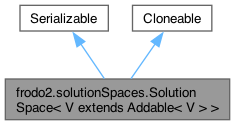
This interface defines common functionalities in all solution spaces. More...
Classes | |
| interface | SparseIterator |
| A SolutionSpace iterator that skips infeasible solutions. More... | |
| interface | Iterator |
| An iterator that does NOT skip infeasible solutions. More... | |
Public Member Functions | |
| void | setProblem (ProblemInterface< V, ?> problem) |
| Sets the problem that should be notified of constraint checks. | |
| boolean | countsCCs () |
| String | getName () |
| void | setName (String name) |
| Sets the name of this space. | |
| String | getRelationName () |
| void | setRelationName (String name) |
| Sets the name of the underlying relation for this space. | |
| String | getOwner () |
| void | setOwner (String owner) |
| Sets the owner. | |
| long | getNumberOfSolutions () |
| Returns the number of solutions in the SolutionSpace. | |
| String[] | getVariables () |
| Returns the internal order of variables used within the SolutionSpace. | |
| int | getNumberOfVariables () |
| Returns the number of variables in the SolutionSpace. | |
| String | getVariable (int index) |
| Returns the variable corresponding to the provided index. | |
| void | renameVariable (String oldName, String newName) |
| Renames a variable. | |
| SolutionSpace< V > | renameAllVars (String[] newVarNames) |
| Creates a shallow clone of this space, with different variable names. | |
| int | getIndex (String variable) |
| Returns the index of the input variable in this SolutionSpace. | |
| V[][] | getDomains () |
| Returns the array containing the domains of the variables. | |
| V[] | getDomain (String variable) |
| Returns an array of all possible values that the variable provided as a parameter can take in this SolutionSpace. | |
| V[] | getDomain (int index) |
| Returns the domain of the variable that corresponds to the provided index. | |
| V[] | getDomain (String variable, int index) |
Returns the variable's domain if index is the variable's index in the array of variables order. | |
| void | setDomain (String var, V[] dom) |
| Sets the domain of a variable. | |
| void | augment (V[] variables_values) |
| Augments the SolutionSpace with a new combination of variable values which constitutes a new solution. | |
| SolutionSpace< V > | slice (String[] variables_names, V[][] sub_domains) |
| Returns a slice of this SolutionSpace. | |
| SolutionSpace< V > | slice (String[] variables_names, V[] values) |
| Returns a slice of this SolutionSpace. | |
| SolutionSpace< V > | slice (String var, V[] subDomain) |
| Slices this SolutionSpace over a single variable. | |
| SolutionSpace< V > | slice (String var, V val) |
| Slices this SolutionSpace over a single variable-value assignment. | |
| SolutionSpace< V > | slice (V[] variables_values) |
| Returns a slice of this SolutionSpace. | |
| boolean | knows (Class<?> spaceClass) |
| Returns whether this space knows how to handle other spaces of the input class. | |
| SolutionSpace< V > | join (SolutionSpace< V > space, String[] total_variables) |
| Returns a SolutionSpace object obtained by joining this SolutionSpace object with the one provided as a parameter. | |
| SolutionSpace< V > | join (SolutionSpace< V > space) |
| Computes the join of this SolutionSpace with the input SolutionSpace. | |
| SolutionSpace< V > | join (SolutionSpace< V >[] spaces, String[] total_variables_order) |
| Returns a SolutionSpace object obtained by joining the SolutionSpace for which this method is called and the SolutionSpaces present in the array of SolutionSpaces given to this method as a parameter. | |
| SolutionSpace< V > | join (SolutionSpace< V >[] spaces) |
| Returns a SolutionSpace object obtained by joining the SolutionSpace for which this method is called and the SolutionSpaces present in the array of SolutionSpaces given to this method as a parameter. | |
| boolean | equals (Object o) |
| Checks for equality. | |
| SolutionSpace< V > | clone () |
| SolutionSpace< V > | resolve () |
| SolutionSpace< V > | resolve (boolean sparse) |
| Returns an explicit representation of this space. | |
| SparseIterator< V > | sparseIter () |
| SparseIterator< V > | sparseIter (String[] order) |
| Returns a sparse iterator with a specific variable order. | |
| Iterator< V > | iterator () |
| Iterator< V > | iterator (String[] order) |
| Returns an iterator with a specific variable order. | |
Detailed Description
This interface defines common functionalities in all solution spaces.
A solution space is a representation of combinations of assignments to variables that are the solution to some problem.
- Parameters
-
<V> the type used for variable values
- Todo
- Define an isIncludedIn() method?
Member Function Documentation
◆ augment()
| void frodo2.solutionSpaces.SolutionSpace< V extends Addable< V > >.augment | ( | V[] | variables_values | ) |
Augments the SolutionSpace with a new combination of variable values which constitutes a new solution.
- Parameters
-
variables_values the assignments to the solution space's variables
- Note
- If the corresponding solution already exists then nothing will change.
◆ clone()
| SolutionSpace< V > frodo2.solutionSpaces.SolutionSpace< V extends Addable< V > >.clone | ( | ) |
- Returns
- a clone of this solution space
◆ countsCCs()
| boolean frodo2.solutionSpaces.SolutionSpace< V extends Addable< V > >.countsCCs | ( | ) |
- Returns
- whether this space counts constraint checks
◆ equals()
| boolean frodo2.solutionSpaces.SolutionSpace< V extends Addable< V > >.equals | ( | Object | o | ) |
Checks for equality.
- Parameters
-
o an Object to be compared with this SolutionSpace
- Returns
- whether the input Object equals this SolutionSpace
- Todo
- Also define an equivalent() method.
◆ getDomain() [1/3]
| V[] frodo2.solutionSpaces.SolutionSpace< V extends Addable< V > >.getDomain | ( | int | index | ) |
Returns the domain of the variable that corresponds to the provided index.
- Parameters
-
index index of the variable
- Returns
- Array containing all the possible values of the variable corresponding to the provided index
◆ getDomain() [2/3]
| V[] frodo2.solutionSpaces.SolutionSpace< V extends Addable< V > >.getDomain | ( | String | variable | ) |
Returns an array of all possible values that the variable provided as a parameter can take in this SolutionSpace.
- Parameters
-
variable the name of the variable
- Returns
- the variable's domain
Referenced by frodo2.solutionSpaces.hypercube.BasicHypercube< V extends Addable< V >, U extends Serializable >.equivalent(), and frodo2.solutionSpaces.hypercube.tests.HypercubeTest.testConsensusWeighted().
◆ getDomain() [3/3]
| V[] frodo2.solutionSpaces.SolutionSpace< V extends Addable< V > >.getDomain | ( | String | variable, |
| int | index ) |
Returns the variable's domain if index is the variable's index in the array of variables order.
- Parameters
-
variable the name of the variable index the index of the variable
- Returns
- Array containing the domain of the variable or
nullif the variable doesn't exist in this SolutionSpace at the provided index
◆ getDomains()
| V[][] frodo2.solutionSpaces.SolutionSpace< V extends Addable< V > >.getDomains | ( | ) |
Returns the array containing the domains of the variables.
- Returns
- two-dimensional array containing the domains of the variables
◆ getIndex()
| int frodo2.solutionSpaces.SolutionSpace< V extends Addable< V > >.getIndex | ( | String | variable | ) |
Returns the index of the input variable in this SolutionSpace.
- Parameters
-
variable the name of the variable
- Returns
- integer representing the index of the variable in the SolutionSpace
◆ getName()
| String frodo2.solutionSpaces.SolutionSpace< V extends Addable< V > >.getName | ( | ) |
- Returns
- the name of this space, if any
◆ getNumberOfSolutions()
| long frodo2.solutionSpaces.SolutionSpace< V extends Addable< V > >.getNumberOfSolutions | ( | ) |
Returns the number of solutions in the SolutionSpace.
- Returns
- integer representing the number of possible assignments in the SolutionSpace
Referenced by frodo2.algorithms.dpop.param.ParamVALUE< Val extends Addable< Val > >.sendVALUEmessage(), and frodo2.solutionSpaces.hypercube.tests.HypercubeTest.testConsensusWeighted().
◆ getNumberOfVariables()
| int frodo2.solutionSpaces.SolutionSpace< V extends Addable< V > >.getNumberOfVariables | ( | ) |
Returns the number of variables in the SolutionSpace.
- Returns
- integer representing the number of variables in the SolutionSpace
Referenced by frodo2.solutionSpaces.hypercube.BasicHypercube< V extends Addable< V >, U extends Serializable >.equivalent(), and frodo2.solutionSpaces.hypercube.tests.HypercubeTest.testConsensusWeighted().
◆ getOwner()
| String frodo2.solutionSpaces.SolutionSpace< V extends Addable< V > >.getOwner | ( | ) |
- Returns
- the agent that owns this space, or "PUBLIC" if it is public, or
nullif the space is owned by all agents involved
◆ getRelationName()
| String frodo2.solutionSpaces.SolutionSpace< V extends Addable< V > >.getRelationName | ( | ) |
- Returns
- the name of the underlying relation for this space, if any
◆ getVariable()
| String frodo2.solutionSpaces.SolutionSpace< V extends Addable< V > >.getVariable | ( | int | index | ) |
Returns the variable corresponding to the provided index.
- Parameters
-
index index of the variable in this SolutionSpace
- Returns
- String representing the variable corresponding to the provided index
◆ getVariables()
| String[] frodo2.solutionSpaces.SolutionSpace< V extends Addable< V > >.getVariables | ( | ) |
Returns the internal order of variables used within the SolutionSpace.
It is used for any function which assumes default/internal order of variables.
- Returns
- String array containing the names of the variables of the SolutionSpace
Referenced by frodo2.algorithms.dpop.stochastic.test.ExpectedUTILtest.Listener.checkOutput(), frodo2.solutionSpaces.hypercube.BasicHypercube< V extends Addable< V >, U extends Serializable >.equals(), frodo2.algorithms.dpop.param.ParamVALUE< Val extends Addable< Val > >.sendVALUEmessage(), and frodo2.solutionSpaces.hypercube.tests.HypercubeTest.testConsensusWeighted().
◆ iterator() [1/2]
| Iterator< V > frodo2.solutionSpaces.SolutionSpace< V extends Addable< V > >.iterator | ( | ) |
- Returns
- an iterator which can be used to iterate through solutions
◆ iterator() [2/2]
| Iterator< V > frodo2.solutionSpaces.SolutionSpace< V extends Addable< V > >.iterator | ( | String[] | order | ) |
Returns an iterator with a specific variable order.
- Parameters
-
order the order of iteration of the variables
- Returns
- an iterator which can be used to iterate through solutions
- Warning
- The input array of variables must contain exactly all of the space's variables.
◆ join() [1/4]
| SolutionSpace< V > frodo2.solutionSpaces.SolutionSpace< V extends Addable< V > >.join | ( | SolutionSpace< V > | space | ) |
Computes the join of this SolutionSpace with the input SolutionSpace.
Order of variables in the resulting SolutionSpace is not specified.
- Parameters
-
space the SolutionSpace to join with this one
- Returns
- the result of the join of the two SolutionSpaces
◆ join() [2/4]
| SolutionSpace< V > frodo2.solutionSpaces.SolutionSpace< V extends Addable< V > >.join | ( | SolutionSpace< V > | space, |
| String[] | total_variables ) |
Returns a SolutionSpace object obtained by joining this SolutionSpace object with the one provided as a parameter.
- Parameters
-
space the SolutionSpace to join with this one total_variables the order of the variables to be used in the resulting SolutionSpace
- Returns
- SolutionSpace object obtained by joining this SolutionSpace with the one provided as a parameter
◆ join() [3/4]
| SolutionSpace< V > frodo2.solutionSpaces.SolutionSpace< V extends Addable< V > >.join | ( | SolutionSpace< V >[] | spaces | ) |
Returns a SolutionSpace object obtained by joining the SolutionSpace for which this method is called and the SolutionSpaces present in the array of SolutionSpaces given to this method as a parameter.
The order of the variables in the resulting SolutionSpace is not defined.
- Parameters
-
spaces an array of the SolutionSpaces to be added to this SolutionSpace
- Returns
- SolutionSpace object obtained by joining this SolutionSpace with all the SolutionSpaces in the array of SolutionSpaces
◆ join() [4/4]
| SolutionSpace< V > frodo2.solutionSpaces.SolutionSpace< V extends Addable< V > >.join | ( | SolutionSpace< V >[] | spaces, |
| String[] | total_variables_order ) |
Returns a SolutionSpace object obtained by joining the SolutionSpace for which this method is called and the SolutionSpaces present in the array of SolutionSpaces given to this method as a parameter.
- Parameters
-
spaces an array of SolutionSpaces to be added to this SolutionSpace total_variables_order the order of variables to be used in the resulting SolutionSpace
- Returns
- SolutionSpace object obtained by joining this SolutionSpace with all the SolutionSpaces in the array of SolutionSpaces
◆ knows()
| boolean frodo2.solutionSpaces.SolutionSpace< V extends Addable< V > >.knows | ( | Class<?> | spaceClass | ) |
Returns whether this space knows how to handle other spaces of the input class.
- Parameters
-
spaceClass class of the other spaces
- Returns
- whether this space knows how to handle the input type of spaces
◆ renameAllVars()
| SolutionSpace< V > frodo2.solutionSpaces.SolutionSpace< V extends Addable< V > >.renameAllVars | ( | String[] | newVarNames | ) |
Creates a shallow clone of this space, with different variable names.
- Parameters
-
newVarNames the new variable names
- Returns
- a shallow clone of this space, with the specified variable names
◆ renameVariable()
| void frodo2.solutionSpaces.SolutionSpace< V extends Addable< V > >.renameVariable | ( | String | oldName, |
| String | newName ) |
Renames a variable.
- Parameters
-
oldName the current name of the variable newName the new name for the variable
◆ resolve() [1/2]
| SolutionSpace< V > frodo2.solutionSpaces.SolutionSpace< V extends Addable< V > >.resolve | ( | ) |
- Returns
- resolve(true)
◆ resolve() [2/2]
| SolutionSpace< V > frodo2.solutionSpaces.SolutionSpace< V extends Addable< V > >.resolve | ( | boolean | sparse | ) |
Returns an explicit representation of this space.
- Parameters
-
sparse whether to use a sparse iterator to resolve the space
- Returns
- an explicit representation of this space
◆ setDomain()
| void frodo2.solutionSpaces.SolutionSpace< V extends Addable< V > >.setDomain | ( | String | var, |
| V[] | dom ) |
Sets the domain of a variable.
- Parameters
-
var the variable dom the new domain for the variable
◆ setName()
| void frodo2.solutionSpaces.SolutionSpace< V extends Addable< V > >.setName | ( | String | name | ) |
Sets the name of this space.
- Parameters
-
name the name of this space
◆ setOwner()
| void frodo2.solutionSpaces.SolutionSpace< V extends Addable< V > >.setOwner | ( | String | owner | ) |
Sets the owner.
- Parameters
-
owner the owner of this space
◆ setProblem()
| void frodo2.solutionSpaces.SolutionSpace< V extends Addable< V > >.setProblem | ( | ProblemInterface< V, ?> | problem | ) |
Sets the problem that should be notified of constraint checks.
- Parameters
-
problem the problem
◆ setRelationName()
| void frodo2.solutionSpaces.SolutionSpace< V extends Addable< V > >.setRelationName | ( | String | name | ) |
Sets the name of the underlying relation for this space.
- Parameters
-
name the name of the underlying relation for this space
◆ slice() [1/5]
| SolutionSpace< V > frodo2.solutionSpaces.SolutionSpace< V extends Addable< V > >.slice | ( | String | var, |
| V | val ) |
Slices this SolutionSpace over a single variable-value assignment.
- Parameters
-
var the variable to be assigned a value val the value to assign to the variable
- Returns
- the SolutionSpace resulting from this slice
◆ slice() [2/5]
| SolutionSpace< V > frodo2.solutionSpaces.SolutionSpace< V extends Addable< V > >.slice | ( | String | var, |
| V[] | subDomain ) |
Slices this SolutionSpace over a single variable.
- Parameters
-
var the variable to be assigned a value subDomain the new domain for this variable (must be a subset of the original domain)
- Returns
- the SolutionSpace resulting from this slice
◆ slice() [3/5]
| SolutionSpace< V > frodo2.solutionSpaces.SolutionSpace< V extends Addable< V > >.slice | ( | String[] | variables_names, |
| V[] | values ) |
Returns a slice of this SolutionSpace.
Slicing corresponds to grounding some of the variables.
- Parameters
-
variables_names the variables to slice values the values for the variables
- Returns
- a SolutionSpace representing a slice of this SolutionSpace
◆ slice() [4/5]
| SolutionSpace< V > frodo2.solutionSpaces.SolutionSpace< V extends Addable< V > >.slice | ( | String[] | variables_names, |
| V | sub_domains[][] ) |
Returns a slice of this SolutionSpace.
Slicing corresponds to reducing the domains of some of the variables.
- Parameters
-
variables_names the variables to slice sub_domains the new domains for the variables
- Returns
- a SolutionSpace representing a slice of this SolutionSpace
◆ slice() [5/5]
| SolutionSpace< V > frodo2.solutionSpaces.SolutionSpace< V extends Addable< V > >.slice | ( | V[] | variables_values | ) |
Returns a slice of this SolutionSpace.
- Parameters
-
variables_values array containing values of the last variables of the SolutionSpace
- Returns
- SolutionSpace object obtained by associating given values to the last variables of the SolutionSpace. The number of these variables depends on the length of the provided array of variable values.
◆ sparseIter() [1/2]
| SparseIterator< V > frodo2.solutionSpaces.SolutionSpace< V extends Addable< V > >.sparseIter | ( | ) |
- Returns
- a sparse iterator which can be used to iterate through feasible solutions
◆ sparseIter() [2/2]
| SparseIterator< V > frodo2.solutionSpaces.SolutionSpace< V extends Addable< V > >.sparseIter | ( | String[] | order | ) |
Returns a sparse iterator with a specific variable order.
- Parameters
-
order the order of iteration of the variables
- Returns
- an iterator which can be used to iterate through solutions
- Warning
- The input array of variables must contain exactly all of the space's variables.
The documentation for this interface was generated from the following file:
- src/frodo2/solutionSpaces/SolutionSpace.java
