A basic hypercube that stores one utility per combination of assigments to variables. More...

Public Member Functions | |
| BasicHypercube (String[] variables_order, V[][] variables_domains, U[] utility_values, U infeasibleUtil) | |
| Construct a new BasicHypercube with provided variables names, the domains of these variables and the utility values. | |
| BasicHypercube (String name, String[] variables_order, V[][] variables_domains, U[] utility_values, U infeasibleUtil) | |
| Construct a new BasicHypercube with provided variables names, the domains of these variables and the utility values. | |
| BasicHypercube (String[] variables_order, V[][] variables_domains, U[] utility_values, U infeasibleUtil, ProblemInterface< V, ?> problem) | |
| Construct a new BasicHypercube with provided variables names, the domains of these variables and the utility values. | |
| BasicHypercube () | |
| Empty constructor that does nothing. | |
| void | writeExternal (ObjectOutput out) throws IOException |
| void | readExternal (ObjectInput in) throws IOException, ClassNotFoundException |
| void | setProblem (ProblemInterface< V, ?> problem) |
| boolean | countsCCs () |
| long | getNumberOfSolutions () |
| Returns the number of utility values in the hypercube. | |
| U | getUtility (V[] variables_values) |
| U | getUtility (String[] variables_names, V[] variables_values) |
| U | getUtility (Map< String, V > assignments) |
| U | getUtilityValueSameOrder (String[] variables_names, V[] variables_values) |
| Returns an object representing the utility value corresponding to the provided variables values. | |
| U | getUtility (long index) |
| Class< U > | getClassOfU () |
| boolean | setUtility (V[] variables_values, U utility) |
| Sets the utility value corresponding to a given assignment to variables. | |
| void | setUtility (long index, U utility) |
| String[] | getVariables () |
| Returns the names of the variables of the hypercube. | |
| int | getNumberOfVariables () |
| Returns the number of variables in the hypercube. | |
| String | getVariable (int index) |
| Returns the variable corresponding to the provided index. | |
| void | renameVariable (String oldName, String newName) |
| BasicHypercube< V, U > | renameAllVars (String[] newVarNames) |
| int | getIndex (String variable) |
| Return the index of the input variable in this hypercube. | |
| V[][] | getDomains () |
| Returns the array containing the domains of the variables. | |
| V[] | getDomain (String variable) |
| Returns an array all the possible values that the variable provided as a parameter can take in this hypercube. | |
| V[] | getDomain (int index) |
| Returns the domain of the variable that corresponds to the provided index. | |
| V[] | getDomain (String variable, int index) |
Returns the variable's domain if index is the variables index in the array of variables order. | |
| void | setDomain (String var, V[] dom) |
| String | toString () |
| String | prettyPrint (U ignoredUtil) |
| boolean | isNull () |
| Check if this hypercube is the NULL hypercube. | |
| void | augment (V[] variables_values, U utility_value) |
| BasicHypercube< V, U > | changeVariablesOrder (String[] variables_order) |
| Return a new BasicHypercube by changing the order of the variables of the hypercube. | |
| void | applyChangeVariablesOrder (String[] variables_order) |
| Changes the variable order of the hypercube by reordering the current utility array. | |
| BasicHypercube< V, U > | applyAugment (String[] new_variables, V[][] new_domains) |
| Augments the hypercube by adding new variables at the beginning of its variables list. | |
| boolean | equivalent (final BasicUtilitySolutionSpace< V, U > space) |
| boolean | isIncludedIn (BasicUtilitySolutionSpace< V, U > space) |
| Iterator< V, U > | iterator () |
| SparseIterator< V, U > | sparseIter () |
| Iterator< V, U > | iterator (String[] order) |
| SparseIterator< V, U > | sparseIter (String[] order) |
| Iterator< V, U > | iterator (String[] variables, V[][] domains) |
| SparseIterator< V, U > | sparseIter (String[] variables, V[][] domains) |
| Iterator< V, U > | iterator (String[] variables, V[][] domains, V[] assignment) |
| SparseIterator< V, U > | sparseIter (String[] variables, V[][] domains, V[] assignment) |
| void | augment (V[] variables_values) |
| SolutionSpace< V > | join (SolutionSpace< V > space, String[] total_variables) |
| SolutionSpace< V > | join (SolutionSpace< V > space) |
| SolutionSpace< V > | join (SolutionSpace< V >[] spaces, String[] total_variables_order) |
| Returns a SolutionSpace object obtained by joining the SolutionSpace for which this method is called and the SolutionSpaces present in the array of SolutionSpaces given to this method as a parameter. | |
| SolutionSpace< V > | join (SolutionSpace< V >[] spaces) |
| BasicHypercube< V, U > | slice (String[] variables_names, V[][] sub_domains) |
| Return a slice of this hypercube. | |
| BasicHypercube< V, U > | applySlice (String[] variables_names, V[][] sub_domains) |
| Return a slice of this hypercube this version of slice does not create a new hypercube but directly modifies the current utility array. | |
| boolean | equals (Object o) |
| int | hashCode () |
| BasicHypercube< V, U > | clone () |
| BasicHypercube< V, U > | resolve () |
| BasicHypercube< V, U > | resolve (boolean unused) |
| BasicUtilitySolutionSpace< V, U > | slice (String[] variables_names, V[] values) |
| BasicUtilitySolutionSpace< V, U > | slice (String var, V[] subDomain) |
| BasicUtilitySolutionSpace< V, U > | slice (String var, V val) |
| Slices this hypercube over a single variable-value assignment. | |
| BasicUtilitySolutionSpace< V, U > | slice (V[] variables_values) |
| Return a slice of this hypercube. | |
| BasicUtilitySolutionSpace< V, U > | compose (final String[] varsOut, final BasicUtilitySolutionSpace< V, ArrayList< V > > subst) |
| The composition operation. | |
| boolean | orderedDomains () |
| checks that the domains of the hypercube are ordered | |
| U | getDefaultUtility () |
| void | setDefaultUtility (U utility) |
| void | setInfeasibleUtility (U utility) |
| boolean | knows (Class<?> spaceClass) |
| String | getName () |
| void | setName (String name) |
| String | getRelationName () |
| void | setRelationName (String name) |
| String | getOwner () |
| void | setOwner (String owner) |
| Sets the owner. | |
| Public Member Functions inherited from frodo2.solutionSpaces.SolutionSpace< V > | |
| void | setProblem (ProblemInterface< V, ?> problem) |
| Sets the problem that should be notified of constraint checks. | |
| boolean | countsCCs () |
| String | getName () |
| void | setName (String name) |
| Sets the name of this space. | |
| String | getRelationName () |
| void | setRelationName (String name) |
| Sets the name of the underlying relation for this space. | |
| String | getOwner () |
| void | setOwner (String owner) |
| Sets the owner. | |
| long | getNumberOfSolutions () |
| Returns the number of solutions in the SolutionSpace. | |
| String[] | getVariables () |
| Returns the internal order of variables used within the SolutionSpace. | |
| int | getNumberOfVariables () |
| Returns the number of variables in the SolutionSpace. | |
| String | getVariable (int index) |
| Returns the variable corresponding to the provided index. | |
| void | renameVariable (String oldName, String newName) |
| Renames a variable. | |
| SolutionSpace< V > | renameAllVars (String[] newVarNames) |
| Creates a shallow clone of this space, with different variable names. | |
| int | getIndex (String variable) |
| Returns the index of the input variable in this SolutionSpace. | |
| V[][] | getDomains () |
| Returns the array containing the domains of the variables. | |
| V[] | getDomain (String variable) |
| Returns an array of all possible values that the variable provided as a parameter can take in this SolutionSpace. | |
| void | setDomain (String var, V[] dom) |
| Sets the domain of a variable. | |
| void | augment (V[] variables_values) |
| Augments the SolutionSpace with a new combination of variable values which constitutes a new solution. | |
| SolutionSpace< V > | slice (String[] variables_names, V[][] sub_domains) |
| Returns a slice of this SolutionSpace. | |
| boolean | knows (Class<?> spaceClass) |
| Returns whether this space knows how to handle other spaces of the input class. | |
| SolutionSpace< V > | join (SolutionSpace< V > space, String[] total_variables) |
| Returns a SolutionSpace object obtained by joining this SolutionSpace object with the one provided as a parameter. | |
| boolean | equals (Object o) |
| Checks for equality. | |
| SolutionSpace< V > | clone () |
| SolutionSpace< V > | resolve () |
| SparseIterator< V > | sparseIter () |
| Iterator< V > | iterator () |
Static Public Member Functions | |
| static< T > T[] | sub (T[] array1, T[] array2) |
| Computes the subtraction of two arrays. | |
| static< V extends Addable< V > V[] | intersection (V[] array1, V[] array2) |
| Computes the intersection between two arrays. | |
Protected Member Functions | |
| void | writeUtilities (ObjectOutput out) throws IOException |
| Serializes the utilities. | |
| void | readUtilities (ObjectInput in) throws ClassNotFoundException, IOException, InvocationTargetException, NoSuchMethodException |
| Deserializes the utilities. | |
| void | setNumberOfSolutions (int new_number_of_utilities) |
| Modifies the number of utility values in the hypercube (in case the utility array is bigger then the actual number of elements). | |
| void | incrNCCCs (long incr) |
| Increments the number of constraint checks. | |
| int | getIndexOfUtilityValue (V[] variables_values) |
| Returns the index of the utility value corresponding to the provided variables values. | |
| SparseIterator< V, U > | sparseIter (U inf) |
| Creates a sparse iterator that skips a specific utility. | |
| Iterator< V, U > | newIter (String[] variables, V[][] domains, V[] assignment, final U skippedUtil) |
| Creates a new iterator for this space. | |
| BasicHypercube< V, U > | slice (String[] remainingVars, V[][] remainingDoms, V[][] iterDoms, long nbrRemainingUtils, Class<?> domClass) |
| Slice method used internally. | |
| BasicHypercube< V, U > | newInstance (String name, String[] new_variables, V[][] new_domains, U[] new_values, U infeasibleUtil) |
| Creates a new instance of a BasicHypercube. | |
| BasicHypercube< V, U > | scalarHypercube (U utility) |
| Creates a new instance of a ScalarBasicHypercube. | |
| boolean | contains (String[] variables_names) |
| Checks if this hypercube contains the provided variables. | |
| boolean | contains (String[] variables_names, V[][] variables_domains) |
| If any of the input variables is in this hypercube, check that the corresponding input domain is a subset of this variable's domain. | |
| boolean | notEmptyDomains (V[][] domains) |
| Checks that there is no empty domain in an array of domains. | |
| boolean | consistentOrder (BasicHypercube< V, U >[] hypercubes) |
| Checks that the variables order is consistent in all hypercubes. | |
| boolean | consistentOrder (String[] variables1) |
| Checks that input variable order is consistent with the order in this hypercube. | |
Protected Attributes | |
| String[] | variables |
| The names of the variables of the hypercube ordered according to their order in the hypercube. | |
| V[][] | domains |
| The domains of the variables of the hypercube. | |
| transient Class< V > | classOfV |
| The class of V. | |
| transient V[] | assignment |
| An array of size variables.length that can be reused, instead of creating a new array each time we need one. | |
| U[] | values |
| The utility values. | |
| ProblemInterface< V, ?> | problem |
| The problem that should be notified of constraint checks. | |
| int | number_of_utility_values |
| The actual number of utilities values in the array. | |
| transient HashMap< V, Integer >[] | steps_hashmaps |
| For each variable, a hashmap that maps every value in the domain of this variable to a step in the utility values array. | |
| String | name = "" |
| The name of this space, if any. | |
| U | infeasibleUtil |
| -INF if we are maximizing, +INF if we are minimizing | |
Package Functions | |
| void | setStepsHashmaps () |
| Based on the hypercube parameters this method fills the steps Hashmap that maps each variable of the hypercube to another Hashmaps that maps each possible value of this variable to a step in the utility values array. | |
| void | setStepsHashmaps (String[] variables2, V[][] domains2, int number_of_utility_values2) |
| Fills the step hashMap of the hypercube. | |
Static Package Functions | |
| [static initializer] | |
Private Member Functions | |
| U | getUtilityNoNCCCs (V[] variables_values) |
| Returns the utility of the input assignment, without incrementing the NCCC counter. | |
| void | fillVariablesValues (V[] variables_values, int index, int[] steps) |
| Computes the variable assignments corresponding to a given utility value. | |
| Iterator< V, U > | iterator (String[] variables, V[][] domains, V[] assignment, final U skippedUtil) |
| Returns an iterator. | |
Private Attributes | |
| String | relationName = "" |
| The name of the underlying relation. | |
| String | owner = null |
| The owner of this space. | |
Static Private Attributes | |
| static int | lastID = -1 |
| The last ID used to instantiate a BasicHypercube. | |
| static HashSet< Class<?> > | knownSpaces |
| The types of spaces that we know how to handle. | |
Detailed Description
A basic hypercube that stores one utility per combination of assigments to variables.
The difference with its subclass Hypercube is that a BasicHypercube can contain utilities that are not Addable. The consequence is that BasicHypercube does not provide any method that requires adding or comparing utilities.
- Parameters
-
<V> the type used for variable values <U> the type used for utility values
Constructor & Destructor Documentation
◆ BasicHypercube() [1/4]
| frodo2.solutionSpaces.hypercube.BasicHypercube< V extends Addable< V >, U extends Serializable >.BasicHypercube | ( | String[] | variables_order, |
| V | variables_domains[][], | ||
| U[] | utility_values, | ||
| U | infeasibleUtil ) |
Construct a new BasicHypercube with provided variables names, the domains of these variables and the utility values.
- Parameters
-
variables_order the array containing the variables names ordered according to their order in the hypercube variables_domains the domains of the variables contained in the variables_order array and ordered in the same order. utility_values the utility values contained in a one-dimensional array. there should be a utility value for each possible combination of values that the variables may take. infeasibleUtil -INF if we are maximizing, +INF if we are minimizing
- Warning
- variables_domains parameter needs to be sorted in ascending order.
- utility_values needs to be properly ordered, the first utility corresponds to the assignment in which each variable is assigned its smallest value.
References infeasibleUtil.
Referenced by [static initializer](), applyAugment(), applySlice(), BasicHypercube(), changeVariablesOrder(), clone(), consistentOrder(), newInstance(), renameAllVars(), resolve(), resolve(), scalarHypercube(), slice(), and slice().
◆ BasicHypercube() [2/4]
| frodo2.solutionSpaces.hypercube.BasicHypercube< V extends Addable< V >, U extends Serializable >.BasicHypercube | ( | String | name, |
| String[] | variables_order, | ||
| V | variables_domains[][], | ||
| U[] | utility_values, | ||
| U | infeasibleUtil ) |
Construct a new BasicHypercube with provided variables names, the domains of these variables and the utility values.
- Parameters
-
name the name of the BasicHypercube variables_order the array containing the variables names ordered according to their order in the hypercube variables_domains the domains of the variables contained in the variables_order array and ordered in the same order. utility_values the utility values contained in a one-dimensional array. there should be a utility value for each possible combination of values that the variables may take. infeasibleUtil -INF if we are maximizing, +INF if we are minimizing
- Warning
- variables_domains parameter needs to be sorted in ascending order.
- utility_values needs to be properly ordered, the first utility corresponds to the assignment in which each variable is assigned its smallest value.
References infeasibleUtil, and name.
◆ BasicHypercube() [3/4]
| frodo2.solutionSpaces.hypercube.BasicHypercube< V extends Addable< V >, U extends Serializable >.BasicHypercube | ( | String[] | variables_order, |
| V | variables_domains[][], | ||
| U[] | utility_values, | ||
| U | infeasibleUtil, | ||
| ProblemInterface< V, ?> | problem ) |
Construct a new BasicHypercube with provided variables names, the domains of these variables and the utility values.
- Parameters
-
variables_order the array containing the variables names ordered according to their order in the hypercube variables_domains the domains of the variables contained in the variables_order array and ordered in the same order. utility_values the utility values contained in a one-dimensional array. there should be a utility value for each possible combination of values that the variables may take. infeasibleUtil -INF if we are maximizing, +INF if we are minimizing problem the problem to be notified of constraint checks
- Warning
- variables_domains parameter needs to be sorted in ascending order.
- utility_values needs to be properly ordered, the first utility corresponds to the assignment in which each variable is assigned its smallest value.
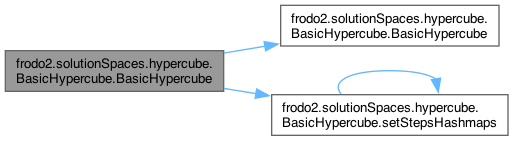
References BasicHypercube(), infeasibleUtil, lastID, problem, setStepsHashmaps(), and values.
◆ BasicHypercube() [4/4]
| frodo2.solutionSpaces.hypercube.BasicHypercube< V extends Addable< V >, U extends Serializable >.BasicHypercube | ( | ) |
Empty constructor that does nothing.
Member Function Documentation
◆ [static initializer]()
|
staticpackage |

◆ applyAugment()
| BasicHypercube< V, U > frodo2.solutionSpaces.hypercube.BasicHypercube< V extends Addable< V >, U extends Serializable >.applyAugment | ( | String[] | new_variables, |
| V | new_domains[][] ) |
Augments the hypercube by adding new variables at the beginning of its variables list.
- Parameters
-
new_variables new variables to augment the hypercube new_domains domains of the new variables
- Returns
- the augmented hypercube
- Todo
- check none of the new variables already belong to this hypercube
References applyAugment(), BasicHypercube(), domains, number_of_utility_values, values, and variables.
Referenced by applyAugment().

◆ applyChangeVariablesOrder()
| void frodo2.solutionSpaces.hypercube.BasicHypercube< V extends Addable< V >, U extends Serializable >.applyChangeVariablesOrder | ( | String[] | variables_order | ) |
Changes the variable order of the hypercube by reordering the current utility array.
- Parameters
-
variables_order the new variables order
already_reordered.remove(i)
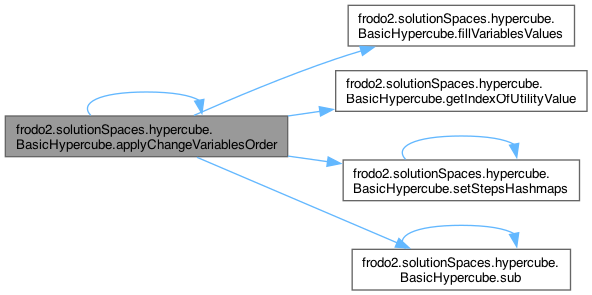
References applyChangeVariablesOrder(), domains, fillVariablesValues(), getIndexOfUtilityValue(), number_of_utility_values, setStepsHashmaps(), steps_hashmaps, sub(), values, and variables.
Referenced by applyChangeVariablesOrder().
◆ applySlice()
| BasicHypercube< V, U > frodo2.solutionSpaces.hypercube.BasicHypercube< V extends Addable< V >, U extends Serializable >.applySlice | ( | String[] | variables_names, |
| V | sub_domains[][] ) |
Return a slice of this hypercube this version of slice does not create a new hypercube but directly modifies the current utility array.
- Parameters
-
variables_names the variables to slice sub_domains the domains of the slice
- Returns
- the new hypercube
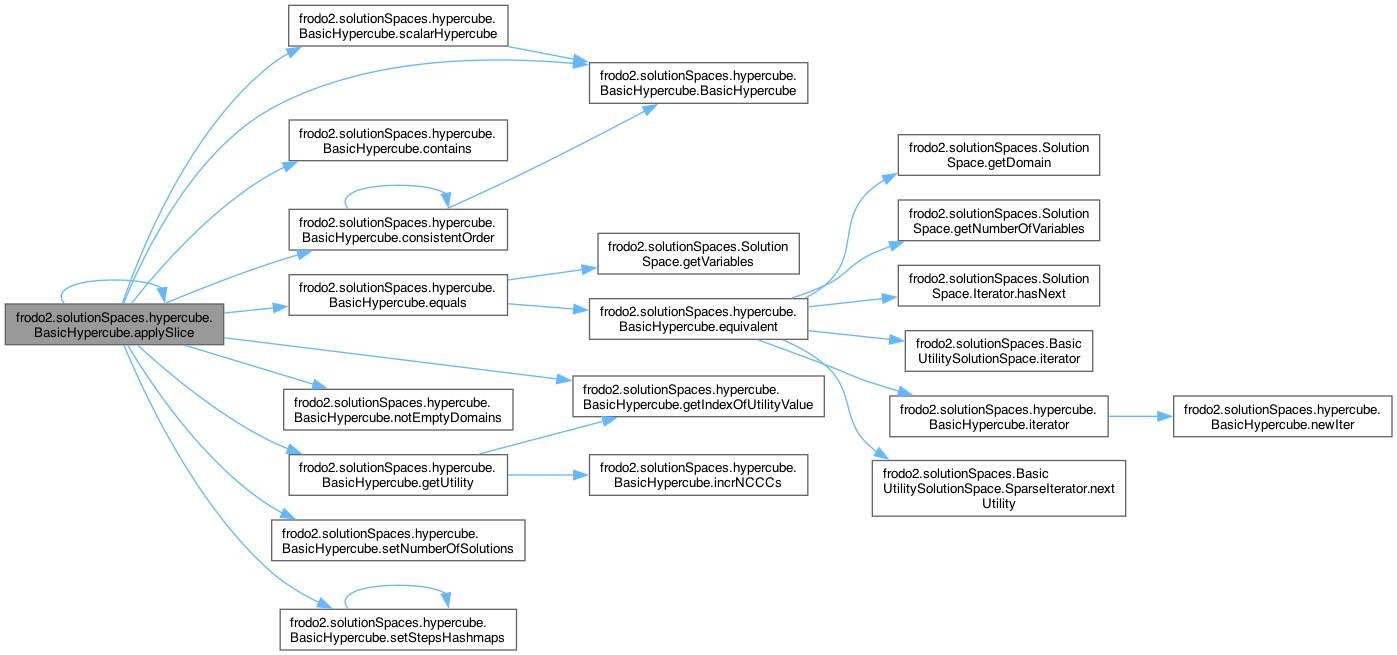
References applySlice(), BasicHypercube(), consistentOrder(), contains(), domains, equals(), getIndexOfUtilityValue(), getUtility(), notEmptyDomains(), scalarHypercube(), setNumberOfSolutions(), setStepsHashmaps(), values, and variables.
Referenced by applySlice().
◆ augment() [1/2]
| void frodo2.solutionSpaces.hypercube.BasicHypercube< V extends Addable< V >, U extends Serializable >.augment | ( | V[] | variables_values | ) |
- See also
- SolutionSpace#augment(Addable[])
- Todo
- Auto-generated method stub
◆ augment() [2/2]
| void frodo2.solutionSpaces.hypercube.BasicHypercube< V extends Addable< V >, U extends Serializable >.augment | ( | V[] | variables_values, |
| U | utility_value ) |
- See also
- BasicUtilitySolutionSpace.augment(Addable[], java.io.Serializable)
- Todo
- Auto-generated method stub
Implements frodo2.solutionSpaces.BasicUtilitySolutionSpace< V extends Addable< V >, U extends Serializable >.
◆ changeVariablesOrder()
| BasicHypercube< V, U > frodo2.solutionSpaces.hypercube.BasicHypercube< V extends Addable< V >, U extends Serializable >.changeVariablesOrder | ( | String[] | variables_order | ) |
Return a new BasicHypercube by changing the order of the variables of the hypercube.
- Parameters
-
variables_order the new order of the variables
- Returns
- BasicHypercube object obtained by changing the order of the variables
- Warning
- The input variable order must contain only and all the variables that belong to the hypercube.
- See also
- BasicUtilitySolutionSpace.changeVariablesOrder(java.lang.String[])
Implements frodo2.solutionSpaces.BasicUtilitySolutionSpace< V extends Addable< V >, U extends Serializable >.
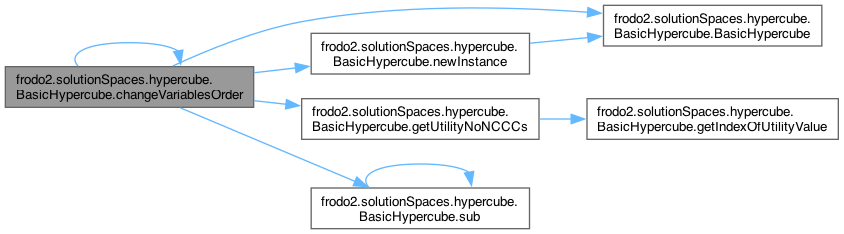
References BasicHypercube(), changeVariablesOrder(), domains, getUtilityNoNCCCs(), newInstance(), number_of_utility_values, sub(), and variables.
Referenced by changeVariablesOrder(), and frodo2.solutionSpaces.hypercube.tests.HypercubeTest.testCompose().
◆ clone()
| BasicHypercube< V, U > frodo2.solutionSpaces.hypercube.BasicHypercube< V extends Addable< V >, U extends Serializable >.clone | ( | ) |
- Returns
- a shallow clone of this BasicHypercube
- See also
- SolutionSpace.clone()
Implements frodo2.solutionSpaces.BasicUtilitySolutionSpace< V extends Addable< V >, U extends Serializable >.
References BasicHypercube(), clone(), domains, newInstance(), values, and variables.
Referenced by clone(), and resolve().

◆ compose()
| BasicUtilitySolutionSpace< V, U > frodo2.solutionSpaces.hypercube.BasicHypercube< V extends Addable< V >, U extends Serializable >.compose | ( | final String[] | varsOut, |
| final BasicUtilitySolutionSpace< V, ArrayList< V > > | subst ) |
The composition operation.
- See also
- BasicUtilitySolutionSpace.compose(java.lang.String[], BasicUtilitySolutionSpace)
- Bug
- I might disagree with this domain; compute the intersection
- Bug
- I might disagree with this domain; compute the intersection
- Bug
- iterate over the intersected domains
Implements frodo2.solutionSpaces.BasicUtilitySolutionSpace< V extends Addable< V >, U extends Serializable >.
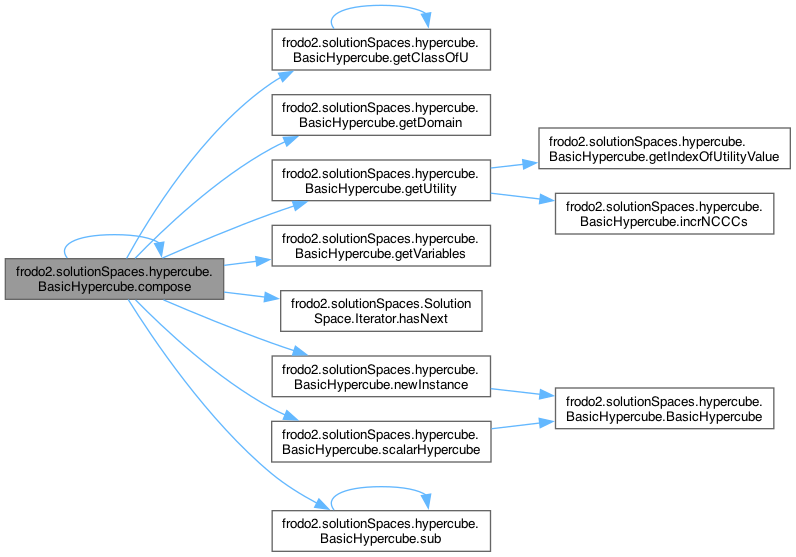
References assignment, classOfV, compose(), getClassOfU(), getDomain(), getUtility(), getVariables(), frodo2.solutionSpaces.SolutionSpace< V extends Addable< V > >.Iterator< V >.hasNext(), newInstance(), frodo2.solutionSpaces.hypercube.Hypercube< V extends Addable< V >, U extends Addable< U > >.NullHypercube< V extends Addable< V >, U extends Addable< U > >.NULL, scalarHypercube(), and sub().
Referenced by compose().
◆ consistentOrder() [1/2]
|
protected |
Checks that the variables order is consistent in all hypercubes.
- Parameters
-
hypercubes space whose variables order is checked
- Returns
- true is variables order in all hypercubes is consistent
- Todo
- Why do a break when you could just directly return false? (applies everywhere)
References BasicHypercube(), consistentOrder(), and variables.
Referenced by applySlice(), and consistentOrder().

◆ consistentOrder() [2/2]
|
protected |
Checks that input variable order is consistent with the order in this hypercube.
- Parameters
-
variables1 variable order
- Returns
- true if variables order in both hypercubes is consistent
References variables.
◆ contains() [1/2]
|
protected |
Checks if this hypercube contains the provided variables.
- Parameters
-
variables_names array of variables
- Returns
- true, if this hypercube contains the provided variables. false, if else
- Note
- This method is only called from within an assert, therefore it is OK if it is not very efficient.
References variables.
Referenced by applySlice(), and slice().
◆ contains() [2/2]
|
protected |
If any of the input variables is in this hypercube, check that the corresponding input domain is a subset of this variable's domain.
- Parameters
-
variables_names array of variables variables_domains array of variables domains
- Returns
trueiff any input variable that is contained in the hypercube has a slicing domain that is a subset of its original domain
- Note
- This method is currently only called from within an assert statement.
References getDomain(), and variables.

◆ countsCCs()
| boolean frodo2.solutionSpaces.hypercube.BasicHypercube< V extends Addable< V >, U extends Serializable >.countsCCs | ( | ) |
- See also
- UtilitySolutionSpace#countsCCs()
◆ equals()
| boolean frodo2.solutionSpaces.hypercube.BasicHypercube< V extends Addable< V >, U extends Serializable >.equals | ( | Object | o | ) |
- See also
- java.lang.Object#equals(java.lang.Object)
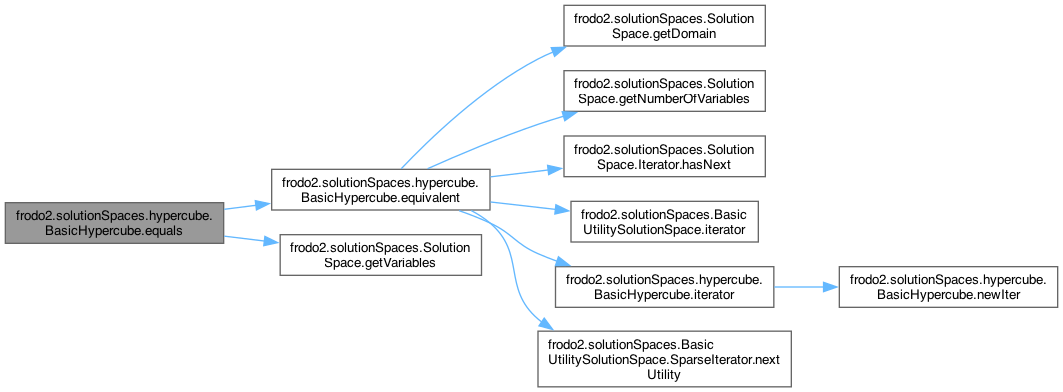
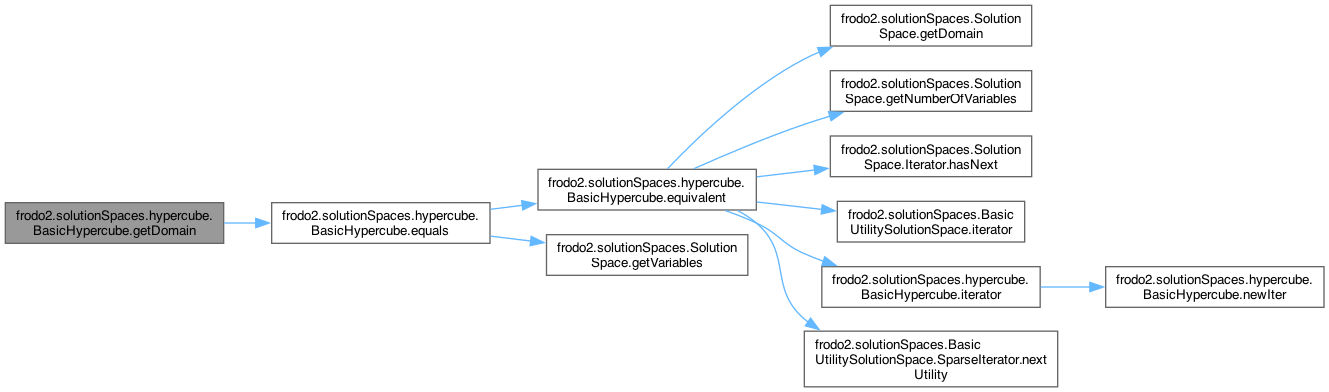
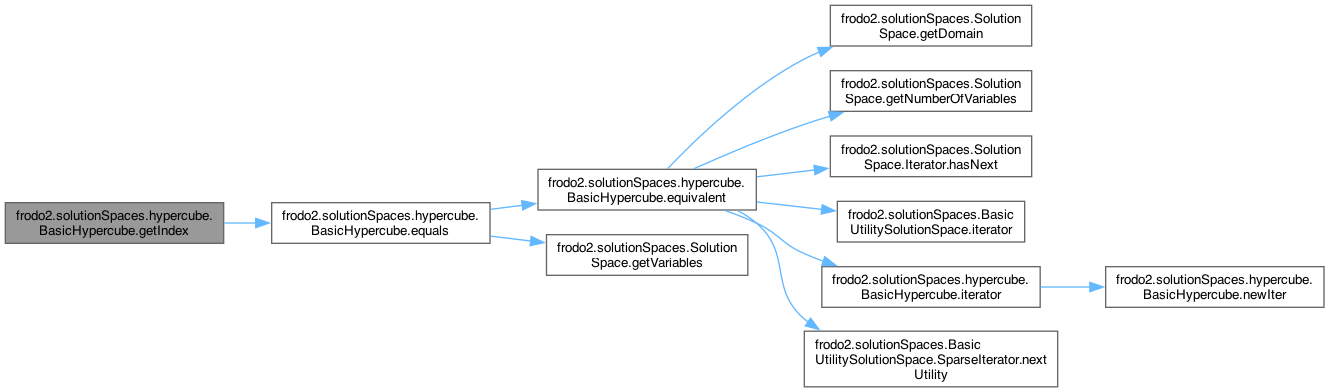
References equivalent(), and frodo2.solutionSpaces.SolutionSpace< V extends Addable< V > >.getVariables().
Referenced by applySlice(), getDomain(), and getIndex().
◆ equivalent()
| boolean frodo2.solutionSpaces.hypercube.BasicHypercube< V extends Addable< V >, U extends Serializable >.equivalent | ( | final BasicUtilitySolutionSpace< V, U > | space | ) |
- See also
- BasicUtilitySolutionSpace#equivalent(BasicUtilitySolutionSpace)
Implements frodo2.solutionSpaces.BasicUtilitySolutionSpace< V extends Addable< V >, U extends Serializable >.
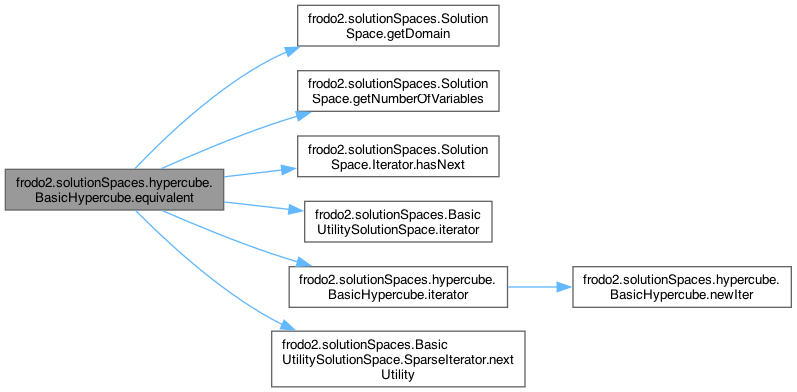
References frodo2.solutionSpaces.SolutionSpace< V extends Addable< V > >.getDomain(), frodo2.solutionSpaces.SolutionSpace< V extends Addable< V > >.getNumberOfVariables(), frodo2.solutionSpaces.SolutionSpace< V extends Addable< V > >.Iterator< V >.hasNext(), frodo2.solutionSpaces.BasicUtilitySolutionSpace< V extends Addable< V >, U extends Serializable >.iterator(), iterator(), and frodo2.solutionSpaces.BasicUtilitySolutionSpace< V extends Addable< V >, U extends Serializable >.SparseIterator< V, U >.nextUtility().
Referenced by equals(), and frodo2.solutionSpaces.hypercube.tests.HypercubeTest.testCompose().
◆ fillVariablesValues()
|
private |
Computes the variable assignments corresponding to a given utility value.
- Parameters
-
variables_values the array to be filled index index of the value in the utility array steps array storing the step for each variable
References domains, and variables.
Referenced by applyChangeVariablesOrder().
◆ getClassOfU()
| Class< U > frodo2.solutionSpaces.hypercube.BasicHypercube< V extends Addable< V >, U extends Serializable >.getClassOfU | ( | ) |
- Returns
- the class used for utility values
Implements frodo2.solutionSpaces.BasicUtilitySolutionSpace< V extends Addable< V >, U extends Serializable >.
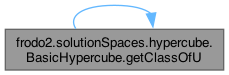
References getClassOfU().
Referenced by compose(), and getClassOfU().
◆ getDefaultUtility()
| U frodo2.solutionSpaces.hypercube.BasicHypercube< V extends Addable< V >, U extends Serializable >.getDefaultUtility | ( | ) |
- Todo
- Auto-generated method stub
Implements frodo2.solutionSpaces.BasicUtilitySolutionSpace< V extends Addable< V >, U extends Serializable >.
◆ getDomain() [1/3]
| V[] frodo2.solutionSpaces.hypercube.BasicHypercube< V extends Addable< V >, U extends Serializable >.getDomain | ( | int | index | ) |
◆ getDomain() [2/3]
| V[] frodo2.solutionSpaces.hypercube.BasicHypercube< V extends Addable< V >, U extends Serializable >.getDomain | ( | String | variable | ) |
Returns an array all the possible values that the variable provided as a parameter can take in this hypercube.
- Parameters
-
variable the name of the variable
- Returns
- the variable domain
References domains, and variables.
Referenced by compose(), contains(), iterator(), and frodo2.solutionSpaces.hypercube.tests.HypercubeTest.testCompose().
◆ getDomain() [3/3]
| V[] frodo2.solutionSpaces.hypercube.BasicHypercube< V extends Addable< V >, U extends Serializable >.getDomain | ( | String | variable, |
| int | index ) |
Returns the variable's domain if index is the variables index in the array of variables order.
- Parameters
-
variable the name of the variable index the index of the variable
- Returns
- Array containing the domain of the variable or null if the variable doesn't exist in this hypercube at the provided index
References domains, equals(), and variables.
◆ getDomains()
| V[][] frodo2.solutionSpaces.hypercube.BasicHypercube< V extends Addable< V >, U extends Serializable >.getDomains | ( | ) |
Returns the array containing the domains of the variables.
- Returns
- two-dimensional array containing the domains of the variables
References domains.
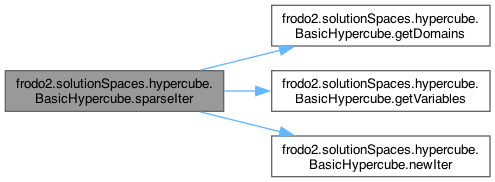
Referenced by sparseIter().
◆ getIndex()
| int frodo2.solutionSpaces.hypercube.BasicHypercube< V extends Addable< V >, U extends Serializable >.getIndex | ( | String | variable | ) |
Return the index of the input variable in this hypercube.
- Parameters
-
variable the name of the variable
- Returns
- integer representing the index of the variable in the hypercube
References equals(), and variables.
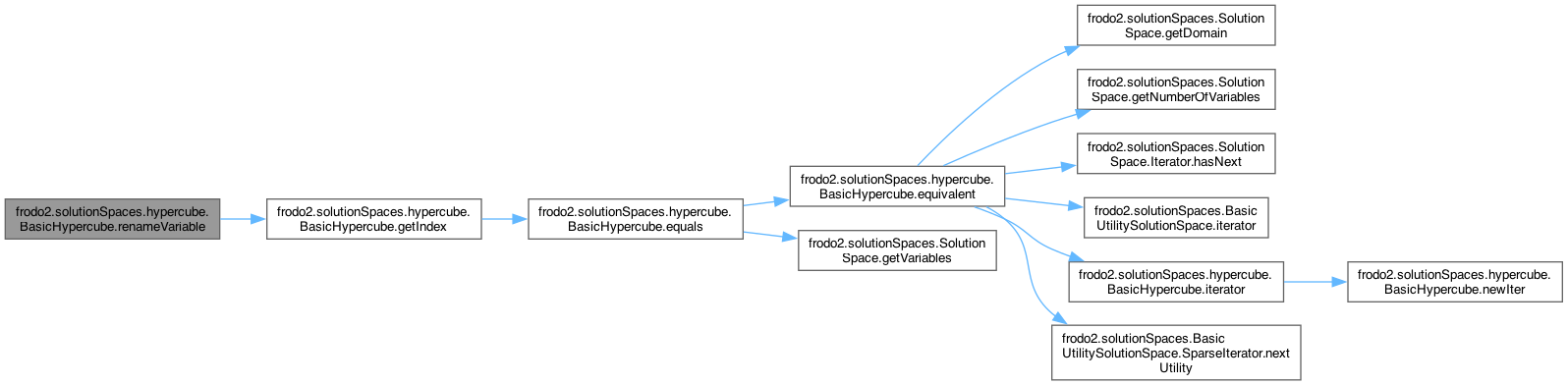
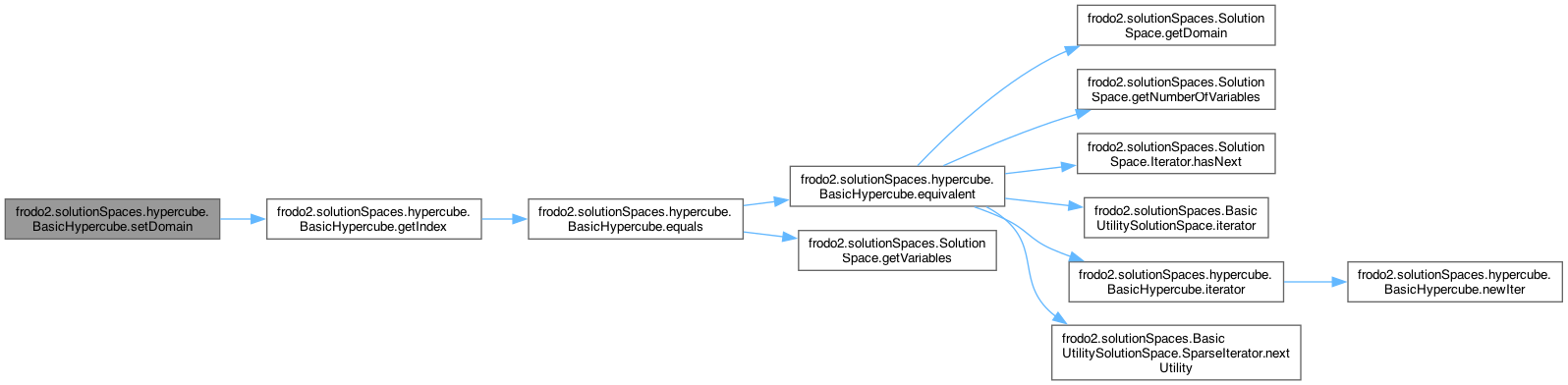
Referenced by renameVariable(), and setDomain().
◆ getIndexOfUtilityValue()
|
protected |
Returns the index of the utility value corresponding to the provided variables values.
- Parameters
-
variables_values the variables values
- Returns
- Integer representing the index of the utility value corresponding to the provided variables values. If given assignment is not present then index of utility value for that assignment is equal to -1.
References steps_hashmaps, and variables.
Referenced by applyChangeVariablesOrder(), applySlice(), getUtility(), getUtilityNoNCCCs(), and setUtility().
◆ getName()
| String frodo2.solutionSpaces.hypercube.BasicHypercube< V extends Addable< V >, U extends Serializable >.getName | ( | ) |
- See also
- SolutionSpace.getName()
References name.
◆ getNumberOfSolutions()
| long frodo2.solutionSpaces.hypercube.BasicHypercube< V extends Addable< V >, U extends Serializable >.getNumberOfSolutions | ( | ) |
Returns the number of utility values in the hypercube.
- Returns
- integer representing the number of utility values in the hypercube
References number_of_utility_values.
◆ getNumberOfVariables()
| int frodo2.solutionSpaces.hypercube.BasicHypercube< V extends Addable< V >, U extends Serializable >.getNumberOfVariables | ( | ) |
Returns the number of variables in the hypercube.
- Returns
- integer representing the number of variables in the hypercube
References variables.
Referenced by frodo2.solutionSpaces.hypercube.ScalarBasicHypercube< V extends Addable< V >, U extends Serializable >.compose(), frodo2.solutionSpaces.hypercube.ScalarHypercube< V extends Addable< V >, U extends Addable< U > >.compose(), and frodo2.solutionSpaces.hypercube.tests.HypercubeTest.testCompose().
◆ getOwner()
| String frodo2.solutionSpaces.hypercube.BasicHypercube< V extends Addable< V >, U extends Serializable >.getOwner | ( | ) |
- See also
- SolutionSpace.getOwner()
References owner.
◆ getRelationName()
| String frodo2.solutionSpaces.hypercube.BasicHypercube< V extends Addable< V >, U extends Serializable >.getRelationName | ( | ) |
- See also
- SolutionSpace.getRelationName()
References relationName.
◆ getUtility() [1/4]
| U frodo2.solutionSpaces.hypercube.BasicHypercube< V extends Addable< V >, U extends Serializable >.getUtility | ( | long | index | ) |
Implements frodo2.solutionSpaces.BasicUtilitySolutionSpace< V extends Addable< V >, U extends Serializable >.
References incrNCCCs(), and values.

◆ getUtility() [2/4]
| U frodo2.solutionSpaces.hypercube.BasicHypercube< V extends Addable< V >, U extends Serializable >.getUtility | ( | Map< String, V > | assignments | ) |
- See also
- BasicUtilitySolutionSpace.getUtility(java.util.Map)
- Warning
- returns
nullif not all variables in the space are assigned values
Implements frodo2.solutionSpaces.BasicUtilitySolutionSpace< V extends Addable< V >, U extends Serializable >.
References getUtility().

◆ getUtility() [3/4]
| U frodo2.solutionSpaces.hypercube.BasicHypercube< V extends Addable< V >, U extends Serializable >.getUtility | ( | String[] | variables_names, |
| V[] | variables_values ) |
- See also
- BasicUtilitySolutionSpace.getUtility(java.lang.String[], Addable[])
- Warning
- returns
nullif not all variables in the space are assigned values
Implements frodo2.solutionSpaces.BasicUtilitySolutionSpace< V extends Addable< V >, U extends Serializable >.
References getUtility(), and variables.

◆ getUtility() [4/4]
| U frodo2.solutionSpaces.hypercube.BasicHypercube< V extends Addable< V >, U extends Serializable >.getUtility | ( | V[] | variables_values | ) |
- See also
- frodo2.solutionSpaces.BasicUtilitySolutionSpace#getUtility(Addable[])
- Warning
- returns null if the input does not specify a value for each variable in the space
Implements frodo2.solutionSpaces.BasicUtilitySolutionSpace< V extends Addable< V >, U extends Serializable >.
References getIndexOfUtilityValue(), incrNCCCs(), and values.
Referenced by applySlice(), compose(), getUtility(), getUtility(), getUtilityValueSameOrder(), slice(), frodo2.solutionSpaces.hypercube.tests.HypercubeTest.testCompose(), and frodo2.solutionSpaces.hypercube.tests.HypercubeTest.verifyProjection().
◆ getUtilityNoNCCCs()
|
private |
Returns the utility of the input assignment, without incrementing the NCCC counter.
- Parameters
-
variables_values assignment
- Returns
- corresponding utility
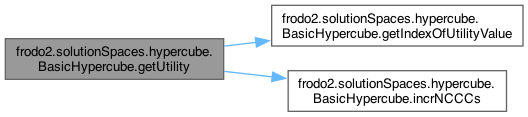
References getIndexOfUtilityValue(), and values.
Referenced by changeVariablesOrder().

◆ getUtilityValueSameOrder()
| U frodo2.solutionSpaces.hypercube.BasicHypercube< V extends Addable< V >, U extends Serializable >.getUtilityValueSameOrder | ( | String[] | variables_names, |
| V[] | variables_values ) |
Returns an object representing the utility value corresponding to the provided variables values.
This method assumes that the order of the variables in the input array of variables is consistent with the order used in the hypercube.
- Parameters
-
variables_names the names of the variables variables_values the values of the variables
- Returns
- the utility value corresponding the provided variables values. It returns
nullif no utility variable was found.
References getUtility(), and variables.

◆ getVariable()
| String frodo2.solutionSpaces.hypercube.BasicHypercube< V extends Addable< V >, U extends Serializable >.getVariable | ( | int | index | ) |
Returns the variable corresponding to the provided index.
- Parameters
-
index index of the variable in this hypercube
- Returns
- String representing the variable corresponding to the provided index
References variables.
◆ getVariables()
| String[] frodo2.solutionSpaces.hypercube.BasicHypercube< V extends Addable< V >, U extends Serializable >.getVariables | ( | ) |
Returns the names of the variables of the hypercube.
- Returns
- String array containing the names of the variables of the hypercube
References variables.
Referenced by compose(), sparseIter(), and frodo2.solutionSpaces.hypercube.tests.HypercubeTest.testCompose().
◆ hashCode()
| int frodo2.solutionSpaces.hypercube.BasicHypercube< V extends Addable< V >, U extends Serializable >.hashCode | ( | ) |
- See also
- java.lang.Object#hashCode()
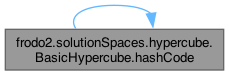
References hashCode(), and name.
Referenced by hashCode().
◆ incrNCCCs()
|
protected |
Increments the number of constraint checks.
- Parameters
-
incr the increment
References problem.
Referenced by frodo2.solutionSpaces.hypercube.BasicHypercubeIter< V extends Addable< V >, U extends Serializable >.getCurrentUtility(), getUtility(), getUtility(), frodo2.solutionSpaces.hypercube.BasicHypercubeIter< V extends Addable< V >, U extends Serializable >.nextSolution(), frodo2.solutionSpaces.hypercube.BasicHypercubeIter< V extends Addable< V >, U extends Serializable >.nextUtility(), resolve(), and writeUtilities().
◆ intersection()
|
static |
Computes the intersection between two arrays.
- Parameters
-
<V> the type of the entries in the arrays array1 the first array array2 the second array
- Returns
- Array containing the intersection of array1 and array2;
null(NOT an empty array) if the intersection is empty
- Warning
- This assumes that the two arrays are ordered.
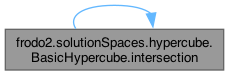
References intersection().
Referenced by intersection(), iterator(), and frodo2.solutionSpaces.JaCoP.JaCoPutilSpace< V extends Addable< V > >.iterator().
◆ isIncludedIn()
| boolean frodo2.solutionSpaces.hypercube.BasicHypercube< V extends Addable< V >, U extends Serializable >.isIncludedIn | ( | BasicUtilitySolutionSpace< V, U > | space | ) |
- See also
- BasicUtilitySolutionSpace#isIncludedIn(BasicUtilitySolutionSpace)
- Todo
- Auto-generated method stub
Implements frodo2.solutionSpaces.BasicUtilitySolutionSpace< V extends Addable< V >, U extends Serializable >.
◆ isNull()
| boolean frodo2.solutionSpaces.hypercube.BasicHypercube< V extends Addable< V >, U extends Serializable >.isNull | ( | ) |
Check if this hypercube is the NULL hypercube.
- Returns
- true if the hypercube is the NULL hypercube and false if else
◆ iterator() [1/5]
| Iterator< V, U > frodo2.solutionSpaces.hypercube.BasicHypercube< V extends Addable< V >, U extends Serializable >.iterator | ( | ) |
Implements frodo2.solutionSpaces.BasicUtilitySolutionSpace< V extends Addable< V >, U extends Serializable >.
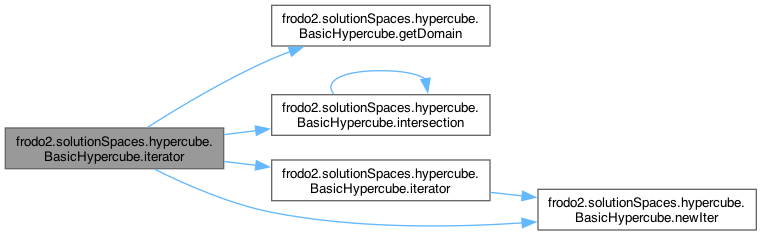
References newIter().
Referenced by equivalent(), iterator(), iterator(), iterator(), slice(), sparseIter(), and sparseIter().

◆ iterator() [2/5]
| Iterator< V, U > frodo2.solutionSpaces.hypercube.BasicHypercube< V extends Addable< V >, U extends Serializable >.iterator | ( | String[] | order | ) |
- See also
- SolutionSpace.iterator(java.lang.String[])
Implements frodo2.solutionSpaces.BasicUtilitySolutionSpace< V extends Addable< V >, U extends Serializable >.
References newIter().

◆ iterator() [3/5]
| Iterator< V, U > frodo2.solutionSpaces.hypercube.BasicHypercube< V extends Addable< V >, U extends Serializable >.iterator | ( | String[] | variables, |
| V | domains[][] ) |
- See also
- BasicUtilitySolutionSpace.iterator(java.lang.String[], Addable[][])
Implements frodo2.solutionSpaces.BasicUtilitySolutionSpace< V extends Addable< V >, U extends Serializable >.
References domains, iterator(), and variables.

◆ iterator() [4/5]
| Iterator< V, U > frodo2.solutionSpaces.hypercube.BasicHypercube< V extends Addable< V >, U extends Serializable >.iterator | ( | String[] | variables, |
| V | domains[][], | ||
| V[] | assignment ) |
- See also
- BasicUtilitySolutionSpace.iterator(java.lang.String[], Addable[][], Addable[])
Implements frodo2.solutionSpaces.BasicUtilitySolutionSpace< V extends Addable< V >, U extends Serializable >.
References assignment, domains, iterator(), and variables.

◆ iterator() [5/5]
|
private |
Returns an iterator.
- Parameters
-
variables The variables to iterate over domains The domains of the variables over which to iterate assignment An array that will be used as the output of nextSolution() skippedUtil The utility value that the sparse iterator should skip (if any)
- Returns
- an iterator which allows to iterate over the given variables and their utilities
References assignment, domains, getDomain(), intersection(), iterator(), newIter(), and variables.
◆ join() [1/4]
| SolutionSpace< V > frodo2.solutionSpaces.hypercube.BasicHypercube< V extends Addable< V >, U extends Serializable >.join | ( | SolutionSpace< V > | space | ) |
- See also
- SolutionSpace#join(SolutionSpace)
◆ join() [2/4]
| SolutionSpace< V > frodo2.solutionSpaces.hypercube.BasicHypercube< V extends Addable< V >, U extends Serializable >.join | ( | SolutionSpace< V > | space, |
| String[] | total_variables ) |
- See also
- SolutionSpace.join(SolutionSpace, java.lang.String[])
- Todo
- Auto-generated method stub
◆ join() [3/4]
| SolutionSpace< V > frodo2.solutionSpaces.hypercube.BasicHypercube< V extends Addable< V >, U extends Serializable >.join | ( | SolutionSpace< V >[] | spaces | ) |
- See also
- SolutionSpace#join(SolutionSpace[])
- Todo
- Auto-generated method stub
◆ join() [4/4]
| SolutionSpace< V > frodo2.solutionSpaces.hypercube.BasicHypercube< V extends Addable< V >, U extends Serializable >.join | ( | SolutionSpace< V >[] | spaces, |
| String[] | total_variables_order ) |
Returns a SolutionSpace object obtained by joining the SolutionSpace for which this method is called and the SolutionSpaces present in the array of SolutionSpaces given to this method as a parameter.
- Parameters
-
spaces an array of the solutionSpaces to be added to this solutionSpace total_variables_order the order of the variables in all solutionSpaces
- Returns
- SolutionSpace object obtained by joining this SolutionSpace with all the SolutionSpaces in the array of SolutionSpaces Originally this function in the hypercubes assumes that order is not conflicting.
◆ knows()
| boolean frodo2.solutionSpaces.hypercube.BasicHypercube< V extends Addable< V >, U extends Serializable >.knows | ( | Class<?> | spaceClass | ) |
- See also
- SolutionSpace#knows(Class)
References knownSpaces.
◆ newInstance()
|
protected |
Creates a new instance of a BasicHypercube.
- Parameters
-
name the name of the new BasicHypercube new_variables list of variables new_domains list of domains new_values array of utility values infeasibleUtil -INF if we are maximizing, +INF if we are minimizing
- Returns
- a new BasicHypercube
References BasicHypercube(), infeasibleUtil, and name.
Referenced by changeVariablesOrder(), clone(), compose(), renameAllVars(), and slice().

◆ newIter()
|
protected |
Creates a new iterator for this space.
- Parameters
-
variables The variables to iterate over domains The domains of the variables over which to iterate assignment An array that will be used as the output of nextSolution() skippedUtil A utility value that should be skipped (if null, nothing is skipped)
- Returns
- a new iterator
References assignment, domains, and variables.
Referenced by iterator(), iterator(), iterator(), sparseIter(), and sparseIter().
◆ notEmptyDomains()
|
protected |
Checks that there is no empty domain in an array of domains.
- Parameters
-
domains array containing domains
- Returns
- true if provided array of domains contains no empty domain
References domains.
Referenced by applySlice(), and slice().
◆ orderedDomains()
| boolean frodo2.solutionSpaces.hypercube.BasicHypercube< V extends Addable< V >, U extends Serializable >.orderedDomains | ( | ) |
◆ prettyPrint()
| String frodo2.solutionSpaces.hypercube.BasicHypercube< V extends Addable< V >, U extends Serializable >.prettyPrint | ( | U | ignoredUtil | ) |
- See also
- BasicUtilitySolutionSpace.prettyPrint(java.io.Serializable)
Implements frodo2.solutionSpaces.BasicUtilitySolutionSpace< V extends Addable< V >, U extends Serializable >.
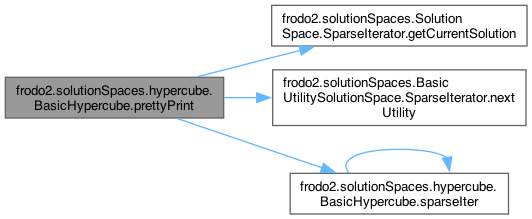
References frodo2.solutionSpaces.SolutionSpace< V extends Addable< V > >.SparseIterator< V >.getCurrentSolution(), frodo2.solutionSpaces.BasicUtilitySolutionSpace< V extends Addable< V >, U extends Serializable >.SparseIterator< V, U >.nextUtility(), and sparseIter().
◆ readExternal()
| void frodo2.solutionSpaces.hypercube.BasicHypercube< V extends Addable< V >, U extends Serializable >.readExternal | ( | ObjectInput | in | ) | throws IOException, ClassNotFoundException |
- See also
- java.io.Externalizable#readExternal(java.io.ObjectInput)
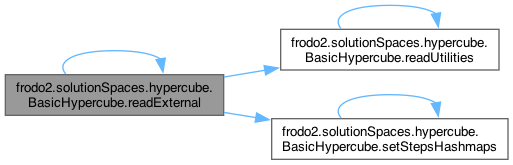
References readExternal(), readUtilities(), and setStepsHashmaps().
Referenced by readExternal().
◆ readUtilities()
|
protected |
Deserializes the utilities.
- Parameters
-
in the input stream
- Exceptions
-
ClassNotFoundException should never happen IOException if an I/O error occurs InvocationTargetException when failing to instantiate instances of the utility class NoSuchMethodException when failing to instantiate instances of the utility class
References readUtilities().
Referenced by readExternal(), and readUtilities().
◆ renameAllVars()
| BasicHypercube< V, U > frodo2.solutionSpaces.hypercube.BasicHypercube< V extends Addable< V >, U extends Serializable >.renameAllVars | ( | String[] | newVarNames | ) |
- See also
- SolutionSpace.renameAllVars(java.lang.String[])
References BasicHypercube(), domains, infeasibleUtil, newInstance(), setProblem(), and values.

◆ renameVariable()
| void frodo2.solutionSpaces.hypercube.BasicHypercube< V extends Addable< V >, U extends Serializable >.renameVariable | ( | String | oldName, |
| String | newName ) |
◆ resolve() [1/2]
| BasicHypercube< V, U > frodo2.solutionSpaces.hypercube.BasicHypercube< V extends Addable< V >, U extends Serializable >.resolve | ( | ) |
Implements frodo2.solutionSpaces.BasicUtilitySolutionSpace< V extends Addable< V >, U extends Serializable >.
References BasicHypercube(), and resolve().
Referenced by resolve().

◆ resolve() [2/2]
| BasicHypercube< V, U > frodo2.solutionSpaces.hypercube.BasicHypercube< V extends Addable< V >, U extends Serializable >.resolve | ( | boolean | unused | ) |
Implements frodo2.solutionSpaces.BasicUtilitySolutionSpace< V extends Addable< V >, U extends Serializable >.
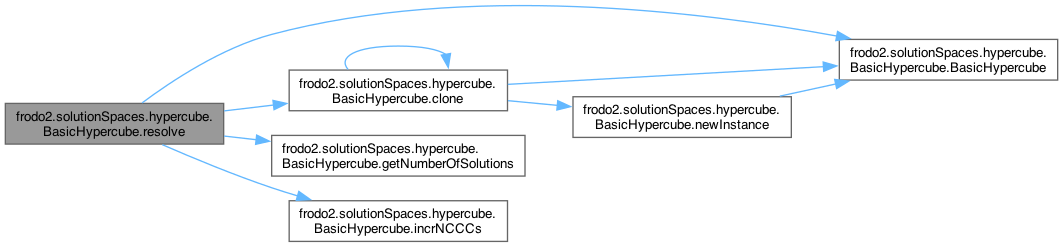
References BasicHypercube(), clone(), getNumberOfSolutions(), and incrNCCCs().
◆ scalarHypercube()
|
protected |
Creates a new instance of a ScalarBasicHypercube.
- Parameters
-
utility the utility of the scalar hypercube
- Returns
- a new instance of a ScalarBasicHypercube
References BasicHypercube().
Referenced by applySlice(), compose(), and slice().

◆ setDefaultUtility()
| void frodo2.solutionSpaces.hypercube.BasicHypercube< V extends Addable< V >, U extends Serializable >.setDefaultUtility | ( | U | utility | ) |
- See also
- BasicUtilitySolutionSpace.setDefaultUtility(java.io.Serializable)
- Todo
- Auto-generated method stub
Implements frodo2.solutionSpaces.BasicUtilitySolutionSpace< V extends Addable< V >, U extends Serializable >.
◆ setDomain()
| void frodo2.solutionSpaces.hypercube.BasicHypercube< V extends Addable< V >, U extends Serializable >.setDomain | ( | String | var, |
| V[] | dom ) |
- See also
- SolutionSpace#setDomain(String, Addable[])
References getIndex().
◆ setInfeasibleUtility()
| void frodo2.solutionSpaces.hypercube.BasicHypercube< V extends Addable< V >, U extends Serializable >.setInfeasibleUtility | ( | U | utility | ) |
- See also
- BasicUtilitySolutionSpace.setInfeasibleUtility(java.io.Serializable)
Implements frodo2.solutionSpaces.BasicUtilitySolutionSpace< V extends Addable< V >, U extends Serializable >.
◆ setName()
| void frodo2.solutionSpaces.hypercube.BasicHypercube< V extends Addable< V >, U extends Serializable >.setName | ( | String | name | ) |
- See also
- SolutionSpace.setName(String)
References name.
◆ setNumberOfSolutions()
|
protected |
Modifies the number of utility values in the hypercube (in case the utility array is bigger then the actual number of elements).
- Parameters
-
new_number_of_utilities new number of utilities of the hypercube
References number_of_utility_values.
Referenced by applySlice().
◆ setOwner()
| void frodo2.solutionSpaces.hypercube.BasicHypercube< V extends Addable< V >, U extends Serializable >.setOwner | ( | String | owner | ) |
◆ setProblem()
| void frodo2.solutionSpaces.hypercube.BasicHypercube< V extends Addable< V >, U extends Serializable >.setProblem | ( | ProblemInterface< V, ?> | problem | ) |
- See also
- SolutionSpace#setProblem(ProblemInterface)
References problem.
Referenced by renameAllVars().
◆ setRelationName()
| void frodo2.solutionSpaces.hypercube.BasicHypercube< V extends Addable< V >, U extends Serializable >.setRelationName | ( | String | name | ) |
References name.
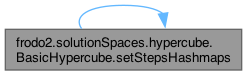
◆ setStepsHashmaps() [1/2]
|
package |
Based on the hypercube parameters this method fills the steps Hashmap that maps each variable of the hypercube to another Hashmaps that maps each possible value of this variable to a step in the utility values array.
References setStepsHashmaps().
Referenced by applyChangeVariablesOrder(), applySlice(), BasicHypercube(), readExternal(), setStepsHashmaps(), and setStepsHashmaps().
◆ setStepsHashmaps() [2/2]
|
package |
Fills the step hashMap of the hypercube.
- Parameters
-
variables2 list of variables domains2 list of domains number_of_utility_values2 number of utility values
References setStepsHashmaps(), and steps_hashmaps.

◆ setUtility() [1/2]
| void frodo2.solutionSpaces.hypercube.BasicHypercube< V extends Addable< V >, U extends Serializable >.setUtility | ( | long | index, |
| U | utility ) |
- See also
- BasicUtilitySolutionSpace.setUtility(long, java.io.Serializable)
Implements frodo2.solutionSpaces.BasicUtilitySolutionSpace< V extends Addable< V >, U extends Serializable >.
◆ setUtility() [2/2]
| boolean frodo2.solutionSpaces.hypercube.BasicHypercube< V extends Addable< V >, U extends Serializable >.setUtility | ( | V[] | variables_values, |
| U | utility ) |
Sets the utility value corresponding to a given assignment to variables.
- Parameters
-
variables_values values for the variables, in the same order as in the hypercube utility the new utility value
- See also
- BasicUtilitySolutionSpace.setUtility(Addable[], java.io.Serializable)
Implements frodo2.solutionSpaces.BasicUtilitySolutionSpace< V extends Addable< V >, U extends Serializable >.
References getIndexOfUtilityValue(), and values.
Referenced by frodo2.solutionSpaces.vehiclerouting.VehicleRoutingSpace< U extends Addable< U > >.project().

◆ slice() [1/6]
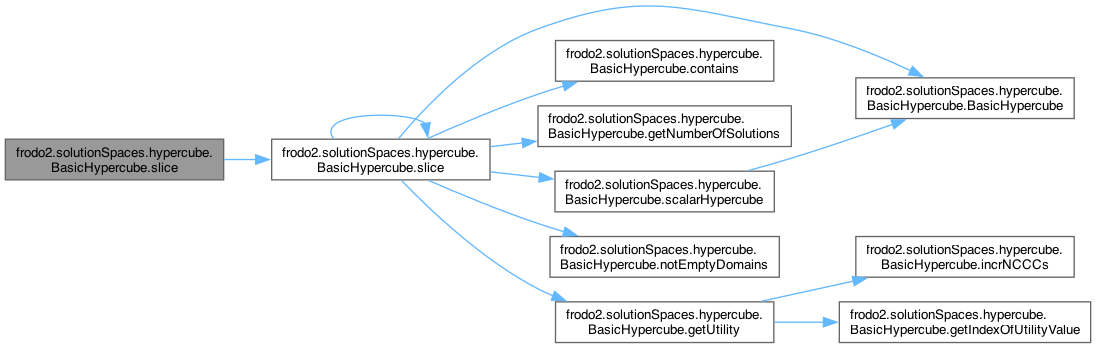
| BasicUtilitySolutionSpace< V, U > frodo2.solutionSpaces.hypercube.BasicHypercube< V extends Addable< V >, U extends Serializable >.slice | ( | String | var, |
| V | val ) |
Slices this hypercube over a single variable-value assignment.
- Parameters
-
var the variable to be assigned a value val the value to assign to the variable
- Returns
- the hypercube resulting from this slice
Implements frodo2.solutionSpaces.BasicUtilitySolutionSpace< V extends Addable< V >, U extends Serializable >.
References slice().
◆ slice() [2/6]
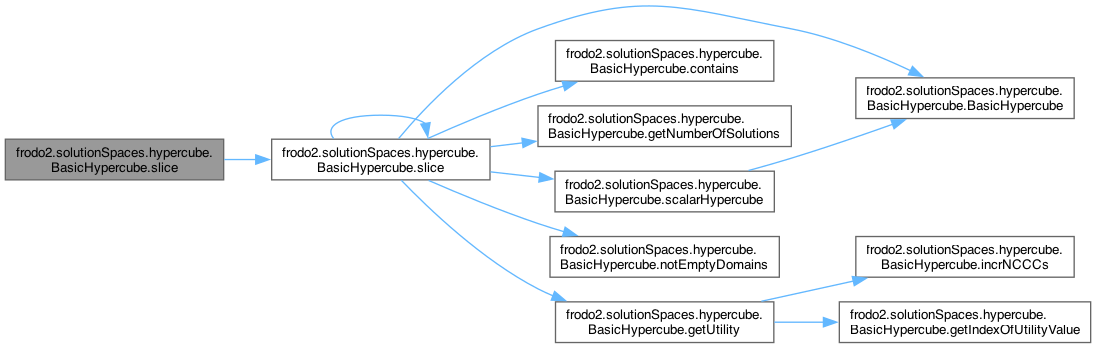
| BasicUtilitySolutionSpace< V, U > frodo2.solutionSpaces.hypercube.BasicHypercube< V extends Addable< V >, U extends Serializable >.slice | ( | String | var, |
| V[] | subDomain ) |
- See also
- BasicUtilitySolutionSpace.slice(java.lang.String, Addable[])
Implements frodo2.solutionSpaces.BasicUtilitySolutionSpace< V extends Addable< V >, U extends Serializable >.
References slice().
◆ slice() [3/6]
|
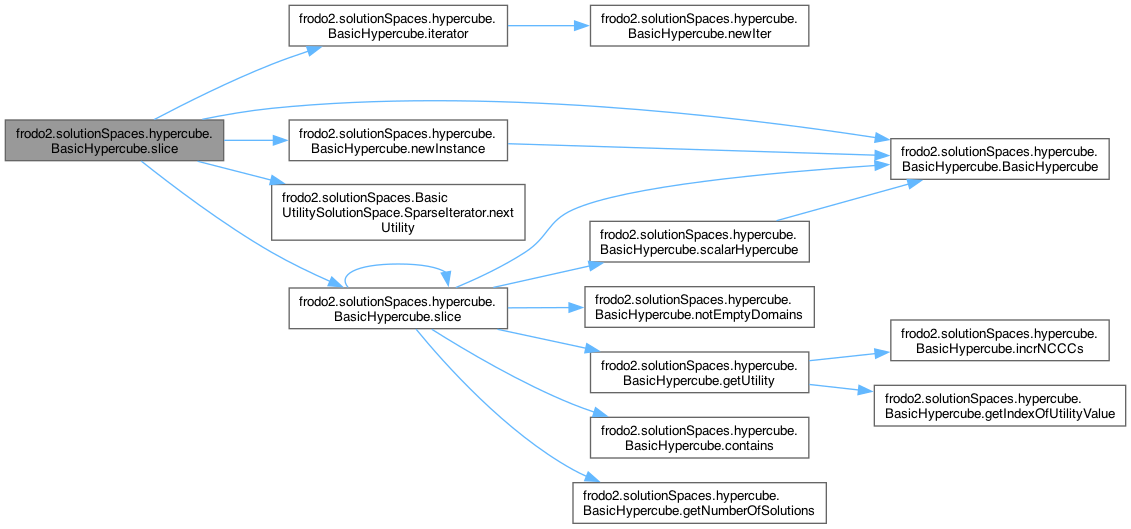
protected |
Slice method used internally.
- Parameters
-
remainingVars the remaining variables remainingDoms the domains of the remaining variables iterDoms the domain slices for this space's variables nbrRemainingUtils the number of remaining utilities domClass the class of V[]
- Returns
- the corresponding sliced space
- Bug
- Don't count NCCCs
References BasicHypercube(), iterator(), newInstance(), frodo2.solutionSpaces.BasicUtilitySolutionSpace< V extends Addable< V >, U extends Serializable >.SparseIterator< V, U >.nextUtility(), and slice().
◆ slice() [4/6]
| BasicUtilitySolutionSpace< V, U > frodo2.solutionSpaces.hypercube.BasicHypercube< V extends Addable< V >, U extends Serializable >.slice | ( | String[] | variables_names, |
| V[] | values ) |
- See also
- BasicUtilitySolutionSpace.slice(java.lang.String[], Addable[])
Implements frodo2.solutionSpaces.BasicUtilitySolutionSpace< V extends Addable< V >, U extends Serializable >.
References slice(), and values.
◆ slice() [5/6]
| BasicHypercube< V, U > frodo2.solutionSpaces.hypercube.BasicHypercube< V extends Addable< V >, U extends Serializable >.slice | ( | String[] | variables_names, |
| V | sub_domains[][] ) |
Return a slice of this hypercube.
- Parameters
-
variables_names the variables to slice sub_domains the domains of the slice
- Returns
- Hypercube representing a slice of this hypercube
- Warning
- Returns itself if the slice has no effect
Implements frodo2.solutionSpaces.BasicUtilitySolutionSpace< V extends Addable< V >, U extends Serializable >.
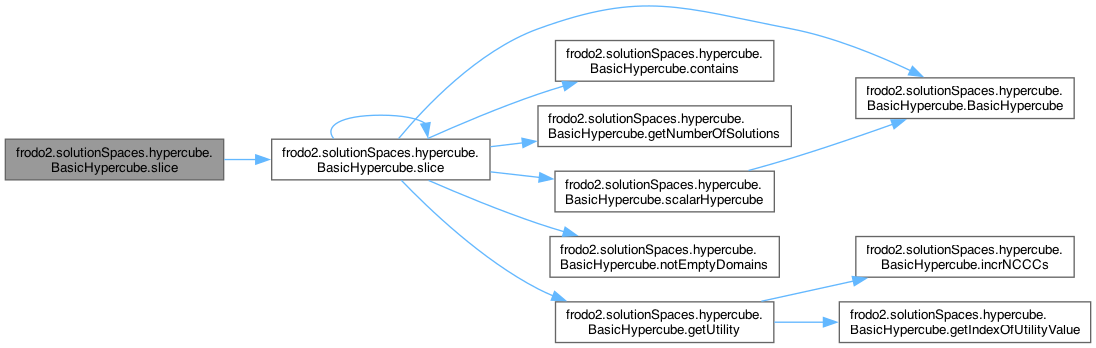
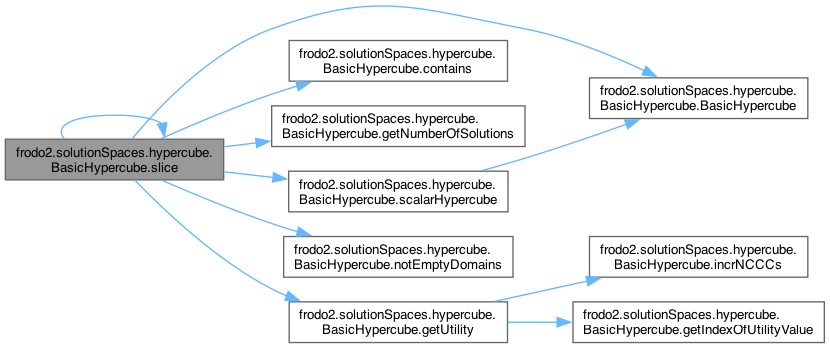
References BasicHypercube(), contains(), getNumberOfSolutions(), getUtility(), notEmptyDomains(), scalarHypercube(), and slice().
Referenced by slice(), slice(), slice(), slice(), slice(), and slice().
◆ slice() [6/6]
| BasicUtilitySolutionSpace< V, U > frodo2.solutionSpaces.hypercube.BasicHypercube< V extends Addable< V >, U extends Serializable >.slice | ( | V[] | variables_values | ) |
Return a slice of this hypercube.
- Parameters
-
variables_values array containing values of the last variables of the hypercube
- Returns
- Hypercube object obtained by associating fixed values to the last variables of the hypercube. the number of this variables depends on the length of the provided array of variables values
Implements frodo2.solutionSpaces.BasicUtilitySolutionSpace< V extends Addable< V >, U extends Serializable >.
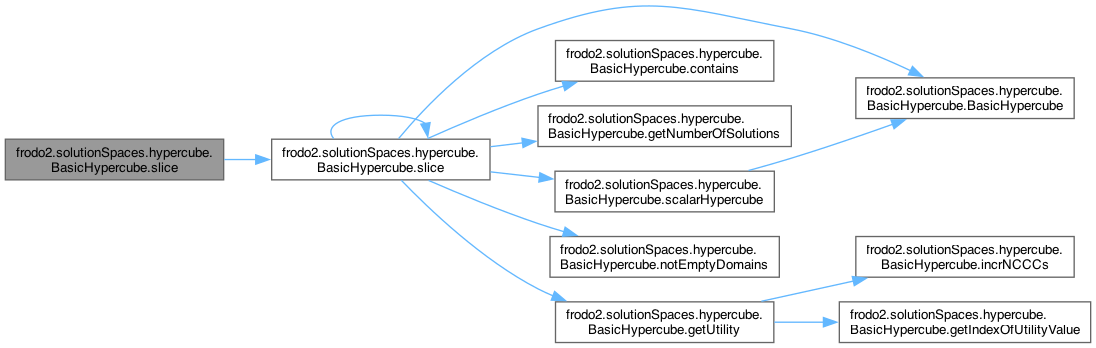
References domains, number_of_utility_values, slice(), steps_hashmaps, and variables.
◆ sparseIter() [1/5]
| SparseIterator< V, U > frodo2.solutionSpaces.hypercube.BasicHypercube< V extends Addable< V >, U extends Serializable >.sparseIter | ( | ) |
Implements frodo2.solutionSpaces.BasicUtilitySolutionSpace< V extends Addable< V >, U extends Serializable >.
References sparseIter().
Referenced by prettyPrint(), and sparseIter().
◆ sparseIter() [2/5]
| SparseIterator< V, U > frodo2.solutionSpaces.hypercube.BasicHypercube< V extends Addable< V >, U extends Serializable >.sparseIter | ( | String[] | order | ) |
- See also
- SolutionSpace.sparseIter(java.lang.String[])
Implements frodo2.solutionSpaces.BasicUtilitySolutionSpace< V extends Addable< V >, U extends Serializable >.
References newIter().

◆ sparseIter() [3/5]
| SparseIterator< V, U > frodo2.solutionSpaces.hypercube.BasicHypercube< V extends Addable< V >, U extends Serializable >.sparseIter | ( | String[] | variables, |
| V | domains[][] ) |
- See also
- BasicUtilitySolutionSpace.sparseIter(java.lang.String[], Addable[][])
Implements frodo2.solutionSpaces.BasicUtilitySolutionSpace< V extends Addable< V >, U extends Serializable >.
References domains, iterator(), and variables.

◆ sparseIter() [4/5]
| SparseIterator< V, U > frodo2.solutionSpaces.hypercube.BasicHypercube< V extends Addable< V >, U extends Serializable >.sparseIter | ( | String[] | variables, |
| V | domains[][], | ||
| V[] | assignment ) |
- See also
- BasicUtilitySolutionSpace.sparseIter(java.lang.String[], Addable[][], Addable[])
Implements frodo2.solutionSpaces.BasicUtilitySolutionSpace< V extends Addable< V >, U extends Serializable >.
References assignment, domains, iterator(), and variables.

◆ sparseIter() [5/5]
|
protected |
Creates a sparse iterator that skips a specific utility.
- Parameters
-
inf the utility to skip
- Returns
- a sparse iterator
References getDomains(), getVariables(), and newIter().
◆ sub()
|
static |
Computes the subtraction of two arrays.
- Parameters
-
<T> the arrays' component type array1 the first array array2 the second array
- Returns
- substraction
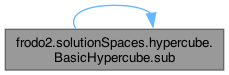
References sub().
Referenced by applyChangeVariablesOrder(), changeVariablesOrder(), compose(), and sub().
◆ toString()
| String frodo2.solutionSpaces.hypercube.BasicHypercube< V extends Addable< V >, U extends Serializable >.toString | ( | ) |
◆ writeExternal()
| void frodo2.solutionSpaces.hypercube.BasicHypercube< V extends Addable< V >, U extends Serializable >.writeExternal | ( | ObjectOutput | out | ) | throws IOException |
- See also
- java.io.Externalizable#writeExternal(java.io.ObjectOutput)
References writeUtilities().

◆ writeUtilities()
|
protected |
Serializes the utilities.
- Parameters
-
out the output stream
- Exceptions
-
IOException if an I/O error occurs
References incrNCCCs().
Referenced by writeExternal().

Member Data Documentation
◆ assignment
|
protected |
An array of size variables.length that can be reused, instead of creating a new array each time we need one.
Referenced by compose(), iterator(), iterator(), newIter(), and sparseIter().
◆ classOfV
|
protected |
The class of V.
Referenced by compose().
◆ domains
|
protected |
The domains of the variables of the hypercube.
Referenced by applyAugment(), applyChangeVariablesOrder(), applySlice(), changeVariablesOrder(), clone(), frodo2.solutionSpaces.hypercube.ScalarBasicHypercube< V extends Addable< V >, U extends Serializable >.compose(), frodo2.solutionSpaces.hypercube.ScalarHypercube< V extends Addable< V >, U extends Addable< U > >.compose(), fillVariablesValues(), getDomain(), getDomain(), getDomain(), getDomains(), iterator(), iterator(), iterator(), newIter(), notEmptyDomains(), orderedDomains(), renameAllVars(), slice(), sparseIter(), sparseIter(), and toString().
◆ infeasibleUtil
|
protected |
-INF if we are maximizing, +INF if we are minimizing
Referenced by BasicHypercube(), BasicHypercube(), BasicHypercube(), newInstance(), and renameAllVars().
◆ knownSpaces
|
staticprivate |
The types of spaces that we know how to handle.
Referenced by [static initializer](), and knows().
◆ lastID
|
staticprivate |
The last ID used to instantiate a BasicHypercube.
Referenced by BasicHypercube().
◆ name
|
protected |
The name of this space, if any.
Referenced by BasicHypercube(), getName(), hashCode(), newInstance(), setName(), and setRelationName().
◆ number_of_utility_values
|
protected |
The actual number of utilities values in the array.
Referenced by applyAugment(), applyChangeVariablesOrder(), changeVariablesOrder(), frodo2.solutionSpaces.hypercube.ScalarBasicHypercube< V extends Addable< V >, U extends Serializable >.compose(), getNumberOfSolutions(), setNumberOfSolutions(), and slice().
◆ owner
|
private |
The owner of this space.
Referenced by getOwner(), and setOwner().
◆ problem
|
protected |
The problem that should be notified of constraint checks.
Referenced by BasicHypercube(), incrNCCCs(), and setProblem().
◆ relationName
|
private |
The name of the underlying relation.
Referenced by getRelationName().
◆ steps_hashmaps
|
protected |
For each variable, a hashmap that maps every value in the domain of this variable to a step in the utility values array.
This is used to speed up access to the utility value of a given combination of variable-value assignments, by avoiding to recompute the position of that utility value in the utility array from scratch every time.
Referenced by applyChangeVariablesOrder(), getIndexOfUtilityValue(), setStepsHashmaps(), and slice().
◆ values
|
protected |
The utility values.
Referenced by applyAugment(), applyChangeVariablesOrder(), applySlice(), BasicHypercube(), clone(), frodo2.solutionSpaces.hypercube.ScalarBasicHypercube< V extends Addable< V >, U extends Serializable >.compose(), frodo2.solutionSpaces.hypercube.ScalarHypercube< V extends Addable< V >, U extends Addable< U > >.compose(), getUtility(), getUtility(), getUtilityNoNCCCs(), renameAllVars(), setUtility(), slice(), and toString().
◆ variables
|
protected |
The names of the variables of the hypercube ordered according to their order in the hypercube.
Referenced by applyAugment(), applyChangeVariablesOrder(), applySlice(), changeVariablesOrder(), clone(), frodo2.solutionSpaces.hypercube.ScalarBasicHypercube< V extends Addable< V >, U extends Serializable >.compose(), frodo2.solutionSpaces.hypercube.ScalarHypercube< V extends Addable< V >, U extends Addable< U > >.compose(), consistentOrder(), consistentOrder(), contains(), contains(), fillVariablesValues(), getDomain(), getDomain(), getDomain(), getIndex(), getIndexOfUtilityValue(), getNumberOfVariables(), getUtility(), getUtilityValueSameOrder(), getVariable(), getVariables(), iterator(), iterator(), iterator(), newIter(), orderedDomains(), slice(), sparseIter(), sparseIter(), and toString().
The documentation for this class was generated from the following file:
- src/frodo2/solutionSpaces/hypercube/BasicHypercube.java
