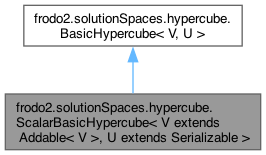
A BasicHypercube that contains only one utility, and no variables. More...
Public Member Functions | |
| ScalarBasicHypercube () | |
| Empty constructor. | |
| ScalarBasicHypercube (U utility, U infeasibleUtil) | |
| Constructor. | |
| void | writeExternal (ObjectOutput out) throws IOException |
| void | readExternal (ObjectInput in) throws IOException, ClassNotFoundException |
| long | getNumberOfSolutions () |
| Always returns 1. | |
| U | getUtility (V[] variables_values) |
| Ignores the input and always returns the utility of this scalar hypercube. | |
| U | getUtility (String[] variables_names, V[] variables_values) |
| Ignores the inputs and always returns the utility of this scalar hypercube. | |
| U | getUtility (long index) |
| Always returns the single utility value of this scalar hypercube. | |
| Class< U > | getClassOfU () |
| boolean | setUtility (V[] variables_values, U utility) |
| Ignores variables_values, and sets its single utility to utility. | |
| void | setUtility (long index, U utility) |
| Ignores index and sets this scalar hypercube's utility to utility. | |
| String[] | getVariables () |
| Returns the names of the variables of the hypercube. | |
| int | getNumberOfVariables () |
| Always returns 0. | |
| String | getVariable (int index) |
Always returns null. | |
| void | renameVariable (String oldName, String newName) |
| Does nothing. | |
| BasicHypercube< V, U > | renameAllVars (String[] newVarNames) |
| int | getIndex (String variable) |
| Always returns -1. | |
| V[][] | getDomains () |
Always returns null. | |
| V[] | getDomain (String variable) |
Always returns null. | |
| V[] | getDomain (int index) |
Always returns null. | |
| V[] | getDomain (String variable, int index) |
Always returns null. | |
| void | setDomain (String var, V[] dom) |
| Does nothing. | |
| String | toString () |
| String | prettyPrint (U unused) |
| void | augment (V[] variables_values) |
| void | augment (V[] variables_values, U utility_value) |
| ScalarBasicHypercube< V, U > | changeVariablesOrder (String[] variables_order) |
| Returns a clone. | |
| boolean | equivalent (BasicUtilitySolutionSpace< V, U > space) |
| Iterator< V, U > | iterator () |
| Iterator< V, U > | iterator (String[] variables) |
| Iterator< V, U > | iterator (String[] variables, V[][] domains, V[] assignment) |
| SparseIterator< V, U > | sparseIter () |
| SparseIterator< V, U > | sparseIter (String[] variables) |
| SparseIterator< V, U > | sparseIter (String[] variables, V[][] domains, V[] assignment) |
| boolean | isIncludedIn (BasicUtilitySolutionSpace< V, U > space) |
| SolutionSpace< V > | join (SolutionSpace< V > space, String[] total_variables) |
| SolutionSpace< V > | join (SolutionSpace< V > space) |
| Computes the join of this solutionSpace with the input solutionSpace. | |
| SolutionSpace< V > | join (SolutionSpace< V >[] spaces, String[] total_variables_order) |
| Returns a SolutionSpace object obtained by joining the SolutionSpace for which this method is called and the SolutionSpaces present in the array of SolutionSpaces given to this method as a parameter. | |
| BasicUtilitySolutionSpace< V, U > | slice (String var, V val) |
| Slices this hypercube over a single variable-value assignment. | |
| ScalarBasicHypercube< V, U > | slice (String[] variables_names, V[][] sub_domains) |
| Returns a clone. | |
| BasicUtilitySolutionSpace< V, U > | slice (V[] variables_values) |
| Return a slice of this hypercube. | |
| BasicHypercube< V, U > | compose (String[] vars, BasicUtilitySolutionSpace< V, ArrayList< V > > substitution) |
| Returns a constant hypercube. | |
| boolean | equals (Object o) |
| ScalarBasicHypercube< V, U > | clone () |
| U | getDefaultUtility () |
| void | setDefaultUtility (U utility) |
| Public Member Functions inherited from frodo2.solutionSpaces.hypercube.BasicHypercube< V, U > | |
| BasicHypercube (String[] variables_order, V[][] variables_domains, U[] utility_values, U infeasibleUtil) | |
| Construct a new BasicHypercube with provided variables names, the domains of these variables and the utility values. | |
| void | writeExternal (ObjectOutput out) throws IOException |
| void | readExternal (ObjectInput in) throws IOException, ClassNotFoundException |
| void | setProblem (ProblemInterface< V, ?> problem) |
| boolean | countsCCs () |
| long | getNumberOfSolutions () |
| Returns the number of utility values in the hypercube. | |
| U | getUtility (V[] variables_values) |
| U | getUtilityValueSameOrder (String[] variables_names, V[] variables_values) |
| Returns an object representing the utility value corresponding to the provided variables values. | |
| Class< U > | getClassOfU () |
| boolean | setUtility (V[] variables_values, U utility) |
| Sets the utility value corresponding to a given assignment to variables. | |
| String[] | getVariables () |
| Returns the names of the variables of the hypercube. | |
| int | getNumberOfVariables () |
| Returns the number of variables in the hypercube. | |
| String | getVariable (int index) |
| Returns the variable corresponding to the provided index. | |
| void | renameVariable (String oldName, String newName) |
| BasicHypercube< V, U > | renameAllVars (String[] newVarNames) |
| int | getIndex (String variable) |
| Return the index of the input variable in this hypercube. | |
| V[][] | getDomains () |
| Returns the array containing the domains of the variables. | |
| V[] | getDomain (String variable) |
| Returns an array all the possible values that the variable provided as a parameter can take in this hypercube. | |
| void | setDomain (String var, V[] dom) |
| String | toString () |
| String | prettyPrint (U ignoredUtil) |
| boolean | isNull () |
| Check if this hypercube is the NULL hypercube. | |
| void | augment (V[] variables_values, U utility_value) |
| BasicHypercube< V, U > | changeVariablesOrder (String[] variables_order) |
| Return a new BasicHypercube by changing the order of the variables of the hypercube. | |
| void | applyChangeVariablesOrder (String[] variables_order) |
| Changes the variable order of the hypercube by reordering the current utility array. | |
| BasicHypercube< V, U > | applyAugment (String[] new_variables, V[][] new_domains) |
| Augments the hypercube by adding new variables at the beginning of its variables list. | |
| boolean | equivalent (final BasicUtilitySolutionSpace< V, U > space) |
| boolean | isIncludedIn (BasicUtilitySolutionSpace< V, U > space) |
| Iterator< V, U > | iterator () |
| SparseIterator< V, U > | sparseIter () |
| SolutionSpace< V > | join (SolutionSpace< V > space, String[] total_variables) |
| BasicHypercube< V, U > | slice (String[] variables_names, V[][] sub_domains) |
| Return a slice of this hypercube. | |
| BasicHypercube< V, U > | applySlice (String[] variables_names, V[][] sub_domains) |
| Return a slice of this hypercube this version of slice does not create a new hypercube but directly modifies the current utility array. | |
| boolean | equals (Object o) |
| int | hashCode () |
| BasicHypercube< V, U > | clone () |
| BasicHypercube< V, U > | resolve () |
| BasicUtilitySolutionSpace< V, U > | compose (final String[] varsOut, final BasicUtilitySolutionSpace< V, ArrayList< V > > subst) |
| The composition operation. | |
| boolean | orderedDomains () |
| checks that the domains of the hypercube are ordered | |
| U | getDefaultUtility () |
| void | setDefaultUtility (U utility) |
| void | setInfeasibleUtility (U utility) |
| boolean | knows (Class<?> spaceClass) |
| String | getName () |
| void | setName (String name) |
| String | getRelationName () |
| void | setRelationName (String name) |
| String | getOwner () |
| void | setOwner (String owner) |
| Sets the owner. | |
Package Functions | |
| void | setStepsHashmaps () |
| Does nothing. | |
| Package Functions inherited from frodo2.solutionSpaces.hypercube.BasicHypercube< V, U > | |
| void | setStepsHashmaps () |
| Based on the hypercube parameters this method fills the steps Hashmap that maps each variable of the hypercube to another Hashmaps that maps each possible value of this variable to a step in the utility values array. | |
Private Attributes | |
| U | utility |
| The utility of this scalar hypercube. | |
Additional Inherited Members | |
| Static Public Member Functions inherited from frodo2.solutionSpaces.hypercube.BasicHypercube< V, U > | |
| static< T > T[] | sub (T[] array1, T[] array2) |
| Computes the subtraction of two arrays. | |
| static< V extends Addable< V > V[] | intersection (V[] array1, V[] array2) |
| Computes the intersection between two arrays. | |
| Protected Member Functions inherited from frodo2.solutionSpaces.hypercube.BasicHypercube< V, U > | |
| void | writeUtilities (ObjectOutput out) throws IOException |
| Serializes the utilities. | |
| void | readUtilities (ObjectInput in) throws ClassNotFoundException, IOException, InvocationTargetException, NoSuchMethodException |
| Deserializes the utilities. | |
| void | setNumberOfSolutions (int new_number_of_utilities) |
| Modifies the number of utility values in the hypercube (in case the utility array is bigger then the actual number of elements). | |
| void | incrNCCCs (long incr) |
| Increments the number of constraint checks. | |
| int | getIndexOfUtilityValue (V[] variables_values) |
| Returns the index of the utility value corresponding to the provided variables values. | |
| Iterator< V, U > | newIter (String[] variables, V[][] domains, V[] assignment, final U skippedUtil) |
| Creates a new iterator for this space. | |
| BasicHypercube< V, U > | newInstance (String name, String[] new_variables, V[][] new_domains, U[] new_values, U infeasibleUtil) |
| Creates a new instance of a BasicHypercube. | |
| BasicHypercube< V, U > | scalarHypercube (U utility) |
| Creates a new instance of a ScalarBasicHypercube. | |
| boolean | contains (String[] variables_names) |
| Checks if this hypercube contains the provided variables. | |
| boolean | notEmptyDomains (V[][] domains) |
| Checks that there is no empty domain in an array of domains. | |
| boolean | consistentOrder (BasicHypercube< V, U >[] hypercubes) |
| Checks that the variables order is consistent in all hypercubes. | |
| Protected Attributes inherited from frodo2.solutionSpaces.hypercube.BasicHypercube< V, U > | |
| String[] | variables |
| The names of the variables of the hypercube ordered according to their order in the hypercube. | |
| V[][] | domains |
| The domains of the variables of the hypercube. | |
| transient Class< V > | classOfV |
| The class of V. | |
| transient V[] | assignment |
| An array of size variables.length that can be reused, instead of creating a new array each time we need one. | |
| U[] | values |
| The utility values. | |
| ProblemInterface< V, ?> | problem |
| The problem that should be notified of constraint checks. | |
| int | number_of_utility_values |
| The actual number of utilities values in the array. | |
| transient HashMap< V, Integer >[] | steps_hashmaps |
| For each variable, a hashmap that maps every value in the domain of this variable to a step in the utility values array. | |
| String | name |
| The name of this space, if any. | |
| U | infeasibleUtil |
| -INF if we are maximizing, +INF if we are minimizing | |
| Static Package Functions inherited from frodo2.solutionSpaces.hypercube.BasicHypercube< V, U > | |
| [static initializer] | |
Detailed Description
A BasicHypercube that contains only one utility, and no variables.
- Parameters
-
<V> the type used for the variable values <U> the type used for the utility values
- Todo
- Test this class
Constructor & Destructor Documentation
◆ ScalarBasicHypercube() [1/2]
| frodo2.solutionSpaces.hypercube.ScalarBasicHypercube< V extends Addable< V >, U extends Serializable >.ScalarBasicHypercube | ( | ) |
Empty constructor.
Referenced by changeVariablesOrder(), clone(), equals(), and slice().
◆ ScalarBasicHypercube() [2/2]
| frodo2.solutionSpaces.hypercube.ScalarBasicHypercube< V extends Addable< V >, U extends Serializable >.ScalarBasicHypercube | ( | U | utility, |
| U | infeasibleUtil ) |
Constructor.
- Parameters
-
utility the utility of the scalar hypercube infeasibleUtil -INF if we are maximizing, +INF if we are minimizing
References frodo2.solutionSpaces.hypercube.BasicHypercube< V, U >.infeasibleUtil, and utility.
Member Function Documentation
◆ augment() [1/2]
| void frodo2.solutionSpaces.hypercube.ScalarBasicHypercube< V extends Addable< V >, U extends Serializable >.augment | ( | V[] | variables_values | ) |
- See also
- BasicHypercube#augment(Addable[])
- Todo
- Auto-generated method stub
◆ augment() [2/2]
| void frodo2.solutionSpaces.hypercube.ScalarBasicHypercube< V extends Addable< V >, U extends Serializable >.augment | ( | V[] | variables_values, |
| U | utility_value ) |
- See also
- BasicHypercube.augment(Addable[], java.io.Serializable)
- Todo
- Auto-generated method stub
◆ changeVariablesOrder()
| ScalarBasicHypercube< V, U > frodo2.solutionSpaces.hypercube.ScalarBasicHypercube< V extends Addable< V >, U extends Serializable >.changeVariablesOrder | ( | String[] | variables_order | ) |
Returns a clone.
- See also
- BasicHypercube.changeVariablesOrder(java.lang.String[])
References clone(), and ScalarBasicHypercube().

◆ clone()
| ScalarBasicHypercube< V, U > frodo2.solutionSpaces.hypercube.ScalarBasicHypercube< V extends Addable< V >, U extends Serializable >.clone | ( | ) |
- See also
- BasicHypercube.clone()
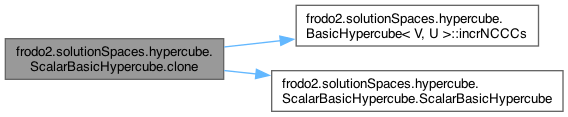
References frodo2.solutionSpaces.hypercube.BasicHypercube< V, U >.incrNCCCs(), frodo2.solutionSpaces.hypercube.BasicHypercube< V, U >.infeasibleUtil, and ScalarBasicHypercube().
Referenced by changeVariablesOrder(), compose(), and slice().
◆ compose()
| BasicHypercube< V, U > frodo2.solutionSpaces.hypercube.ScalarBasicHypercube< V extends Addable< V >, U extends Serializable >.compose | ( | String[] | vars, |
| BasicUtilitySolutionSpace< V, ArrayList< V > > | substitution ) |
Returns a constant hypercube.
- See also
- BasicHypercube.compose(java.lang.String[], BasicUtilitySolutionSpace)
- Todo
- Implement the case when the substitution is not a BasicHypercube
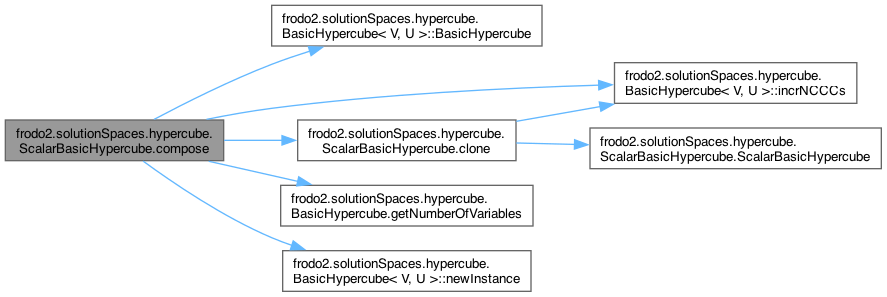
References frodo2.solutionSpaces.hypercube.BasicHypercube< V, U >.BasicHypercube(), clone(), frodo2.solutionSpaces.hypercube.BasicHypercube< V extends Addable< V >, U extends Serializable >.domains, frodo2.solutionSpaces.hypercube.BasicHypercube< V extends Addable< V >, U extends Serializable >.getNumberOfVariables(), frodo2.solutionSpaces.hypercube.BasicHypercube< V, U >.incrNCCCs(), frodo2.solutionSpaces.hypercube.BasicHypercube< V, U >.name, frodo2.solutionSpaces.hypercube.BasicHypercube< V, U >.newInstance(), frodo2.solutionSpaces.hypercube.BasicHypercube< V extends Addable< V >, U extends Serializable >.number_of_utility_values, frodo2.solutionSpaces.hypercube.BasicHypercube< V extends Addable< V >, U extends Serializable >.values, and frodo2.solutionSpaces.hypercube.BasicHypercube< V extends Addable< V >, U extends Serializable >.variables.
◆ equals()
| boolean frodo2.solutionSpaces.hypercube.ScalarBasicHypercube< V extends Addable< V >, U extends Serializable >.equals | ( | Object | o | ) |
- See also
- BasicHypercube.equals(java.lang.Object)
References getUtility(), frodo2.solutionSpaces.hypercube.BasicHypercube< V, U >.incrNCCCs(), ScalarBasicHypercube(), and utility.
Referenced by equivalent().

◆ equivalent()
| boolean frodo2.solutionSpaces.hypercube.ScalarBasicHypercube< V extends Addable< V >, U extends Serializable >.equivalent | ( | BasicUtilitySolutionSpace< V, U > | space | ) |
- See also
- BasicHypercube#equivalent(BasicUtilitySolutionSpace)
References equals().

◆ getClassOfU()
| Class< U > frodo2.solutionSpaces.hypercube.ScalarBasicHypercube< V extends Addable< V >, U extends Serializable >.getClassOfU | ( | ) |
- See also
- BasicHypercube.getClassOfU()
◆ getDefaultUtility()
| U frodo2.solutionSpaces.hypercube.ScalarBasicHypercube< V extends Addable< V >, U extends Serializable >.getDefaultUtility | ( | ) |
- Todo
- Auto-generated method stub
◆ getDomain() [1/3]
| V[] frodo2.solutionSpaces.hypercube.ScalarBasicHypercube< V extends Addable< V >, U extends Serializable >.getDomain | ( | int | index | ) |
Always returns null.
- See also
- BasicHypercube.getDomain(int)
◆ getDomain() [2/3]
| V[] frodo2.solutionSpaces.hypercube.ScalarBasicHypercube< V extends Addable< V >, U extends Serializable >.getDomain | ( | String | variable | ) |
Always returns null.
- See also
- BasicHypercube.getDomain(java.lang.String)
◆ getDomain() [3/3]
| V[] frodo2.solutionSpaces.hypercube.ScalarBasicHypercube< V extends Addable< V >, U extends Serializable >.getDomain | ( | String | variable, |
| int | index ) |
Always returns null.
- See also
- BasicHypercube.getDomain(java.lang.String, int)
◆ getDomains()
| V[][] frodo2.solutionSpaces.hypercube.ScalarBasicHypercube< V extends Addable< V >, U extends Serializable >.getDomains | ( | ) |
Always returns null.
- See also
- BasicHypercube.getDomains()
◆ getIndex()
| int frodo2.solutionSpaces.hypercube.ScalarBasicHypercube< V extends Addable< V >, U extends Serializable >.getIndex | ( | String | variable | ) |
Always returns -1.
- See also
- BasicHypercube.getIndex(java.lang.String)
◆ getNumberOfSolutions()
| long frodo2.solutionSpaces.hypercube.ScalarBasicHypercube< V extends Addable< V >, U extends Serializable >.getNumberOfSolutions | ( | ) |
Always returns 1.
◆ getNumberOfVariables()
| int frodo2.solutionSpaces.hypercube.ScalarBasicHypercube< V extends Addable< V >, U extends Serializable >.getNumberOfVariables | ( | ) |
Always returns 0.
◆ getUtility() [1/3]
| U frodo2.solutionSpaces.hypercube.ScalarBasicHypercube< V extends Addable< V >, U extends Serializable >.getUtility | ( | long | index | ) |
Always returns the single utility value of this scalar hypercube.
- See also
- BasicHypercube.getUtility(long)
References frodo2.solutionSpaces.hypercube.BasicHypercube< V, U >.incrNCCCs().

◆ getUtility() [2/3]
| U frodo2.solutionSpaces.hypercube.ScalarBasicHypercube< V extends Addable< V >, U extends Serializable >.getUtility | ( | String[] | variables_names, |
| V[] | variables_values ) |
Ignores the inputs and always returns the utility of this scalar hypercube.
- See also
- BasicHypercube.getUtility(java.lang.String[], Addable[])
References frodo2.solutionSpaces.hypercube.BasicHypercube< V, U >.incrNCCCs().

◆ getUtility() [3/3]
| U frodo2.solutionSpaces.hypercube.ScalarBasicHypercube< V extends Addable< V >, U extends Serializable >.getUtility | ( | V[] | variables_values | ) |
Ignores the input and always returns the utility of this scalar hypercube.
- See also
- BasicHypercube#getUtility(Addable[])
References frodo2.solutionSpaces.hypercube.BasicHypercube< V, U >.incrNCCCs().
Referenced by equals().

◆ getVariable()
| String frodo2.solutionSpaces.hypercube.ScalarBasicHypercube< V extends Addable< V >, U extends Serializable >.getVariable | ( | int | index | ) |
Always returns null.
- See also
- BasicHypercube.getVariable(int)
◆ getVariables()
| String[] frodo2.solutionSpaces.hypercube.ScalarBasicHypercube< V extends Addable< V >, U extends Serializable >.getVariables | ( | ) |
Returns the names of the variables of the hypercube.
- Returns
- String array containing the names of the variables of the hypercube
◆ isIncludedIn()
| boolean frodo2.solutionSpaces.hypercube.ScalarBasicHypercube< V extends Addable< V >, U extends Serializable >.isIncludedIn | ( | BasicUtilitySolutionSpace< V, U > | space | ) |
- See also
- BasicHypercube#isIncludedIn(BasicUtilitySolutionSpace)
- Todo
- Auto-generated method stub
◆ iterator() [1/3]
| Iterator< V, U > frodo2.solutionSpaces.hypercube.ScalarBasicHypercube< V extends Addable< V >, U extends Serializable >.iterator | ( | ) |
- See also
- BasicHypercube.iterator()
References frodo2.solutionSpaces.hypercube.BasicHypercube< V, U >.incrNCCCs(), and frodo2.solutionSpaces.hypercube.BasicHypercube< V, U >.infeasibleUtil.

◆ iterator() [2/3]
| Iterator< V, U > frodo2.solutionSpaces.hypercube.ScalarBasicHypercube< V extends Addable< V >, U extends Serializable >.iterator | ( | String[] | variables | ) |
References frodo2.solutionSpaces.hypercube.BasicHypercube< V, U >.incrNCCCs(), frodo2.solutionSpaces.hypercube.BasicHypercube< V, U >.infeasibleUtil, and frodo2.solutionSpaces.hypercube.BasicHypercube< V, U >.variables.

◆ iterator() [3/3]
| Iterator< V, U > frodo2.solutionSpaces.hypercube.ScalarBasicHypercube< V extends Addable< V >, U extends Serializable >.iterator | ( | String[] | variables, |
| V | domains[][], | ||
| V[] | assignment ) |
- See also
- BasicHypercube#iterator(String[], Addable[][])
References frodo2.solutionSpaces.hypercube.BasicHypercube< V, U >.assignment, frodo2.solutionSpaces.hypercube.BasicHypercube< V, U >.domains, frodo2.solutionSpaces.hypercube.BasicHypercube< V, U >.incrNCCCs(), frodo2.solutionSpaces.hypercube.BasicHypercube< V, U >.infeasibleUtil, and frodo2.solutionSpaces.hypercube.BasicHypercube< V, U >.variables.

◆ join() [1/3]
| SolutionSpace< V > frodo2.solutionSpaces.hypercube.ScalarBasicHypercube< V extends Addable< V >, U extends Serializable >.join | ( | SolutionSpace< V > | space | ) |
Computes the join of this solutionSpace with the input solutionSpace.
Order of variables is chosen as it fits.
- Todo
- Auto-generated method stub
◆ join() [2/3]
| SolutionSpace< V > frodo2.solutionSpaces.hypercube.ScalarBasicHypercube< V extends Addable< V >, U extends Serializable >.join | ( | SolutionSpace< V > | space, |
| String[] | total_variables ) |
- See also
- BasicHypercube.join(SolutionSpace, java.lang.String[])
- Todo
- Auto-generated method stub
◆ join() [3/3]
| SolutionSpace< V > frodo2.solutionSpaces.hypercube.ScalarBasicHypercube< V extends Addable< V >, U extends Serializable >.join | ( | SolutionSpace< V >[] | spaces, |
| String[] | total_variables_order ) |
Returns a SolutionSpace object obtained by joining the SolutionSpace for which this method is called and the SolutionSpaces present in the array of SolutionSpaces given to this method as a parameter.
- Parameters
-
spaces an array of the solutionSpaces to be added to this solutionSpace total_variables_order the order of the variables in all solutionSpaces
- Returns
- SolutionSpace object obtained by joining this SolutionSpace with all the SolutionSpaces in the array of SolutionSpaces Originally this function in the hypercubes assumes that order is not conflicting.
- Todo
- Auto-generated method stub
◆ prettyPrint()
| String frodo2.solutionSpaces.hypercube.ScalarBasicHypercube< V extends Addable< V >, U extends Serializable >.prettyPrint | ( | U | unused | ) |
- See also
- BasicHypercube.prettyPrint(java.io.Serializable)
References toString().

◆ readExternal()
| void frodo2.solutionSpaces.hypercube.ScalarBasicHypercube< V extends Addable< V >, U extends Serializable >.readExternal | ( | ObjectInput | in | ) | throws IOException, ClassNotFoundException |
- See also
- java.io.Externalizable#readExternal(java.io.ObjectInput)
References readExternal().
Referenced by readExternal().
◆ renameAllVars()
| BasicHypercube< V, U > frodo2.solutionSpaces.hypercube.ScalarBasicHypercube< V extends Addable< V >, U extends Serializable >.renameAllVars | ( | String[] | newVarNames | ) |
References frodo2.solutionSpaces.hypercube.BasicHypercube< V, U >.BasicHypercube().

◆ renameVariable()
| void frodo2.solutionSpaces.hypercube.ScalarBasicHypercube< V extends Addable< V >, U extends Serializable >.renameVariable | ( | String | oldName, |
| String | newName ) |
Does nothing.
◆ setDefaultUtility()
| void frodo2.solutionSpaces.hypercube.ScalarBasicHypercube< V extends Addable< V >, U extends Serializable >.setDefaultUtility | ( | U | utility | ) |
- See also
- BasicHypercube.setDefaultUtility(java.io.Serializable)
- Todo
- Auto-generated method stub
References utility.
◆ setDomain()
| void frodo2.solutionSpaces.hypercube.ScalarBasicHypercube< V extends Addable< V >, U extends Serializable >.setDomain | ( | String | var, |
| V[] | dom ) |
Does nothing.
- See also
- BasicHypercube#setDomain(String, Addable[])
◆ setStepsHashmaps()
|
package |
Does nothing.
◆ setUtility() [1/2]
| void frodo2.solutionSpaces.hypercube.ScalarBasicHypercube< V extends Addable< V >, U extends Serializable >.setUtility | ( | long | index, |
| U | utility ) |
Ignores index and sets this scalar hypercube's utility to utility.
- See also
- BasicHypercube.setUtility(long, java.io.Serializable)
References utility.
◆ setUtility() [2/2]
| boolean frodo2.solutionSpaces.hypercube.ScalarBasicHypercube< V extends Addable< V >, U extends Serializable >.setUtility | ( | V[] | variables_values, |
| U | utility ) |
Ignores variables_values, and sets its single utility to utility.
- See also
- BasicHypercube.setUtility(Addable[], java.io.Serializable)
References utility.
◆ slice() [1/3]
| BasicUtilitySolutionSpace< V, U > frodo2.solutionSpaces.hypercube.ScalarBasicHypercube< V extends Addable< V >, U extends Serializable >.slice | ( | String | var, |
| V | val ) |
Slices this hypercube over a single variable-value assignment.
- Parameters
-
var the variable to be assigned a value val the value to assign to the variable
- Returns
- the hypercube resulting from this slice
- Todo
- implement it
◆ slice() [2/3]
| ScalarBasicHypercube< V, U > frodo2.solutionSpaces.hypercube.ScalarBasicHypercube< V extends Addable< V >, U extends Serializable >.slice | ( | String[] | variables_names, |
| V | sub_domains[][] ) |
Returns a clone.
- See also
- BasicHypercube.slice(java.lang.String[], Addable[][])
References clone(), and ScalarBasicHypercube().

◆ slice() [3/3]
| BasicUtilitySolutionSpace< V, U > frodo2.solutionSpaces.hypercube.ScalarBasicHypercube< V extends Addable< V >, U extends Serializable >.slice | ( | V[] | variables_values | ) |
Return a slice of this hypercube.
- Parameters
-
variables_values array containing values of the last variables of the hypercube
- Returns
- Hypercube object obtained by associating fixed values to the last variables of the hypercube. the number of this variables depends on the length of the provided array of variables values
- Todo
- implement it.
◆ sparseIter() [1/3]
| SparseIterator< V, U > frodo2.solutionSpaces.hypercube.ScalarBasicHypercube< V extends Addable< V >, U extends Serializable >.sparseIter | ( | ) |
- See also
- BasicHypercube.sparseIter()
References frodo2.solutionSpaces.hypercube.BasicHypercube< V, U >.incrNCCCs(), and frodo2.solutionSpaces.hypercube.BasicHypercube< V, U >.infeasibleUtil.

◆ sparseIter() [2/3]
| SparseIterator< V, U > frodo2.solutionSpaces.hypercube.ScalarBasicHypercube< V extends Addable< V >, U extends Serializable >.sparseIter | ( | String[] | variables | ) |
References frodo2.solutionSpaces.hypercube.BasicHypercube< V, U >.incrNCCCs(), frodo2.solutionSpaces.hypercube.BasicHypercube< V, U >.infeasibleUtil, and frodo2.solutionSpaces.hypercube.BasicHypercube< V, U >.variables.

◆ sparseIter() [3/3]
| SparseIterator< V, U > frodo2.solutionSpaces.hypercube.ScalarBasicHypercube< V extends Addable< V >, U extends Serializable >.sparseIter | ( | String[] | variables, |
| V | domains[][], | ||
| V[] | assignment ) |
- See also
- BasicHypercube#sparseIter(String[], Addable[][])
References frodo2.solutionSpaces.hypercube.BasicHypercube< V, U >.assignment, frodo2.solutionSpaces.hypercube.BasicHypercube< V, U >.domains, frodo2.solutionSpaces.hypercube.BasicHypercube< V, U >.incrNCCCs(), frodo2.solutionSpaces.hypercube.BasicHypercube< V, U >.infeasibleUtil, and frodo2.solutionSpaces.hypercube.BasicHypercube< V, U >.variables.

◆ toString()
| String frodo2.solutionSpaces.hypercube.ScalarBasicHypercube< V extends Addable< V >, U extends Serializable >.toString | ( | ) |
◆ writeExternal()
| void frodo2.solutionSpaces.hypercube.ScalarBasicHypercube< V extends Addable< V >, U extends Serializable >.writeExternal | ( | ObjectOutput | out | ) | throws IOException |
- See also
- java.io.Externalizable#writeExternal(java.io.ObjectOutput)
References frodo2.solutionSpaces.hypercube.BasicHypercube< V, U >.incrNCCCs(), frodo2.solutionSpaces.hypercube.BasicHypercube< V, U >.infeasibleUtil, and frodo2.solutionSpaces.hypercube.BasicHypercube< V, U >.name.

Member Data Documentation
◆ utility
|
private |
The utility of this scalar hypercube.
Referenced by equals(), ScalarBasicHypercube(), setDefaultUtility(), setUtility(), setUtility(), and toString().
The documentation for this class was generated from the following file:
- src/frodo2/solutionSpaces/hypercube/ScalarBasicHypercube.java
