|
| | Daemon (boolean useUI) |
| | The constructor.
|
| | Daemon (boolean useUI, int port) |
| | The constructor.
|
| | Daemon (boolean useUI, int port, String workDir) |
| | The constructor.
|
| | Daemon (AgentAddress controllerAddress, boolean useUI) |
| | A constructor that tells the daemon the controller's address.
|
| | Daemon (AgentAddress controllerAddress, boolean useUI, String workDir) |
| | A constructor that tells the daemon the controller's address.
|
| | Daemon (AgentAddress controllerAddress, boolean useUI, int port) |
| | A constructor that tells the daemon the controller's address.
|
| | Daemon (AgentAddress controllerAddress, boolean useUI, int port, String workDir) |
| | A constructor that tells the daemon the controller's address.
|
| int | getPort () |
| Collection< String > | getAgents () |
| | get the list of agents running under this daemon
|
| void | addAgent (String ID, AgentInterface<?> agent) |
| | Add an agent to the list of agents.
|
| void | addOutputPipe (String fromID, String toID, QueueOutputPipeInterface pipe) |
| | Add agent toID's input pipe as an output pipe to agent fromID's queue.
|
| void | registerDaemon () |
| | Register the daemon to the controller.
|
| QueueIOPipe | getInput () |
| | Getter for the Daemons internal input pipe.
|
| void | clearAgents () |
| | Delete the pointers to all agents that are running.
|
| void | exit (boolean quit) |
| | Exit the daemon.
|
|
| static void | main (String[] args) |
|
| static final String | DAEMON = "frodo2.daemon.Daemon" |
| | The id of the daemon.
|
|
| Queue | daemonQueue |
| | The daemons queue.
|
| boolean | isFinished = false |
| | When the controller is non-omniscient, keeps track of whether the daemon has run out of problem instances to solve.
|
|
| void | init (boolean useUI, String workDir) |
| | Initialisation.
|
- Author
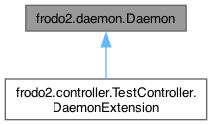
- Brammert Ottens, Thomas Leaute This is the client side daemon that spawns new agents for the experiments
◆ Daemon() [1/7]
| frodo2.daemon.Daemon.Daemon |
( |
boolean | useUI | ) |
|
The constructor.
- Parameters
-
| useUI | whether or not to use the User Interface |
References DEFAULT_PORT.
Referenced by Daemon(), and main().
◆ Daemon() [2/7]
| frodo2.daemon.Daemon.Daemon |
( |
boolean | useUI, |
|
|
int | port ) |
The constructor.
- Parameters
-
| useUI | whether or not to use the User Interface |
| port | the port number the daemon listens on |
References port.
◆ Daemon() [3/7]
| frodo2.daemon.Daemon.Daemon |
( |
boolean | useUI, |
|
|
int | port, |
|
|
String | workDir ) |
The constructor.
- Parameters
-
| useUI | whether or not to use the User Interface |
| port | the port number the daemon listens on |
| workDir | the working directory |
References init(), and port.
◆ Daemon() [4/7]
| frodo2.daemon.Daemon.Daemon |
( |
AgentAddress | controllerAddress, |
|
|
boolean | useUI ) |
A constructor that tells the daemon the controller's address.
- Parameters
-
| controllerAddress | address of the controller |
| useUI | whether or not to use the User Interface |
◆ Daemon() [5/7]
| frodo2.daemon.Daemon.Daemon |
( |
AgentAddress | controllerAddress, |
|
|
boolean | useUI, |
|
|
String | workDir ) |
A constructor that tells the daemon the controller's address.
- Parameters
-
| controllerAddress | address of the controller |
| useUI | whether or not to use the User Interface |
| workDir | the working directory |
References Daemon().
◆ Daemon() [6/7]
| frodo2.daemon.Daemon.Daemon |
( |
AgentAddress | controllerAddress, |
|
|
boolean | useUI, |
|
|
int | port ) |
A constructor that tells the daemon the controller's address.
- Parameters
-
| controllerAddress | address of the controller |
| useUI | whether or not to use the User Interface |
| port | the port number the daemon listens on |
References port.
◆ Daemon() [7/7]
| frodo2.daemon.Daemon.Daemon |
( |
AgentAddress | controllerAddress, |
|
|
boolean | useUI, |
|
|
int | port, |
|
|
String | workDir ) |
A constructor that tells the daemon the controller's address.
- Parameters
-
| controllerAddress | address of the controller |
| useUI | whether or not to use the User Interface |
| port | the port number the daemon listens on |
| workDir | the working directory |
References init(), port, and ui.
◆ addAgent()
| void frodo2.daemon.Daemon.addAgent |
( |
String | ID, |
|
|
AgentInterface<?> | agent ) |
Add an agent to the list of agents.
- Parameters
-
| ID | ID of the agent |
| agent | the agent itself |
References agentList.
◆ addOutputPipe()
Add agent toID's input pipe as an output pipe to agent fromID's queue.
- Parameters
-
| fromID | ID of the sender agent |
| toID | ID of the recipient agent |
| pipe | the pipe the sender should use to send messages to the recipient |
References agentList.
◆ clearAgents()
| void frodo2.daemon.Daemon.clearAgents |
( |
| ) |
|
Delete the pointers to all agents that are running.
Used to clear up after an experiment.
References agentList.
◆ exit()
| void frodo2.daemon.Daemon.exit |
( |
boolean | quit | ) |
|
◆ getAgents()
| Collection< String > frodo2.daemon.Daemon.getAgents |
( |
| ) |
|
get the list of agents running under this daemon
- Returns
- a collection of agent names
References agentList.
◆ getInput()
◆ getPort()
| int frodo2.daemon.Daemon.getPort |
( |
| ) |
|
- Returns
- the port number that the daemon listens on
◆ init()
| void frodo2.daemon.Daemon.init |
( |
boolean | useUI, |
|
|
String | workDir ) |
|
private |
Initialisation.
- Parameters
-
| useUI | whether or not to use the User Interface |
| workDir | the working directory |
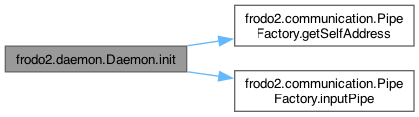
References agentList, constructor, daemonAddress, daemonId, daemonQueue, frodo2.communication.PipeFactory.getSelfAddress(), inputInternal, frodo2.communication.PipeFactory.inputPipe(), lwp, frodo2.controller.Controller.PipeFactoryInstance, port, and ui.
Referenced by Daemon(), and Daemon().
◆ main()
| void frodo2.daemon.Daemon.main |
( |
String[] | args | ) |
|
|
static |
◆ registerDaemon()
| void frodo2.daemon.Daemon.registerDaemon |
( |
| ) |
|
◆ agentList
◆ configMan
The local configuration manager.
◆ constructor
the constructor
Referenced by init().
◆ DAEMON
| final String frodo2.daemon.Daemon.DAEMON = "frodo2.daemon.Daemon" |
|
static |
◆ daemonAddress
◆ daemonId
| String frodo2.daemon.Daemon.daemonId |
◆ daemonQueue
| Queue frodo2.daemon.Daemon.daemonQueue |
|
protected |
◆ DEFAULT_PORT
| final int frodo2.daemon.Daemon.DEFAULT_PORT = 25000 |
|
staticprivate |
◆ inputInternal
◆ isFinished
| boolean frodo2.daemon.Daemon.isFinished = false |
|
protected |
◆ lwp
Local white pages.
Referenced by init().
◆ port
| int frodo2.daemon.Daemon.port |
|
private |
◆ ui
| UserIO frodo2.daemon.Daemon.ui |
|
private |
The documentation for this class was generated from the following file: