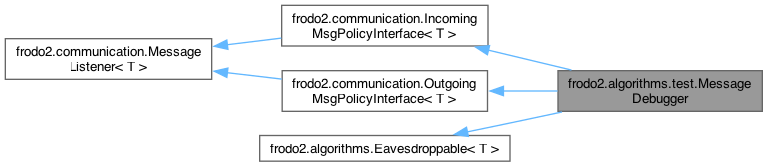
Prints out all messages received and sent by the agent. More...
Public Member Functions | |
| MessageDebugger (DCOPProblemInterface<?, ?> problem, Element params) | |
| Constructor. | |
| void | setQueue (Queue queue) |
| Collection< MessageType > | getMsgTypes () |
| Decision | notifyOut (Message msg) |
| Decision | notifyOut (Object fromAgent, Message msg, Collection<? extends Object > toAgents) |
| void | notifyIn (Message msg) |
| void | notifyIn (Message msg, Object toAgent) |
| MessageDebugger | getEavesdropper () |
| Public Member Functions inherited from frodo2.communication.OutgoingMsgPolicyInterface< T > | |
| default Decision | notifyOut (Object fromAgent, Message msg) |
| Notifies the listener of an outgoing message. | |
| default Decision | notifyOut (Message msg, Collection<? extends Object > toAgents) |
| Notifies the listener of an outgoing message. | |
Private Member Functions | |
| MessageDebugger (DCOPProblemInterface<?, ?> problem, boolean perAgent, boolean hideSystemMessages, String vizClassName) | |
| Constructor. | |
| Visualizer | createVisualizer () |
Private Attributes | |
| final String | agent |
| The name of this agent. | |
| final boolean | hideSystemMessages |
| Whether to display system messages. | |
| boolean | perAgent = false |
| If true, the eavesdropper will be added to each agent's queue and report message exchanged. | |
| final String | vizClassName |
| The class name for the Visualizer. | |
| final Visualizer | viz |
| The Visualizer used to display the messages exchanged. | |
| final DCOPProblemInterface<?, ?> | problem |
| The problem instance. | |
Detailed Description
Prints out all messages received and sent by the agent.
- Warning
- Printing out all messages exchanges can be computationally expensive. Only use this feature for debugging purposes.
Constructor & Destructor Documentation
◆ MessageDebugger() [1/2]
| frodo2.algorithms.test.MessageDebugger.MessageDebugger | ( | DCOPProblemInterface<?, ?> | problem, |
| Element | params ) |
Constructor.
- Parameters
-
problem the problem instance params the parameters for this module
References createVisualizer(), and problem.
Referenced by getEavesdropper().

◆ MessageDebugger() [2/2]
|
private |
Constructor.
- Parameters
-
problem the problem instance perAgent if true, the eavesdropper will be added to each agent's queue and report message exchanged hideSystemMessages whether to display system messages vizClassName the class name for the Visualizer
References createVisualizer(), hideSystemMessages, perAgent, problem, and vizClassName.

Member Function Documentation
◆ createVisualizer()
|
private |
- Returns
- a Visualizer of the class specified in the agent config
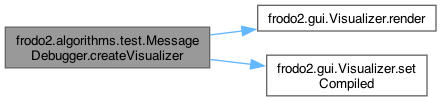
References frodo2.gui.Visualizer.render(), and frodo2.gui.Visualizer.setCompiled().
Referenced by MessageDebugger(), and MessageDebugger().
◆ getEavesdropper()
| MessageDebugger frodo2.algorithms.test.MessageDebugger.getEavesdropper | ( | ) |
- See also
- Eavesdroppable.getEavesdropper()
Implements frodo2.algorithms.Eavesdroppable< T >.
References MessageDebugger().

◆ getMsgTypes()
| Collection< MessageType > frodo2.algorithms.test.MessageDebugger.getMsgTypes | ( | ) |
Implements frodo2.communication.MessageListener< T >.
References frodo2.communication.MessageType.ROOT.
◆ notifyIn() [1/2]
| void frodo2.algorithms.test.MessageDebugger.notifyIn | ( | Message | msg | ) |
Implements frodo2.communication.IncomingMsgPolicyInterface< T >.
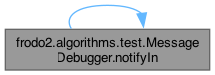
References notifyIn().
Referenced by notifyIn().
◆ notifyIn() [2/2]
| void frodo2.algorithms.test.MessageDebugger.notifyIn | ( | Message | msg, |
| Object | toAgent ) |
Implements frodo2.communication.IncomingMsgPolicyInterface< T >.
References frodo2.communication.Message.getType(), frodo2.communication.MessageType.isParent(), frodo2.gui.Visualizer.showIncomingAgentMessage(), and frodo2.communication.MessageType.SYSTEM.

◆ notifyOut() [1/2]
Implements frodo2.communication.OutgoingMsgPolicyInterface< T >.
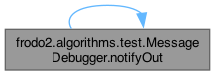
References notifyOut().
Referenced by notifyOut().
◆ notifyOut() [2/2]
| Decision frodo2.algorithms.test.MessageDebugger.notifyOut | ( | Object | fromAgent, |
| Message | msg, | ||
| Collection<? extends Object > | toAgents ) |
- See also
- OutgoingMsgPolicyInterface#notifyOut(Object, Message, Collection)
Implements frodo2.communication.OutgoingMsgPolicyInterface< T >.
References frodo2.controller.Controller.CONTROLLER, frodo2.daemon.Daemon.DAEMON, frodo2.communication.OutgoingMsgPolicyInterface< T >.Decision.DONTCARE, frodo2.communication.Message.getType(), frodo2.communication.MessageType.isParent(), frodo2.gui.Visualizer.showOutgoingAgentMessage(), frodo2.algorithms.AgentInterface< V extends Addable< V > >.STATS_MONITOR, and frodo2.communication.MessageType.SYSTEM.

◆ setQueue()
| void frodo2.algorithms.test.MessageDebugger.setQueue | ( | Queue | queue | ) |
Implements frodo2.communication.MessageListener< T >.
Member Data Documentation
◆ agent
|
private |
The name of this agent.
◆ hideSystemMessages
|
private |
Whether to display system messages.
Referenced by MessageDebugger().
◆ perAgent
|
private |
If true, the eavesdropper will be added to each agent's queue and report message exchanged.
Referenced by MessageDebugger().
◆ problem
|
private |
The problem instance.
Referenced by MessageDebugger(), and MessageDebugger().
◆ viz
|
private |
The Visualizer used to display the messages exchanged.
◆ vizClassName
|
private |
The class name for the Visualizer.
Referenced by MessageDebugger().
The documentation for this class was generated from the following file:
- src/frodo2/algorithms/test/MessageDebugger.java
