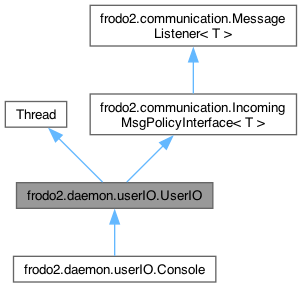
Public Member Functions | |
| UserIO (Daemon daemon) | |
| Constructor. | |
| void | start () |
| void | load (String filename) |
| Used to load a new configuration file. | |
| Collection< MessageType > | getMsgTypes () |
| void | notifyIn (Message msg) |
| void | setQueue (Queue queue) |
| void | registerController (AgentAddress address) |
| Report the daemon to the controller. | |
| void | exit () |
| Quit the daemon;. | |
| abstract void | tellUser (String message) |
| Give a message to the user. | |
| abstract void | stopRunning () |
| Stop the user interface. | |
| Public Member Functions inherited from frodo2.communication.IncomingMsgPolicyInterface< T > | |
| default void | notifyIn (Message msg, Object toAgent) |
| Notifies the listener of an incoming message. | |
Package Attributes | |
| Daemon | daemon |
| The daemon this UI belongs to. | |
| Queue | queue |
| the daemons queue | |
Private Attributes | |
| ArrayList< MessageType > | msgTypes = new ArrayList <MessageType> () |
| The list of messages types this listener wants to be notified of. | |
Detailed Description
Constructor & Destructor Documentation
◆ UserIO()
| frodo2.daemon.userIO.UserIO.UserIO | ( | Daemon | daemon | ) |
- Parameters
-
daemon the daemon
References frodo2.controller.ConfigurationManager.AGENT_CONFIGURATION_MESSAGE, daemon, frodo2.controller.WhitePages.KILL_AGENTS, msgTypes, and frodo2.controller.userIO.UserIO.USER_NOTIFICATION_MSG.
Member Function Documentation
◆ exit()
| void frodo2.daemon.userIO.UserIO.exit | ( | ) |
◆ getMsgTypes()
| Collection< MessageType > frodo2.daemon.userIO.UserIO.getMsgTypes | ( | ) |
Implements frodo2.communication.MessageListener< T >.
References msgTypes.
◆ load()
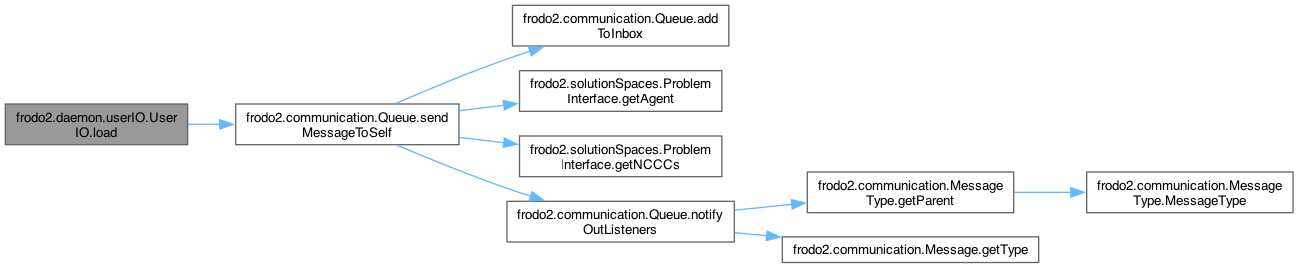
| void frodo2.daemon.userIO.UserIO.load | ( | String | filename | ) |
Used to load a new configuration file.
- Parameters
-
filename the file to be loaded
References frodo2.controller.userIO.UserIO.CONFIGURATION_MSG, and frodo2.communication.Queue.sendMessageToSelf().
Referenced by frodo2.daemon.userIO.Console.parseInput().
◆ notifyIn()
| void frodo2.daemon.userIO.UserIO.notifyIn | ( | Message | msg | ) |
Implements frodo2.communication.IncomingMsgPolicyInterface< T >.
References notifyIn(), tellUser(), and frodo2.controller.userIO.UserIO.USER_NOTIFICATION_MSG.
Referenced by notifyIn().

◆ registerController()
| void frodo2.daemon.userIO.UserIO.registerController | ( | AgentAddress | address | ) |
Report the daemon to the controller.
- Parameters
-
address of the controller
References frodo2.daemon.LocalWhitePages.CONTROLLER_ID, daemon, frodo2.controller.messages.MessageAgentReporting.DEAMON_REPORTING, frodo2.output, frodo2.communication.PipeFactory.outputPipe(), frodo2.controller.Controller.PipeFactoryInstance, and queue.
Referenced by frodo2.daemon.userIO.Console.parseInput().

◆ setQueue()
| void frodo2.daemon.userIO.UserIO.setQueue | ( | Queue | queue | ) |
Implements frodo2.communication.MessageListener< T >.
References queue.
◆ start()
| void frodo2.daemon.userIO.UserIO.start | ( | ) |
- See also
- java.lang.Thread#start()
◆ stopRunning()
|
abstract |
Stop the user interface.
Reimplemented in frodo2.daemon.userIO.Console.
◆ tellUser()
|
abstract |
Give a message to the user.
- Parameters
-
message the message to be presented to the user
Reimplemented in frodo2.daemon.userIO.Console.
Referenced by notifyIn().
Member Data Documentation
◆ daemon
|
package |
The daemon this UI belongs to.
Referenced by frodo2.daemon.userIO.Console.Console(), exit(), registerController(), and UserIO().
◆ msgTypes
|
private |
The list of messages types this listener wants to be notified of.
Referenced by getMsgTypes(), and UserIO().
◆ queue
|
package |
the daemons queue
Referenced by registerController(), and setQueue().
The documentation for this class was generated from the following file:
- src/frodo2/daemon/userIO/UserIO.java
