Module that intercepts messages during UTIL and VALUE propagation and obfuscates the variable names, variable domains, and utility values. More...

Public Member Functions | |
| VariableObfuscation (DCOPProblemInterface< V, U > problem, Element parameters) | |
| Constructor. | |
| Decision | notifyOut (Message msg) |
| Collection< MessageType > | getMsgTypes () |
| void | setQueue (Queue queue) |
| void | notifyIn (Message msg) |
| Public Member Functions inherited from frodo2.communication.OutgoingMsgPolicyInterface< T > | |
| default Decision | notifyOut (Object fromAgent, Message msg) |
| Notifies the listener of an outgoing message. | |
| default Decision | notifyOut (Object fromAgent, Message msg, Collection<? extends Object > toAgents) |
| Notifies the listener of an outgoing message. | |
| default Decision | notifyOut (Message msg, Collection<? extends Object > toAgents) |
| Notifies the listener of an outgoing message. | |
| Public Member Functions inherited from frodo2.communication.IncomingMsgPolicyInterface< T > | |
| default void | notifyIn (Message msg, Object toAgent) |
| Notifies the listener of an incoming message. | |
Static Public Attributes | |
| static final MessageType | CODE_NAME_TYPE = new MessageType ("P-DPOP", "VariableObfuscation", "Code_Name") |
| The type of the messages containing code names. | |
| static final MessageType | OBFUSCATED_VALUE_TYPE = new MessageType ("P-DPOP", "VariableObfuscation", "VALUE") |
| The type of obfuscated VALUE messages. | |
| static final MessageType | OBFUSCATED_UTIL_TYPE = new MessageType ("P-DPOP", "VariableObfuscation", "UTIL") |
| The type of obfuscated UTIL messages. | |
Private Member Functions | |
| void | generateCodeName (String var) |
| In mergeBack mode: Generates one codeName for the input variable Without mergeBack mode: Initiate general codeName map only. | |
| void | generateUtilObfuscKeys (String var) |
| In mergeBack mode: Generates a range of utilityKey for the input variable Without mergeBack mode: Initiate general utilityKey map only. | |
| void | generateNewCodeName (String myVar, String child) |
| Generates a new codeName and new utility keys for the couple myVar-child and add it in the corresponding generals tables. | |
| void | initiateAllMaps (String var) |
| Initiates all maps for the input variable. | |
| String | randomCodeName () |
| Create a random integer of 32 bits and return it in hex-decimal string form. | |
| V[] | randomDomain (V[] initDom) |
| Generates a domain of random numbers. | |
| V | getTranslatedValue (String myVar, String other, V value, boolean decode) |
| Translates (decodes or encodes) a specified value of the domain of variable other. | |
| void | init () |
| Initiates the variableObfuscation module. | |
| void | init (String var) |
| Initiates all datastructures related to the input variable. | |
| void | generateObfuscatedDomains (String var) |
| In mergeBack mode: Generates an obfuscated domain for the input variable. | |
| void | sendDelayedMsg (String myVar) |
| Send the delayed UTILmsg. | |
| void | addReverseMap (String parent, String myVar, String codeName, V[] domain, V[] obfuscatedDomain, AddableBigInteger[] utilityKeys) |
| Puts in the reverse maps the assignment codeName-variable and parent-domain for a given child variable. | |
| String | decodeCodeName (String myVar, String codeName) |
| Returns the variable assigned with the given codeName if and only if the variable who want to decode is a child or a pseudo child of the coded variable. | |
| String | encodeCodeName (String myVar, String parent) |
| Returns the codeName assigned with the given parent if and only if the variable who wants to decode is a child or a pseudo child of the coded variable. | |
| V[] | decodeDomain (String myVar, String parent) |
| Returns the parent's cleartext domain if and only if the variable who wants to decode is a child or wants to decode its own domain. | |
| V[] | encodeDomain (String myVar, String parent) |
| Returns the parent's obfuscated domain if and only if the variable who wants to obfuscate is a child or wants to obfuscate its own domain. | |
| AddableBigInteger[] | encryptUtility (String myVar, String parent) |
| AddableBigInteger[] | decryptUtility (String myVar, String child) |
| AddableBigInteger[] | decryptMySelfUtility (String myVar, String child) |
Private Attributes | |
| Random | rand = new SecureRandom() |
| A random Stream. | |
| Map< String, String > | codeNamesMerged = new HashMap<String, String>() |
| A Map containing assignments variable-codeName with mergeBack. | |
| Map< String, Map< String, String > > | codeNamesUnique = new HashMap<String, Map<String, String>>() |
| A Map containing assignment variable-codeName without mergeBack: (Pseudo-)Parent - Child - CodeName. | |
| Map< String, V[]> | obfuscatedMergedDomains = new HashMap<String, V[]>() |
| A Map containing assignments variable-domain with mergeBack. | |
| Map< String, Map< String, V[]> > | obfuscatedUniqueDomains = new HashMap<String, Map<String, V[]>>() |
| A Map containing assignments variable-domain without mergeBack: (Pseudo-)Parent - Child - Domain. | |
| Map< String, AddableBigInteger[]> | utilKeyMerged = new HashMap<String, AddableBigInteger[]>() |
| A Map containing assignments of obfuscation keys to all variables of this agent. | |
| Map< String, Map< String, AddableBigInteger[]> > | utilKeyUnique = new HashMap<String, Map<String, AddableBigInteger[]>>() |
| A Map containing assignments of obfuscation keys without mergeBack: (Pseudo-)Parent - Child - UtilKey. | |
| Map< String, Map< String, String > > | decodeCodeName = new HashMap<String, Map<String, String>>() |
| Map for all variables of this agent of reverse map assignment codeName-variable of their (pseudo-)parents: Child - Parents' CodeName - (Pseudo-)Parent. | |
| Map< String, Map< String, String > > | encodeParent = new HashMap<String, Map<String, String>>() |
| Map for all variables of this agent of map assignment variable-codeName of their (pseudo-)parents: Child - (Pseudo-)Parent - Parents' CodeName. | |
| Map< String, Map< String, List< V[]> > > | decodeDomains = new HashMap<String, Map< String, List<V[]> >>() |
| Map for all variables of this agent of map assignment variable-domain of their (pseudo-)parents: Child - (Pseudo-)Parent - Domain. | |
| Map< String, Map< String, AddableBigInteger[]> > | receivedUtilKey = new HashMap<String, Map<String, AddableBigInteger[]>>() |
| Map for all variables of this agent of maps of variable-utility obfuscation key assignments Child - (Pseudo-)Parent - Utility key. | |
| Map< String, Map< String, AddableBigInteger[]> > | ownUtilKey = new HashMap<String, Map<String, AddableBigInteger[]>>() |
| own - (myChild OR myCodeName sent to myChild) - myUTIL | |
| Map< String, Integer > | numDecrypt = new HashMap<String, Integer>() |
| Map with : Parent - Number of time utilities in UTILmsg must be decrypted. | |
| Map< String, String > | parents = new HashMap<String, String>() |
| The true parent of each of this agent's variables in the DFS. | |
| final boolean | mergeBack |
| If mergeBackEdges are allowed. | |
| final AddableBigInteger | infeasibleUtil |
| Long.MIN_VALUE if the problem is a maximization problem, Long.MAX_VALUE otherwise. | |
| final int | numBits |
| The size of the BigInteger for the utility obfuscation. | |
| final int | default_numBits = 128 |
| The size by default of the BigInteger used for utility obfuscation. | |
| Map< String, Integer > | incomingExpected = new HashMap<String, Integer>() |
| For each internal variable, the number of codeName messages it is still expecting. | |
| Map< String, ArrayList< UTILmsg< V, AddableBigInteger > > > | waitingMsg = new HashMap<String, ArrayList<UTILmsg<V, AddableBigInteger>>>() |
| Set of all waiting msg. | |
| Map< String, Boolean > | hasDecoded = new HashMap<String, Boolean>() |
| Map that says if a variable has decoded a UTIL. | |
| Map< String, Map< String, ArrayList< String > > > | utilContent = new HashMap<String, Map<String, ArrayList<String>>>() |
| Map with the UTIL codeNames received (used without mergeBack). | |
| Queue | queue |
| The agent's queue. | |
| boolean | started = false |
| Whether the algorithm has already started. | |
| DCOPProblemInterface< V, U > | problem |
| Problem description. | |
Detailed Description
Module that intercepts messages during UTIL and VALUE propagation and obfuscates the variable names, variable domains, and utility values.
- Parameters
-
<V> the type used for variable values <U> the type used for utility values, in stats gatherer mode only (in normal mode, AddableBigInteger is used)
Constructor & Destructor Documentation
◆ VariableObfuscation()
| frodo2.algorithms.dpop.privacy.VariableObfuscation< V extends Addable< V >, U extends Addable< U > >.VariableObfuscation | ( | DCOPProblemInterface< V, U > | problem, |
| Element | parameters ) |
Constructor.
- Parameters
-
problem problem description parameters if mergeBackEdges feature is used or not
References default_numBits, infeasibleUtil, mergeBack, numBits, problem, and VariableObfuscation().
Referenced by sendDelayedMsg(), and VariableObfuscation().
Member Function Documentation
◆ addReverseMap()
|
private |
Puts in the reverse maps the assignment codeName-variable and parent-domain for a given child variable.
- Parameters
-
parent the parent that sent this message myVar the given child variable that received the assignment codeName-variable from its parent codeName The code name of the parent domain the domain of the parent variable, in cleartext obfuscatedDomain the obfuscated domain of the parent utilityKeys the utility obfuscation keys of the parent
References decodeCodeName, decodeDomains, encodeParent, and receivedUtilKey.
Referenced by notifyOut().
◆ decodeCodeName()
|
private |
Returns the variable assigned with the given codeName if and only if the variable who want to decode is a child or a pseudo child of the coded variable.
Else, return null
- Parameters
-
myVar the variable who want to decode the codeName codeName the codeName to decode
- Returns
- the variable which correspond to the code name or null if this knowledge is unknown
References decodeCodeName.
◆ decodeDomain()
|
private |
Returns the parent's cleartext domain if and only if the variable who wants to decode is a child or wants to decode its own domain.
Else, returns null
- Parameters
-
myVar the variable who want to decode the domain parent the parent whose domain has to be decoded
- Returns
- The parent's cleartext domain. Or null if this parent's cleartext domain is unknown.
References decodeDomains.
Referenced by getTranslatedValue().
◆ decryptMySelfUtility()
|
private |
- Parameters
-
myVar the variable that wants to decrypt its own utility keys child the child to whom myVar has sent this utilityKey
- Returns
- a tab with the utility keys of inverse sign
References frodo2.solutionSpaces.crypto.AddableBigInteger.flipSign(), and ownUtilKey.

◆ decryptUtility()
|
private |
- Parameters
-
myVar the variable that called this method child the variable whose utility keys we want
- Returns
- the tab of the utility keys of inverse sign
References frodo2.solutionSpaces.crypto.AddableBigInteger.flipSign(), and receivedUtilKey.

◆ encodeCodeName()
|
private |
Returns the codeName assigned with the given parent if and only if the variable who wants to decode is a child or a pseudo child of the coded variable.
Else, returns null
- Parameters
-
myVar the variable who wants to decode the codeName parent the parent to encode
- Returns
- the codeName which corresponds to the parent or null if this codename is unknown
References encodeParent.
◆ encodeDomain()
|
private |
Returns the parent's obfuscated domain if and only if the variable who wants to obfuscate is a child or wants to obfuscate its own domain.
Else, returns null
- Parameters
-
myVar the variable who wants to obfuscate the domain parent the parent whose domain has to be obfuscated
- Returns
- The parent's obfuscated domain. Or
nullif this parent's domain is unknown.
References decodeDomains.
Referenced by getTranslatedValue().
◆ encryptUtility()
|
private |
- Parameters
-
myVar the variable that called this method parent the variable whose utility keys we want
- Returns
- the tab of the utility keys
References receivedUtilKey.
◆ generateCodeName()
|
private |
In mergeBack mode: Generates one codeName for the input variable Without mergeBack mode: Initiate general codeName map only.
- Parameters
-
var the variable
References codeNamesMerged, codeNamesUnique, mergeBack, and randomCodeName().
Referenced by init().

◆ generateNewCodeName()
|
private |
Generates a new codeName and new utility keys for the couple myVar-child and add it in the corresponding generals tables.
- Parameters
-
myVar the var that generates the codeName child the child who will receive msg that contains myVar's codeName
- Warning
- to use only without mergeBack mode
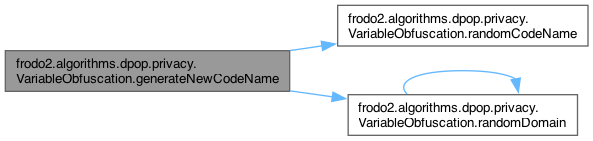
References codeNamesUnique, mergeBack, numBits, obfuscatedUniqueDomains, problem, rand, randomCodeName(), randomDomain(), and utilKeyUnique.
Referenced by notifyOut().
◆ generateObfuscatedDomains()
|
private |
In mergeBack mode: Generates an obfuscated domain for the input variable.
Without mergeBack mode: Only initiates the table
- Parameters
-
var the variable
References mergeBack, obfuscatedMergedDomains, obfuscatedUniqueDomains, problem, and randomDomain().
Referenced by init().

◆ generateUtilObfuscKeys()
|
private |
In mergeBack mode: Generates a range of utilityKey for the input variable Without mergeBack mode: Initiate general utilityKey map only.
- Parameters
-
var the variable
References mergeBack, numBits, problem, rand, utilKeyMerged, and utilKeyUnique.
Referenced by init().
◆ getMsgTypes()
| Collection< MessageType > frodo2.algorithms.dpop.privacy.VariableObfuscation< V extends Addable< V >, U extends Addable< U > >.getMsgTypes | ( | ) |
Implements frodo2.communication.MessageListener< T >.
References CODE_NAME_TYPE, OBFUSCATED_UTIL_TYPE, OBFUSCATED_VALUE_TYPE, frodo2.algorithms.dpop.UTILpropagation< Val extends Addable< Val >, U extends Addable< U > >.OPT_UTIL_MSG_TYPE, frodo2.algorithms.varOrdering.dfs.DFSgeneration< V extends Addable< V >, U extends Addable< U > >.OUTPUT_MSG_TYPE, frodo2.algorithms.AgentInterface< V extends Addable< V > >.START_AGENT, frodo2.algorithms.dpop.UTILpropagation< Val extends Addable< Val >, U extends Addable< U > >.UTIL_MSG_TYPE, and frodo2.algorithms.dpop.VALUEpropagation< Val extends Addable< Val > >.VALUE_MSG_TYPE.
◆ getTranslatedValue()
|
private |
Translates (decodes or encodes) a specified value of the domain of variable other.
- Parameters
-
myVar the variable who calls this method other the variable who owns the value to translate value the value to be translated decode trueif myVar wants to decode the value,falseif myVar wants to encode the value
- Returns
- the specified value translated (decoded or encoded) if myVar knows the translation, else returns
null
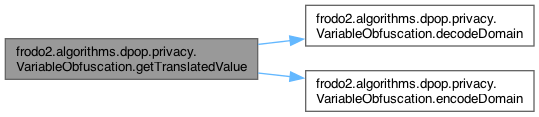
References decodeDomain(), and encodeDomain().
◆ init() [1/2]
|
private |
Initiates the variableObfuscation module.
References hasDecoded, init(), and problem.
Referenced by init(), and notifyIn().
◆ init() [2/2]
|
private |
Initiates all datastructures related to the input variable.
- Parameters
-
var the variable
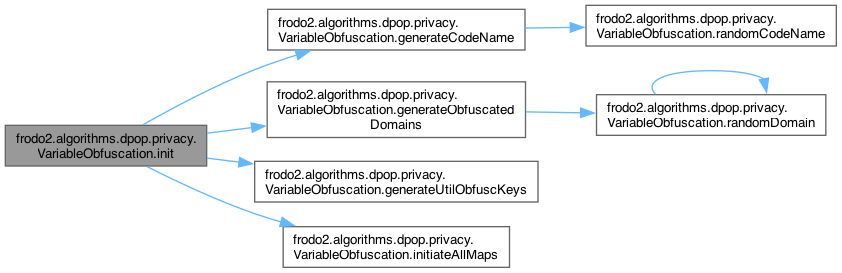
References generateCodeName(), generateObfuscatedDomains(), generateUtilObfuscKeys(), and initiateAllMaps().
◆ initiateAllMaps()
|
private |
Initiates all maps for the input variable.
- Parameters
-
var the variable
References decodeCodeName, decodeDomains, encodeParent, incomingExpected, mergeBack, ownUtilKey, receivedUtilKey, utilContent, and waitingMsg.
Referenced by init().
◆ notifyIn()
| void frodo2.algorithms.dpop.privacy.VariableObfuscation< V extends Addable< V >, U extends Addable< U > >.notifyIn | ( | Message | msg | ) |
Implements frodo2.communication.IncomingMsgPolicyInterface< T >.
References CODE_NAME_TYPE, frodo2.communication.MessageType.equals(), init(), notifyIn(), OBFUSCATED_UTIL_TYPE, and started.
Referenced by notifyIn(), and sendDelayedMsg().

◆ notifyOut()
| Decision frodo2.algorithms.dpop.privacy.VariableObfuscation< V extends Addable< V >, U extends Addable< U > >.notifyOut | ( | Message | msg | ) |
Implements frodo2.communication.OutgoingMsgPolicyInterface< T >.
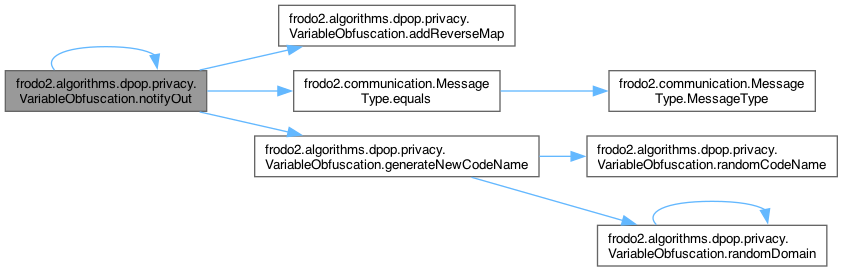
References addReverseMap(), codeNamesMerged, codeNamesUnique, decodeCodeName, decodeDomains, frodo2.communication.MessageType.equals(), generateNewCodeName(), incomingExpected, mergeBack, notifyOut(), numDecrypt, obfuscatedMergedDomains, obfuscatedUniqueDomains, frodo2.algorithms.varOrdering.dfs.DFSgeneration< V extends Addable< V >, U extends Addable< U > >.OUTPUT_MSG_TYPE, ownUtilKey, parents, problem, queue, utilContent, utilKeyMerged, and utilKeyUnique.
Referenced by notifyOut(), and sendDelayedMsg().
◆ randomCodeName()
|
private |
Create a random integer of 32 bits and return it in hex-decimal string form.
- Returns
- a randomCodeName
References rand.
Referenced by generateCodeName(), and generateNewCodeName().
◆ randomDomain()
|
private |
Generates a domain of random numbers.
- Parameters
-
initDom the initial domain
- Returns
- a random domain of values in form of a array of size specified
- Todo
- Make all obfuscated domains with the same size (given as a parameter in the XML file).
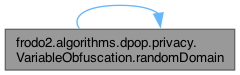
References randomDomain().
Referenced by generateNewCodeName(), generateObfuscatedDomains(), and randomDomain().
◆ sendDelayedMsg()
|
private |
Send the delayed UTILmsg.
- Parameters
-
myVar the var who can send its UTILmsg
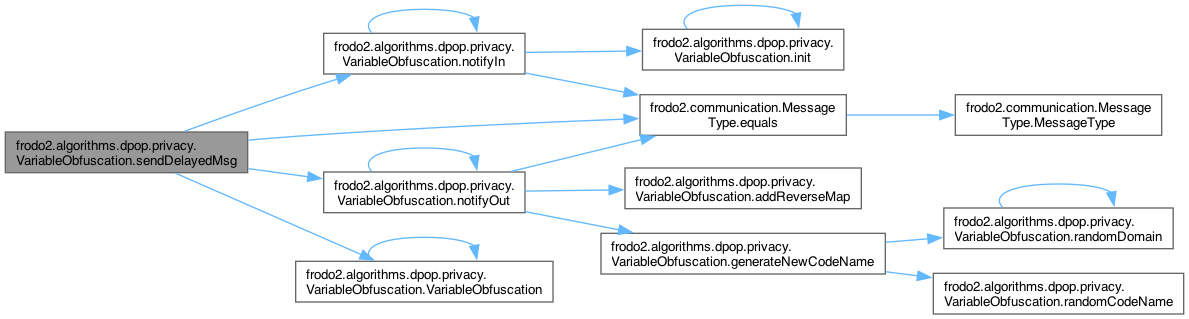
References frodo2.communication.MessageType.equals(), notifyIn(), notifyOut(), problem, frodo2.algorithms.dpop.UTILpropagation< Val extends Addable< Val >, U extends Addable< U > >.UTIL_MSG_TYPE, VariableObfuscation(), and waitingMsg.
◆ setQueue()
| void frodo2.algorithms.dpop.privacy.VariableObfuscation< V extends Addable< V >, U extends Addable< U > >.setQueue | ( | Queue | queue | ) |
Implements frodo2.communication.MessageListener< T >.
References queue.
Member Data Documentation
◆ CODE_NAME_TYPE
|
static |
The type of the messages containing code names.
Referenced by frodo2.algorithms.dpop.privacy.CodeNameMsg< V extends Addable< V > >.CodeNameMsg(), frodo2.algorithms.dpop.privacy.CodeNameMsg< V extends Addable< V > >.CodeNameMsg(), frodo2.algorithms.dpop.privacy.test.VariableObfuscationTest< V extends Addable< V > >.getMsgTypes(), getMsgTypes(), frodo2.algorithms.dpop.privacy.test.VariableObfuscationTest< V extends Addable< V > >.notifyIn(), and notifyIn().
◆ codeNamesMerged
|
private |
A Map containing assignments variable-codeName with mergeBack.
- Note
- must be used only when codeName are generated or to send codeNameMsg when mergeBack=true
Referenced by generateCodeName(), and notifyOut().
◆ codeNamesUnique
|
private |
A Map containing assignment variable-codeName without mergeBack: (Pseudo-)Parent - Child - CodeName.
- Note
- must be used only when codeName are generated or to send codeNameMsg when mergeBack=false
Referenced by generateCodeName(), generateNewCodeName(), and notifyOut().
◆ decodeCodeName
|
private |
Map for all variables of this agent of reverse map assignment codeName-variable of their (pseudo-)parents: Child - Parents' CodeName - (Pseudo-)Parent.
Referenced by addReverseMap(), decodeCodeName(), initiateAllMaps(), and notifyOut().
◆ decodeDomains
|
private |
Map for all variables of this agent of map assignment variable-domain of their (pseudo-)parents: Child - (Pseudo-)Parent - Domain.
Cleartext domain in [0], obfuscated domain in [1]
Referenced by addReverseMap(), decodeDomain(), encodeDomain(), initiateAllMaps(), and notifyOut().
◆ default_numBits
|
private |
The size by default of the BigInteger used for utility obfuscation.
Referenced by VariableObfuscation().
◆ encodeParent
|
private |
Map for all variables of this agent of map assignment variable-codeName of their (pseudo-)parents: Child - (Pseudo-)Parent - Parents' CodeName.
Referenced by addReverseMap(), encodeCodeName(), and initiateAllMaps().
◆ hasDecoded
|
private |
Map that says if a variable has decoded a UTIL.
Referenced by init().
◆ incomingExpected
|
private |
For each internal variable, the number of codeName messages it is still expecting.
Referenced by initiateAllMaps(), and notifyOut().
◆ infeasibleUtil
|
private |
Long.MIN_VALUE if the problem is a maximization problem, Long.MAX_VALUE otherwise.
Referenced by VariableObfuscation().
◆ mergeBack
|
private |
If mergeBackEdges are allowed.
Referenced by generateCodeName(), generateNewCodeName(), generateObfuscatedDomains(), generateUtilObfuscKeys(), initiateAllMaps(), notifyOut(), and VariableObfuscation().
◆ numBits
|
private |
The size of the BigInteger for the utility obfuscation.
Referenced by generateNewCodeName(), generateUtilObfuscKeys(), and VariableObfuscation().
◆ numDecrypt
|
private |
Map with : Parent - Number of time utilities in UTILmsg must be decrypted.
Referenced by notifyOut().
◆ OBFUSCATED_UTIL_TYPE
|
static |
The type of obfuscated UTIL messages.
Referenced by frodo2.algorithms.dpop.privacy.test.VariableObfuscationTest< V extends Addable< V > >.getMsgTypes(), getMsgTypes(), notifyIn(), frodo2.algorithms.dpop.privacy.ObsfUTILmsg< V extends Addable< V > >.ObsfUTILmsg(), and frodo2.algorithms.dpop.privacy.ObsfUTILmsg< V extends Addable< V > >.ObsfUTILmsg().
◆ OBFUSCATED_VALUE_TYPE
|
static |
The type of obfuscated VALUE messages.
Referenced by frodo2.algorithms.dpop.privacy.test.VariableObfuscationTest< V extends Addable< V > >.getMsgTypes(), getMsgTypes(), frodo2.algorithms.dpop.privacy.ObfsVALUEmsg< V extends Addable< V > >.ObfsVALUEmsg(), and frodo2.algorithms.dpop.privacy.ObfsVALUEmsg< V extends Addable< V > >.ObfsVALUEmsg().
◆ obfuscatedMergedDomains
|
private |
A Map containing assignments variable-domain with mergeBack.
- Note
- must be used only when domains are generated or to send codeNameMsg when mergeBack=true
Referenced by generateObfuscatedDomains(), and notifyOut().
◆ obfuscatedUniqueDomains
|
private |
A Map containing assignments variable-domain without mergeBack: (Pseudo-)Parent - Child - Domain.
- Note
- must be used only when domains are generated or to send codeNameMsg when mergeBack=false
Referenced by generateNewCodeName(), generateObfuscatedDomains(), and notifyOut().
◆ ownUtilKey
|
private |
own - (myChild OR myCodeName sent to myChild) - myUTIL
Referenced by decryptMySelfUtility(), initiateAllMaps(), and notifyOut().
◆ parents
|
private |
The true parent of each of this agent's variables in the DFS.
Referenced by notifyOut().
◆ problem
|
private |
Problem description.
Referenced by generateNewCodeName(), generateObfuscatedDomains(), generateUtilObfuscKeys(), init(), notifyOut(), sendDelayedMsg(), and VariableObfuscation().
◆ queue
|
private |
The agent's queue.
Referenced by notifyOut(), and setQueue().
◆ rand
|
private |
A random Stream.
Referenced by generateNewCodeName(), generateUtilObfuscKeys(), and randomCodeName().
◆ receivedUtilKey
|
private |
Map for all variables of this agent of maps of variable-utility obfuscation key assignments Child - (Pseudo-)Parent - Utility key.
Referenced by addReverseMap(), decryptUtility(), encryptUtility(), and initiateAllMaps().
◆ started
|
private |
Whether the algorithm has already started.
Referenced by notifyIn().
◆ utilContent
|
private |
Map with the UTIL codeNames received (used without mergeBack).
Variable X - Children of X - CodeName(s) of X
- Note
- used only without mergeBack
Referenced by initiateAllMaps(), and notifyOut().
◆ utilKeyMerged
|
private |
A Map containing assignments of obfuscation keys to all variables of this agent.
- Note
- must be used only when domains are generated or to send utilKey when mergeBack=true
Referenced by generateUtilObfuscKeys(), and notifyOut().
◆ utilKeyUnique
|
private |
A Map containing assignments of obfuscation keys without mergeBack: (Pseudo-)Parent - Child - UtilKey.
- Note
- must be used only when domains are generated or to send utilKey when mergeBack=false
Referenced by generateNewCodeName(), generateUtilObfuscKeys(), and notifyOut().
◆ waitingMsg
|
private |
Set of all waiting msg.
Referenced by initiateAllMaps(), and sendDelayedMsg().
The documentation for this class was generated from the following file:
- src/frodo2/algorithms/dpop/privacy/VariableObfuscation.java
