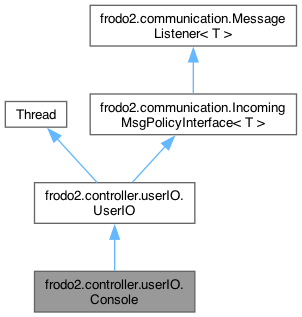
A simple console based user interface. More...
Public Member Functions | |
| Console (Controller control) | |
| The constructor. | |
| boolean | askUserYesNo (String message) |
| void | tellUser (String message) |
| void | showUserDaemonList (HashMap< String, AgentAddress > daemons) |
| void | showUserAgentList (HashMap< String, AgentAddress > agents) |
| void | stopRunning () |
| void | run () |
| The main loop that waits for user input is situated here. | |
| void | parseInput (String input) |
| A simple function that looks at the input and determines what to. | |
| Public Member Functions inherited from frodo2.controller.userIO.UserIO | |
| UserIO (Controller control) | |
| A basic constructor. | |
| void | start () |
| Collection< MessageType > | getMsgTypes () |
| void | setQueue (Queue queue) |
| void | notifyIn (Message msg) |
| The user interface responds to message of the type USER_NOTIFICATION_MSG, that contain message to be displayed to the user. | |
| void | load (String filename) |
| Used to load a new configuration file. | |
| void | startExperiment () |
| Used to start the experiments. | |
| void | setDebug (boolean b) |
| Used to stop the experiments. | |
| void | setLogging (boolean b) |
| Tell the controller whether we want to log everything or not. | |
| void | getDaemonList () |
| Ask the white pages for a list of all daemons that are registered. | |
| void | getAgentList () |
| Ask the white pages for a list of all agents that are registered. | |
| void | exit () |
| Stop the experiment, clean everything up and exit the program. | |
| Public Member Functions inherited from frodo2.communication.IncomingMsgPolicyInterface< T > | |
| default void | notifyIn (Message msg, Object toAgent) |
| Notifies the listener of an incoming message. | |
Package Attributes | |
| boolean | done = false |
| This variable is used to determine whether the program should exit or not. | |
Private Attributes | |
| final String | prefix |
| The command line prefix. | |
Additional Inherited Members | |
| Static Public Attributes inherited from frodo2.controller.userIO.UserIO | |
| static final MessageType | CONFIGURATION_MSG = MessageType.SYSTEM.newChild("UserIO", "Configure") |
| The message type used to convey the configuration file. | |
| static final MessageType | USER_NOTIFICATION_MSG = MessageType.SYSTEM.newChild("UserIO", "User-Notification") |
| The message type used to send messages to the user. | |
| static final MessageType | START_MSG = MessageType.SYSTEM.newChild("UserIO", "StartE") |
| The message the user sends to start the experiment. | |
| static final MessageType | DEAMON_LIST_REQUEST = MessageType.SYSTEM.newChild("UserIO", "Daemon list requested") |
| Message send to request a list of daemons from the white pages. | |
| static final MessageType | AGENTS_LIST_REQUEST = MessageType.SYSTEM.newChild("UserIO", "Agent list requested") |
| Message send to request a list of agents from the white pages. | |
| Protected Member Functions inherited from frodo2.controller.userIO.UserIO | |
| UserIO () | |
| Default constructor. | |
| Protected Attributes inherited from frodo2.controller.userIO.UserIO | |
| Queue | controlQueue |
| The queue of the controller. | |
| Controller | control |
| The controller. | |
Detailed Description
A simple console based user interface.
It responds to the following commands:
- to load a configuration file, type open [filename]
- to start the experiments, type start
- to exit, type exit
Constructor & Destructor Documentation
◆ Console()
| frodo2.controller.userIO.Console.Console | ( | Controller | control | ) |
The constructor.
- Parameters
-
control the controller
References frodo2.controller.userIO.UserIO.control.
Member Function Documentation
◆ askUserYesNo()
| boolean frodo2.controller.userIO.Console.askUserYesNo | ( | String | message | ) |
- See also
- frodo2.controller.userIO.UserIO.askUserYesNo(java.lang.String)
- Todo
- Auto-generated method stub
Reimplemented from frodo2.controller.userIO.UserIO.
◆ parseInput()
| void frodo2.controller.userIO.Console.parseInput | ( | String | input | ) |
A simple function that looks at the input and determines what to.
- Parameters
-
input input String
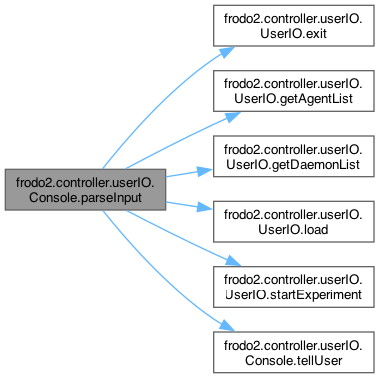
References frodo2.controller.userIO.UserIO.exit(), frodo2.controller.userIO.UserIO.getAgentList(), frodo2.controller.userIO.UserIO.getDaemonList(), frodo2.controller.userIO.UserIO.load(), frodo2.controller.userIO.UserIO.startExperiment(), and tellUser().
Referenced by run().
◆ run()
| void frodo2.controller.userIO.Console.run | ( | ) |
The main loop that waits for user input is situated here.
- See also
- java.lang.Thread#run()
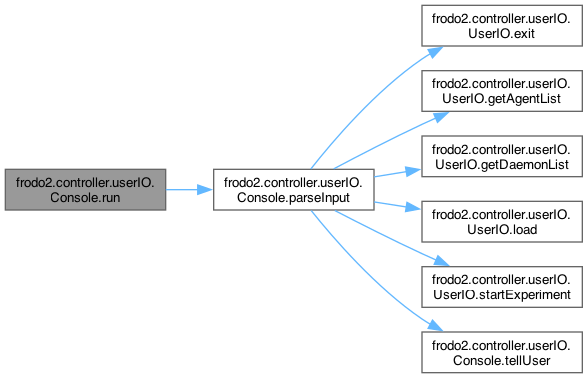
References done, and parseInput().
◆ showUserAgentList()
| void frodo2.controller.userIO.Console.showUserAgentList | ( | HashMap< String, AgentAddress > | agents | ) |
- See also
- frodo2.controller.userIO.UserIO.showUserAgentList(java.util.HashMap)
Reimplemented from frodo2.controller.userIO.UserIO.
◆ showUserDaemonList()
| void frodo2.controller.userIO.Console.showUserDaemonList | ( | HashMap< String, AgentAddress > | daemons | ) |
- See also
- frodo2.controller.userIO.UserIO.showUserDaemonList(java.util.HashMap)
Reimplemented from frodo2.controller.userIO.UserIO.
◆ stopRunning()
| void frodo2.controller.userIO.Console.stopRunning | ( | ) |
Reimplemented from frodo2.controller.userIO.UserIO.
References done.
◆ tellUser()
| void frodo2.controller.userIO.Console.tellUser | ( | String | message | ) |
- See also
- frodo2.controller.userIO.UserIO.tellUser(java.lang.String)
Reimplemented from frodo2.controller.userIO.UserIO.
Referenced by parseInput().
Member Data Documentation
◆ done
|
package |
This variable is used to determine whether the program should exit or not.
Referenced by run(), and stopRunning().
◆ prefix
|
private |
The command line prefix.
The documentation for this class was generated from the following file:
- src/frodo2/controller/userIO/Console.java
