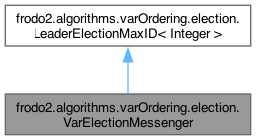
A version of LeaderElectionMaxID that uses random numbers as IDs and lies in order to protect topology privacy. More...
Public Member Functions | |
| VarElectionMessenger (String comID, int myID, Collection< String > neighbors, int minNbrLies) | |
| Constructor. | |
| Public Member Functions inherited from frodo2.algorithms.varOrdering.election.LeaderElectionMaxID< Integer > | |
| Collection< MessageType > | getMsgTypes () |
| void | setQueue (Queue queue) |
| LeaderElectionMaxID (String comID, T myID, Collection< String > neighbors, int nbrSteps) | |
| Constructor. | |
| void | notifyIn (Message msg) |
| The actual algorithm. | |
Protected Member Functions | |
| Integer | getMaxID () |
| Protected Member Functions inherited from frodo2.algorithms.varOrdering.election.LeaderElectionMaxID< Integer > | |
| T | getMaxID () |
Private Member Functions | |
| int | nbLies (int minNbLies) |
| Compute the number of times the variable will lie. | |
Private Attributes | |
| int | nbrTruthfulSteps |
| The number of last steps during which the variable tells the truth. | |
| Random | rand |
| A random stream. | |
Additional Inherited Members | |
| Static Public Attributes inherited from frodo2.algorithms.varOrdering.election.LeaderElectionMaxID< Integer > | |
| static MessageType | START_MSG_TYPE |
| The type of the message used to tell the protocol to start. | |
| static final MessageType | LE_MSG_TYPE |
| The type of the messages used to carry agent IDs. | |
| static final MessageType | OUTPUT_MSG_TYPE |
| The type of the output message. | |
| Protected Attributes inherited from frodo2.algorithms.varOrdering.election.LeaderElectionMaxID< Integer > | |
| T | myID |
| This agent's ID. | |
| T | maxID |
| Current computed maximum ID. | |
| int | stepCountdown |
| Index of the current step in the protocol, decremented until it reaches 0. | |
Detailed Description
A version of LeaderElectionMaxID that uses random numbers as IDs and lies in order to protect topology privacy.
Constructor & Destructor Documentation
◆ VarElectionMessenger()
| frodo2.algorithms.varOrdering.election.VarElectionMessenger.VarElectionMessenger | ( | String | comID, |
| int | myID, | ||
| Collection< String > | neighbors, | ||
| int | minNbrLies ) |
Constructor.
- Parameters
-
comID communication ID used to identify this agent as the sender of messages myID ID that uniquely identifies this agent neighbors the neighbors of this agent minNbrLies Minimal authorized number of lies.
- Note
- minNbrLies must be an upper bound the diameter of the largest component of the constraint graph for the algorithm to work properly.
References frodo2.algorithms.varOrdering.election.LeaderElectionMaxID< Integer >.comID, frodo2.algorithms.varOrdering.election.LeaderElectionMaxID< Integer >.myID, nbLies(), and frodo2.algorithms.varOrdering.election.LeaderElectionMaxID< Integer >.neighbors.

Member Function Documentation
◆ getMaxID()
|
protected |
- Returns
- If the var lies it will return a random number between the last maxID sent and its current maxID else, it will return maxID
References frodo2.algorithms.varOrdering.election.LeaderElectionMaxID< Integer >.maxID, frodo2.algorithms.varOrdering.election.LeaderElectionMaxID< Integer >.myID, rand, and frodo2.algorithms.varOrdering.election.LeaderElectionMaxID< Integer >.stepCountdown.
◆ nbLies()
|
private |
Compute the number of times the variable will lie.
- Parameters
-
minNbLies the minimal number of lies.
- Returns
- value between minNbLies and (2*minNbLies)
References rand.
Referenced by VarElectionMessenger().
Member Data Documentation
◆ nbrTruthfulSteps
|
private |
The number of last steps during which the variable tells the truth.
◆ rand
|
private |
A random stream.
Referenced by getMaxID(), and nbLies().
The documentation for this class was generated from the following file:
- src/frodo2/algorithms/varOrdering/election/VarElectionMessenger.java
