This message contains the util information a child reports to its parent when responding to an ASK message. More...

Public Member Functions | |
| UTILmsg () | |
| Empty constructor. | |
| UTILmsg (String sender, String receiver, Good< Val, U > good) | |
| Constructor for a message without domain info. | |
| UTILmsg (MessageType type, String sender, String receiver, Good< Val, U > good) | |
| Constructor for a message without domain info. | |
| void | writeExternal (ObjectOutput out) throws IOException |
| void | readExternal (ObjectInput in) throws IOException, ClassNotFoundException |
| String | toString () |
| String | getSender () |
| Returns the sender of the message. | |
| String | getReceiver () |
| Returns the receiver of the message. | |
| Good< Val, U > | getGood (String[] variables) |
| Returns the good. | |
| Public Member Functions inherited from frodo2.communication.MessageWith2Payloads< T1 extends Serializable, T2 extends Serializable > | |
| MessageWith2Payloads (MessageType type, T1 payload1, T2 payload2) | |
| Constructor. | |
| MessageWith2Payloads () | |
| Empty constructor. | |
| MessageWith2Payloads< T1, T2 > | clone () |
| T1 | getPayload1 () |
| void | setPayload1 (T1 payload1) |
| T2 | getPayload2 () |
| void | setPayload2 (T2 payload2) |
| Public Member Functions inherited from frodo2.communication.Message | |
| Message (MessageType type) | |
| Constructor. | |
| Message () | |
| Empty constructor. | |
| MessageType | getType () |
| void | fakeSerialize () |
| Pretends to serialize the message. | |
Protected Attributes | |
| Val[] | values |
| The variable values for a particular assignment. | |
| U | utility |
| The utility for this particular assignment. | |
| Protected Attributes inherited from frodo2.communication.Message | |
| MessageType | type |
| The type of this message. | |
Detailed Description
This message contains the util information a child reports to its parent when responding to an ASK message.
It contains the following utility information
- an assignment
- the utility corresponding to this assignment (be it speculative or not)
- Parameters
-
<Val> type used for variable values <U> type used for utility values
Constructor & Destructor Documentation
◆ UTILmsg() [1/3]
| frodo2.algorithms.odpop.UTILmsg< Val extends Addable< Val >, U extends Addable< U > >.UTILmsg | ( | ) |
◆ UTILmsg() [2/3]
| frodo2.algorithms.odpop.UTILmsg< Val extends Addable< Val >, U extends Addable< U > >.UTILmsg | ( | String | sender, |
| String | receiver, | ||
| Good< Val, U > | good ) |
Constructor for a message without domain info.
- Parameters
-
sender The sender of the message receiver The recipient of the message good The good to be send
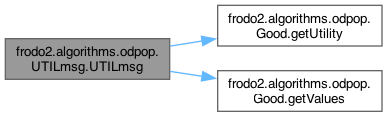
References frodo2.algorithms.odpop.Good< Val extends Addable< Val >, U extends Addable< U > >.getUtility(), frodo2.algorithms.odpop.Good< Val extends Addable< Val >, U extends Addable< U > >.getValues(), frodo2.algorithms.odpop.UTILpropagationFullDomain< Val extends Addable< Val >, U extends Addable< U >, L extends LeafNode< U > >.UTIL_MSG, utility, and values.
◆ UTILmsg() [3/3]
| frodo2.algorithms.odpop.UTILmsg< Val extends Addable< Val >, U extends Addable< U > >.UTILmsg | ( | MessageType | type, |
| String | sender, | ||
| String | receiver, | ||
| Good< Val, U > | good ) |
Constructor for a message without domain info.
- Parameters
-
type The type of this message sender The sender of the message receiver The recipient of the message good The good to be send
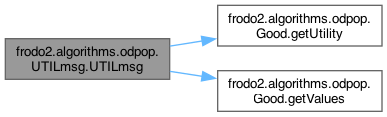
References frodo2.algorithms.odpop.Good< Val extends Addable< Val >, U extends Addable< U > >.getUtility(), frodo2.algorithms.odpop.Good< Val extends Addable< Val >, U extends Addable< U > >.getValues(), frodo2.communication.Message.type, utility, and values.
Member Function Documentation
◆ getGood()
| Good< Val, U > frodo2.algorithms.odpop.UTILmsg< Val extends Addable< Val >, U extends Addable< U > >.getGood | ( | String[] | variables | ) |
◆ getReceiver()
| String frodo2.algorithms.odpop.UTILmsg< Val extends Addable< Val >, U extends Addable< U > >.getReceiver | ( | ) |
Returns the receiver of the message.
- Returns
- receiver
References frodo2.communication.MessageWith2Payloads< T1 extends Serializable, T2 extends Serializable >.getPayload2().
Referenced by toString().

◆ getSender()
| String frodo2.algorithms.odpop.UTILmsg< Val extends Addable< Val >, U extends Addable< U > >.getSender | ( | ) |
Returns the sender of the message.
- Returns
- sender
References frodo2.communication.MessageWith2Payloads< T1 extends Serializable, T2 extends Serializable >.getPayload1().
Referenced by toString().

◆ readExternal()
| void frodo2.algorithms.odpop.UTILmsg< Val extends Addable< Val >, U extends Addable< U > >.readExternal | ( | ObjectInput | in | ) | throws IOException, ClassNotFoundException |
- See also
- java.io.Externalizable#readExternal(java.io.ObjectInput)
Reimplemented from frodo2.communication.MessageWith2Payloads< T1 extends Serializable, T2 extends Serializable >.
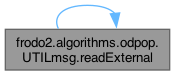
References readExternal().
Referenced by readExternal().
◆ toString()
| String frodo2.algorithms.odpop.UTILmsg< Val extends Addable< Val >, U extends Addable< U > >.toString | ( | ) |
- See also
- MessageWith2Payloads.toString()
Reimplemented from frodo2.communication.MessageWith2Payloads< T1 extends Serializable, T2 extends Serializable >.
References getReceiver(), and getSender().

◆ writeExternal()
| void frodo2.algorithms.odpop.UTILmsg< Val extends Addable< Val >, U extends Addable< U > >.writeExternal | ( | ObjectOutput | out | ) | throws IOException |
- See also
- java.io.Externalizable#writeExternal(java.io.ObjectOutput)
Reimplemented from frodo2.communication.MessageWith2Payloads< T1 extends Serializable, T2 extends Serializable >.
Member Data Documentation
◆ utility
|
protected |
◆ values
|
protected |
The documentation for this class was generated from the following file:
- src/frodo2/algorithms/odpop/UTILmsg.java
