Loading...
Searching...
No Matches
org.jacop.constraints.SequenceCloneable Class Reference
A cloneable version of the Sequence constraint. More...
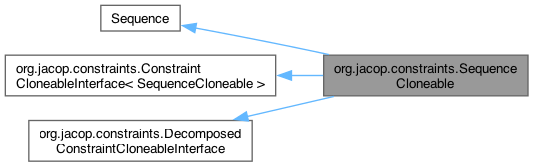
Inheritance diagram for org.jacop.constraints.SequenceCloneable:
Public Member Functions | |
| SequenceCloneable (IntVarCloneable[] list, IntervalDomain set, int q, int min, int max) | |
| It creates a Sequence constraint. | |
| SequenceCloneable | cloneInto (StoreCloneable targetStore) throws FailException |
| List< IntVar > | arguments () |
| String | id () |
| List< Constraint > | decompose (Store store) |
| Public Member Functions inherited from org.jacop.constraints.ConstraintCloneableInterface< SequenceCloneable > | |
| abstract C | cloneInto (StoreCloneable targetStore) throws CloneNotSupportedException, FailException |
| Creates a new constraint that is a (state-less) clone of this one, but expressed on the variables with the same names found in the input store. | |
Static Public Member Functions | |
| static List< Constraint > | decomposeByRegular (Sequence sequence) |
| Preferred and default option of decomposing Sequence constraint. | |
Private Attributes | |
| final String | id |
| This constraint's ID/name. | |
Static Private Attributes | |
| static int | idNbr = 0 |
| Used to increment the id of constraints. | |
Detailed Description
A cloneable version of the Sequence constraint.
Constructor & Destructor Documentation
◆ SequenceCloneable()
| org.jacop.constraints.SequenceCloneable.SequenceCloneable | ( | IntVarCloneable[] | list, |
| IntervalDomain | set, | ||
| int | q, | ||
| int | min, | ||
| int | max ) |
It creates a Sequence constraint.
- Parameters
-
list variables which assignment is constrained by Sequence constraint. set set of values which occurrence is counted within each sequence. q the length of the sequence min the minimal occurrences of values from set within a sequence. max the maximal occurrences of values from set within a sequence.
References idNbr.
Referenced by cloneInto().
Member Function Documentation
◆ arguments()
| List< IntVar > org.jacop.constraints.SequenceCloneable.arguments | ( | ) |
◆ cloneInto()
| SequenceCloneable org.jacop.constraints.SequenceCloneable.cloneInto | ( | StoreCloneable | targetStore | ) | throws FailException |

◆ decompose()
| List< Constraint > org.jacop.constraints.SequenceCloneable.decompose | ( | Store | store | ) |
- See also
- org.jacop.constraints.Sequence#decompose(org.jacop.core.Store)
References decomposeByRegular().
Here is the call graph for this function:

◆ decomposeByRegular()
|
static |
Preferred and default option of decomposing Sequence constraint.
- Parameters
-
sequence sequence constraint to be decomposed by regular.
- Returns
- a list of constraints that are used to decompose the sequence constraints.
- Note
- Copied from Sequence.
Referenced by decompose().
◆ id()
| String org.jacop.constraints.SequenceCloneable.id | ( | ) |
Member Data Documentation
◆ id
|
private |
This constraint's ID/name.
◆ idNbr
|
staticprivate |
Used to increment the id of constraints.
Referenced by SequenceCloneable().
The documentation for this class was generated from the following file:
- src/org/jacop/constraints/SequenceCloneable.java
