This class is designed to store GOODs received by a node from its children, and is used in the O-DPOP algorithm. More...

Classes | |
| class | IntArrayWrapper |
| The IntArrayWrapper is used as a key for (partial) assignments. More... | |
Public Member Functions | |
| InnerNodeTree (String ownVariable, Val[] ownVariableDomain, UtilitySolutionSpace< Val, U > space, int numberOfChildren, U zero, L leafNodeInstance, U infeasibleUtil, boolean maximize, boolean collectStats) | |
| A constructor. | |
| InnerNodeTree (String ownVariable, Val[] ownVariableDomain, List< UtilitySolutionSpace< Val, U > > spaces, int numberOfChildren, U zero, L leafNodeInstance, U infeasibleUtil, boolean maximize, boolean collectStats) | |
| A constructor. | |
| boolean | add (Good< Val, U > g, int sender) |
| Adds a good to the tree. | |
| void | setFinalDomainSize (String[] variables, int[] domainSize) |
| String | toString () |
| Method used for debugging purposes. | |
| IntArrayWrapper | createIntArrayWrapper (int[] array) |
| IntArrayWrapper | createIntArrayWrapper (int size) |
| boolean | checkLeaf (L leaf, IntArrayWrapper currentPath, boolean checkUB, U utility, int sender) |
| Method to check that the utility and UB are consistent with the available information. | |
| boolean | add (Good< Val, U > g, int sender, HashMap< String, Val[]> domains) |
| Val[][] | getDomains () |
| Public Member Functions inherited from frodo2.algorithms.odpop.goodsTree.InnerNodeTreeFullDomain.InnerNodeTree< Val, U, L > | |
| boolean | add (Good< Val, U > g, int sender, HashMap< String, Val[]> domains) |
| Adds a good to the tree. | |
| Good< Val, U > | getAmax () |
| void | getBestAssignmentForOwnVariable (HashMap< String, Val > contextMap) |
| String[] | getChildSeparatorReportingOrder (int child) |
| Returns the variables in the childs separator in the order it reported them. | |
| int | getChildSeparatorSize (int child) |
| HashMap< String, Val > | getChildValues (HashMap< String, Val > parentContext, int child) |
| Given a map that maps variables to values, this method returns the values belonging to the variables in a child's separator. | |
| int[] | getFinalDomainSize () |
| Val[][] | getDomains () |
| boolean | hasFullInfo () |
| boolean | hasMore () |
| boolean | isValuationSufficient () |
| boolean | knowsVariable (String variable) |
| boolean | notEnoughInfo () |
| void | removeAMax () |
| void | setChildrenSeparator (int child, String[] variables) |
| Initializes the separator of a child. | |
| boolean | setChildDone (int child) |
| If a child has send a DONE message, the upper bound should be set to -infinity. | |
| String | toString () |
| Method used for debugging purposes. | |
| IntArrayWrapper | createIntArrayWrapper (int[] array) |
| boolean | checkLeaf (L leaf, IntArrayWrapper currentPath, boolean checkUB, U utility, int sender) |
| Method to check that the utility and UB are consistent with the available information. | |
| boolean | compareWithHypercube (UtilitySolutionSpace< Val, U > h) |
| Method to check the initialization of the tree. | |
| boolean | pathExists (Val[] values) |
| boolean | UBexists (InnerNode< U, L > currentNode, int depth) |
| Test to see whether a leafnode used as upperbound actually exists, i.e. | |
| boolean | Utilexists (InnerNode< U, L > currentNode, int depth) |
| Checks whether the maxUtil of a node actually exists. | |
| int | treeSize () |
| Wrapper around treeSize(int, int, Node). | |
| void | setFinalDomainSize (String[] variables, int[] domainSize) |
Protected Member Functions | |
| InnerNodeTree (String ownVariable, Val[] ownVariableDomain, UtilitySolutionSpace< Val, U > space, U zero, int numberOfChildren, U infeasibleUtil, boolean maximize, boolean collectStats) | |
| A constructor. | |
| InnerNodeTree (String ownVariable, Val[] ownVariableDomain, List< UtilitySolutionSpace< Val, U > > spaces, U zero, int numberOfChildren, U infeasibleUtil, boolean maximize, boolean collectStats) | |
| A constructor. | |
| InnerNodeTree (L leafNodeInstance, String ownVariable, Val[] ownVariableDomain, UtilitySolutionSpace< Val, U > space, U zero, int numberOfChildren, U infeasibleUtil, boolean maximize, boolean collectStats) | |
| A dummy constructor to be used by extending classes. | |
| InnerNodeTree (L leafNodeInstance, String ownVariable, Val[] ownVariableDomain, List< UtilitySolutionSpace< Val, U > > spaces, U zero, int numberOfChildren, U infeasibleUtil, boolean maximize, boolean collectStats) | |
| A dummy constructor to be used by extending classes. | |
| void | addNewDomainElement (HashMap< String, Val > newValues) |
| This method adds a new variable to the data structure. | |
| void | addNewDomainElementNoUB (int depth, int horizon, IntArrayWrapper currentPath, int[] partialPath, int[] newDomainPath, frodo2.algorithms.odpop.goodsTree.InnerNodeTreeFullDomain.InnerNode< U, L > currentNodeUncast, Good< Val, U > g, U utilityDelta, int sender, boolean onPartialPath, boolean fill) |
| This method is called when a new domain element is discovered before the UBs can be calculated. | |
| void | addNewDomainElementWithUB (int depth, int horizon, IntArrayWrapper currentPath, int[] partialPath, int[] newDomainPath, frodo2.algorithms.odpop.goodsTree.InnerNodeTreeFullDomain.InnerNode< U, L > currentNodeUncast, Good< Val, U > g, U utilityDelta, int sender, boolean onPartialPath, boolean fill) |
| This method is called when a new domain element is discovered while the UB is already set. | |
| int[] | addNewVariable (String[] allVariables, HashMap< String, Val > newVariables, int sender) |
| This method adds new variables to the data structure. | |
| void | changeDummyToReal (int depth, InnerNode< U, L > currentNode, boolean change) |
| Changes all dummy children of the variables in dummyToReal to real nodes. | |
| void | changeDummyToReal (int depth, IntArrayWrapper currentPath, InnerNode< U, L > currentNode, boolean change) |
| Changes all dummy children of the variables in dummyToReal to real nodes. | |
| InnerNode< U, L > | createInnerNode (int numberOfChildren) |
| InnerNode< U, L > | createInnerNode (Node< U >[] children) |
| L | createLeaf (IntArrayWrapper currentPath, boolean real, Good< Val, U > g, int child, final boolean withUB) |
| Method to create a new leaf node. | |
| L | createLeaf (IntArrayWrapper currentPath, boolean real, final boolean withUB) |
| Method to create a new leaf node. | |
| frodo2.algorithms.odpop.goodsTree.InnerNodeTreeFullDomain.InnerNode< U, L > | createPathNoUB (int depth, frodo2.algorithms.odpop.goodsTree.InnerNodeTreeFullDomain.InnerNodeTree.IntArrayWrapper currentPathUncast, int[] partialPath, boolean real, Good< Val, U > g, int sender) |
| Given a partial path, this method creates the path in the tree. | |
| boolean | findUnused (int depth, int[] localPath, InnerNode< U, L > currentNode) |
| Check whether the assignment to the local problem, represented by localPath, can still be used somewhere. | |
| U | getOwnVariableOptions (int[] optimalPath, Val[] assignments) |
| Given the assignment of variables in its separator, this method returns the utility for all domain elements of the own variable. | |
| void | init (int numberOfChildren, U zero) |
| Initialize all the variables of the tree. | |
| U | initiateBounds (frodo2.algorithms.odpop.goodsTree.InnerNodeTreeFullDomain.InnerNode< U, L > currentNodeUncast, frodo2.algorithms.odpop.goodsTree.InnerNodeTreeFullDomain.InnerNodeTree.IntArrayWrapper currentPathUncast, int depth, boolean onLocalPath, Good< Val, U > g, int sender) |
| This method adds the dummy part to the tree. | |
| void | updatePath (int depth, frodo2.algorithms.odpop.goodsTree.InnerNodeTreeFullDomain.InnerNodeTree.IntArrayWrapper currentPathUncast, int[] partialPath, frodo2.algorithms.odpop.goodsTree.InnerNodeTreeFullDomain.InnerNode< U, L > currentNodeUncast, Good< Val, U > g, U utilityDelta, int sender, boolean onLocalPath, final boolean withUB) |
| This method walks trough the tree according to the given partial path and finds all leaf nodes that correspond to assignments that are compatible with the good to be added. | |
| boolean | upperBoundChangesUtil (frodo2.algorithms.odpop.goodsTree.InnerNodeTreeFullDomain.InnerNode< U, L > node, U UB) |
| void | removeDummies (int removalDepth, boolean[] change, int depth, frodo2.algorithms.odpop.goodsTree.InnerNodeTreeFullDomain.InnerNode< U, L > currentNodeUncast) |
| Remove the dummy element for the variables marked in change. | |
| boolean | hasSupport (IntArrayWrapper currentPath) |
| Method to check whether a particular leaf node has support, i.e. | |
| boolean | checkTree (int depth, frodo2.algorithms.odpop.goodsTree.InnerNodeTreeFullDomain.InnerNode< U, L > currentNodeUncast, frodo2.algorithms.odpop.goodsTree.InnerNodeTreeFullDomain.InnerNodeTree.IntArrayWrapper currentPathUncast, boolean UB, boolean checkLeafs, boolean checkSupport, boolean checkUtil) |
| This method checks the tree on the following properties. | |
| Protected Member Functions inherited from frodo2.algorithms.odpop.goodsTree.InnerNodeTreeFullDomain.InnerNodeTree< Val, U, L > | |
| InnerNodeTree (String ownVariable, Val[] ownVariableDomain, UtilitySolutionSpace< Val, U > space, U zero, int numberOfChildren, U infeasibleUtil, boolean maximize, boolean collectStats) | |
| A constructor. | |
| int[] | addNewVariable (String[] allVariables, HashMap< String, Val > newVariables, HashMap< String, Val[]> newDomains, int sender) |
| This method adds new variables to the data structure. | |
| boolean | addVariableToTree (int nbrNewVariables, IntArrayWrapper currentPath, int[] indexPath, int depth, InnerNode< U, L > oldRoot, InnerNode< U, L > currentNode, boolean possibleInconsistencies, boolean onIndexPath, int sender) |
| This method is called when variables are received. | |
| InnerNode< U, L > | createInnerNode (int numberOfChildren) |
| Create an inner node with a specified number of children. | |
| L | createLeaf (IntArrayWrapper currentPath, Good< Val, U > g, int child, final boolean withUB) |
| Method to create a new leaf node. | |
| InnerNode< U, L > | createPathNoUB (int depth, IntArrayWrapper currentPath, int[] partialPath, boolean real, Good< Val, U > g, int sender) |
| Given a partial path, this method creates the path in the tree. | |
| void | finalDomainSizeReceiver () |
| logs the reception of a domain size info message | |
| int[] | getOwnVariableOptions (Val[] assignments) |
| Given the assignment of variables in its separator, this method returns the utility for all domain elements of the own variable. | |
| U | getUtilityLocalProblem (IntArrayWrapper currentPath) |
| Given an assignment to all the variables, represented as a path in the tree, this method returns the utility given by the variable's local problem. | |
| void | init (int numberOfChildren, U zero) |
| Initialize all the variables of the tree. | |
| void | initializeUpperBoundSums () |
| Initializes both the sum of bounds array and the powersOf2 array. | |
| U | initiateBounds (InnerNode< U, L > currentNode, IntArrayWrapper currentPath, int depth, boolean onLocalPath, Good< Val, U > g, int sender) |
| This method instantiates the upper bounds. | |
| boolean | localPathAlive (int depth, InnerNode< U, L > currentNode) |
| Used to check whether the local path chosen is still alive For debuggin purposes only. | |
| boolean | pathAlive (int[] path, int depth, InnerNode< U, L > currentNode) |
| Method to check whether the (possibly) partial path is alive, i.e. | |
| void | updatePath (int depth, IntArrayWrapper currentPath, int[] partialPath, InnerNode< U, L > currentNode, Good< Val, U > g, U utilityDelta, int sender, boolean onLocalPath, final boolean withUB) |
| This method walks trough the tree according to the given partial path and finds all leaf nodes that correspond to assignments that are compatible with the good to be added. | |
| void | updateLocalProblem () |
| void | updateUpperBoundSums (int child, U oldBound, U newBound) |
| Updates the upperBoundSums array given the child that has changed its bound, the old bound and the new bound. | |
| boolean | upperBoundChangesUtil (InnerNode< U, L > node, U UB) |
| U | recalculateUB (int depth, InnerNode< U, L > currentNodeUncast, U UBtoBeat, boolean recalculateUtil, boolean recalculateUB) |
| This method recalculates the upper bound for a particular node. | |
| void | removeInconsistencies (InnerNode< U, L > currentNode, int depth, IntArrayWrapper currentPath) |
| This method checks whether any of the leafnodes have become infeasible due to the addition of a new variable. | |
| boolean | removePath (int depth, InnerNode< U, L > currentNode, boolean onLocalPath) |
| This method finds the leaf node corresponding to the current best assignment, removes all its children and sets its parent node to a dead node. | |
| IntArrayWrapper | toKey (Val[] values, String[] variables, int sender) |
| Takes a good received by a child and transforms the assignment to a key. | |
| boolean | checkTree (int depth, InnerNode< U, L > currentNode, IntArrayWrapper currentPath, boolean UB, boolean checkLeafs, boolean checkSupport, boolean checkUtil) |
| This method checks the tree on the following properties. | |
| boolean | hasSupport (IntArrayWrapper currentPath) |
| Method to check whether a particular leaf node has support, i.e. | |
| boolean | setOldUB () |
| Used to set the old upperbound. | |
Protected Attributes | |
| HashMap< String, Integer > | finalDomainSizeUnknownVariables |
| the final domain sizes of as yet unknown variables | |
| boolean[] | dummy |
| Used to determine whether a variable has a dummy element or not. | |
| int | dummyDepth |
| The depth until where one can find dummy variables. | |
| int | numberOfDummies |
| Counts the number of dummy variables in the tree. | |
| int | numberOfAncestors |
| Stores the number of higher priority neighbours. | |
| int | upperboundArraySize |
| The size of the array containing precalculated upperbounds. | |
| ArrayList< HashMap< IntArrayWrapper, U > > | goodsReceived |
| For each child a map that stores the utilities received from children. | |
| Protected Attributes inherited from frodo2.algorithms.odpop.goodsTree.InnerNodeTreeFullDomain.InnerNodeTree< Val, U, L > | |
| HashMap< String, Integer > | variableToDepth |
| links a variable to its depth in the tree. | |
| HashMap< String, HashMap< Val, Integer > > | valuePointers |
| Used to determine to which child a variable value corresponds to. | |
| int[] | domainSize |
| Stores, for a level in the tree, the size of the domain of the corresponding variable. | |
| int[] | finalDomainSize |
| Stores the final sizes of the domains of all the variables. | |
| int[] | branchingFactor |
| For every level of the tree, it stores the branching factor. | |
| boolean[][] | childrenVariables |
| Stores which variables are in a child's separator. | |
| String[][] | childrenVariablesReportingOrder |
| For each child it stores the order in which the variables are reported. | |
| int[] | separatorSizePerChild |
| Stores the number of reported variables per child. | |
| boolean[] | ownVariables |
| Stores which are this variable's neighbours. | |
| ArrayList< HashMap< IntArrayWrapper, U > > | goodsReceived |
| For each child a map that stores the utilities received from children. | |
| boolean | storeReceivedGoods |
| If domain or variable information is incomplete received goods must be stored, otherwise they can be discarded after processing. | |
| boolean | hasLocalProblem |
true when this variable has a local problem, and false otherwise | |
| U | optimalLocalUtility |
| The optimal utility of the local problem. | |
| int[] | optimalLocalPath |
| The path of the currently optimal local solution. | |
| U | localUpperBound |
| The upperbound on all the completely unseen assignments. | |
| U[] | upperBounds |
| For each child it stores that last confirmed utility received. | |
| U[] | upperBoundSums |
| For every combination of children, this array contains the sum of upperBounds belonging to the selected children. | |
| int | maxNumberLocalProblemOccurences |
| The total number of times a solution to a local problem can be used in the separator problem. | |
| int[] | powersOf2 |
| Pre-calculated powers of 2. | |
| int | upperBoundIsInfiniteCounter |
| Counts the number of children that have already sent at least one confirmed good. | |
| int | upperBoundIsMinInfiniteCounter |
| COunts the number of children that have already reported a minInfinite value. | |
| HashMap< String, ArrayList< Val > > | domains |
| The variable domains, where the position in the ArrayList denotes which child corresponds to the value. | |
| int | numberOfChildren |
| The number of children of the variable. | |
| InnerNode< U, L > | root |
| The root of the tree. | |
| boolean | fullInfo |
| True when the information on the final domain size is complete. | |
| int | fullInfoCounter |
| Counts the number of children from which one still needs to receive domain information. | |
| boolean | stillToSend |
| True if the domain information has not been requested yet. | |
| L | leafNodeInstance |
| An instance of a leaf node, used to create new instances. | |
| U | oldUB |
| Stores the UB as it was before a new good has been received. | |
| int | localCounter |
| The number of times the currently best local solution has NOT been used in the tree, i.e. | |
| String[][] | unpackedVariablesPerChild |
| Per child the unpacked variables (different from the reported variables). | |
| HashMap< String, Val[]> | toBeProcessedDomains |
Domains still to be added to domains. | |
Private Member Functions | |
| void | addVariableToTree (int nbrNewVariables, int depth, InnerNode< U, L > oldRoot, InnerNode< U, L > currentNode, boolean possibleInconsistencies) |
| This method is called when variables are received. | |
| InnerNode< U, L > | createPathWithUB (int depth, frodo2.algorithms.odpop.goodsTree.InnerNodeTreeFullDomain.InnerNodeTree.IntArrayWrapper currentPathUncast, int[] partialPath, boolean real, Good< Val, U > g, int sender) |
| Given a partial path, this method creates the path in the tree. | |
| InnerNode< U, L > | fillTree (InnerNode< U, L > example, int depth, IntArrayWrapper currentPath, boolean real, boolean onLocalPath, final boolean withUB, boolean onPartialPath, int[] partialPath, Good< Val, U > g, int sender) |
| Fills a part of the tree that has been created by the reception of a new domain value. | |
| void | fillTree (int depth, int[] partialPath, InnerNode< U, L > currentNode, IntArrayWrapper currentPath, Good< Val, U > g, U utilityDelta, int sender, boolean real, boolean onLocalPath, final boolean withUB, boolean onPartialPath, boolean fill) |
| Fills a part of the tree that should be converted from dummy to real by the reception of a new domain value. | |
| int | setFinalDomainSize (boolean[] change, String variable, int size, int depth) |
| Sets the final size of the domain of a variable. | |
| boolean | checkDummy (int depth, InnerNode< U, L > currentNode) |
| Check whether only the parts of the tree that should be dummy are dummy. | |
Static Private Attributes | |
| static final long | serialVersionUID = 5527333118050747769L |
| Used for serialization. | |
Additional Inherited Members | |
| Static Protected Attributes inherited from frodo2.algorithms.odpop.goodsTree.InnerNodeTreeFullDomain.InnerNodeTree< Val, U, L > | |
| static final long | serialVersionUID |
| Used for serialization. | |
Detailed Description
This class is designed to store GOODs received by a node from its children, and is used in the O-DPOP algorithm.
A GOOD contains an assignment to a set of variables, and a utility. A GOOD is identified by its assignment, and in this class the GOODs are ordered using a tree based on these assignments.
The basic functionality of this class is to either add a received GOOD to the tree, or to obtain the assignment that has the highest utility.
- Parameters
-
<Val> type used for variable values <U> type used for utility values <L> type used for the leaf node
- Todo
- write Unit test for this class
Constructor & Destructor Documentation
◆ InnerNodeTree() [1/6]
|
protected |
A constructor.
- Parameters
-
ownVariable The variable that owns this tree ownVariableDomain The domain of ownVariablespace The space controlled by this tree zero The zero utility numberOfChildren The number of children of this tree infeasibleUtil The infeasible utility maximize when truewe are maximizing, whenfalsewe are minimizingcollectStats truewhen statistics should be collected, andfalseotherwise
References frodo2.algorithms.odpop.goodsTree.InnerNodeTreeFullDomain.InnerNodeTree< Val, U, L >.numberOfChildren.
◆ InnerNodeTree() [2/6]
|
protected |
A constructor.
- Parameters
-
ownVariable The variable that owns this tree ownVariableDomain The domain of ownVariablespaces The space controlled by this tree zero The zero utility numberOfChildren The number of children of this tree infeasibleUtil The infeasible utility maximize when truewe are maximizing, whenfalsewe are minimizingcollectStats truewhen statistics should be collected, andfalseotherwise
References frodo2.algorithms.odpop.goodsTree.InnerNodeTreeFullDomain.InnerNodeTree< Val, U, L >.numberOfChildren.
◆ InnerNodeTree() [3/6]
|
protected |
A dummy constructor to be used by extending classes.
- Parameters
-
leafNodeInstance an instance of the leaf node class ownVariable The variable that owns this tree ownVariableDomain The domain of ownVariablespace The local problem zero The zero utility numberOfChildren The number of children of this tree infeasibleUtil The infeasible utility maximize when truewe are maximizing, whenfalsewe are minimizingcollectStats truewhen statistics should be collected, andfalseotherwise
References frodo2.algorithms.odpop.goodsTree.InnerNodeTreeFullDomain.InnerNodeTree< Val, U, L >.leafNodeInstance, and frodo2.algorithms.odpop.goodsTree.InnerNodeTreeFullDomain.InnerNodeTree< Val, U, L >.numberOfChildren.
◆ InnerNodeTree() [4/6]
|
protected |
A dummy constructor to be used by extending classes.
- Parameters
-
leafNodeInstance an instance of the leaf node class ownVariable The variable that owns this tree ownVariableDomain The domain of ownVariablespaces The local problem zero The zero utility numberOfChildren The number of children of this tree infeasibleUtil The infeasible utility maximize when truewe are maximizing, whenfalsewe are minimizingcollectStats truewhen statistics should be collected, andfalseotherwise
References frodo2.algorithms.odpop.goodsTree.InnerNodeTreeFullDomain.InnerNodeTree< Val, U, L >.leafNodeInstance, and frodo2.algorithms.odpop.goodsTree.InnerNodeTreeFullDomain.InnerNodeTree< Val, U, L >.numberOfChildren.
◆ InnerNodeTree() [5/6]
| frodo2.algorithms.odpop.goodsTree.InnerNodeTree.InnerNodeTree< Val extends Addable< Val >, U extends Addable< U >, L extends LeafNode< U > >.InnerNodeTree | ( | String | ownVariable, |
| Val[] | ownVariableDomain, | ||
| UtilitySolutionSpace< Val, U > | space, | ||
| int | numberOfChildren, | ||
| U | zero, | ||
| L | leafNodeInstance, | ||
| U | infeasibleUtil, | ||
| boolean | maximize, | ||
| boolean | collectStats ) |
A constructor.
- Warning
- we assume that the agent's own variable is put in the end of variables_order
- Parameters
-
ownVariable The variable ID ownVariableDomain The domain of ownVariablespace The hypercube representing the local problem numberOfChildren The number of children zero The zero utility leafNodeInstance an instance of the leaf node class infeasibleUtil The infeasible utility maximize when truewe are maximizing, whenfalsewe are minimizingcollectStats truewhen statistics should be collected, andfalseotherwise
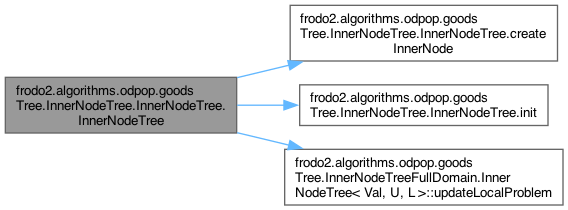
References frodo2.algorithms.odpop.goodsTree.InnerNodeTreeFullDomain.InnerNodeTree< Val, U, L >.branchingFactor, createInnerNode(), frodo2.algorithms.odpop.goodsTree.InnerNodeTreeFullDomain.InnerNodeTree< Val, U, L >.fullInfo, frodo2.algorithms.odpop.goodsTree.InnerNodeTreeFullDomain.InnerNodeTree< Val, U, L >.hasLocalProblem, init(), frodo2.algorithms.odpop.goodsTree.InnerNodeTreeFullDomain.InnerNodeTree< Val, U, L >.leafNodeInstance, frodo2.algorithms.odpop.goodsTree.InnerNodeTreeFullDomain.InnerNodeTree< Val, U, L >.numberOfChildren, frodo2.algorithms.odpop.goodsTree.InnerNodeTreeFullDomain.InnerNodeTree< Val, U, L >.root, and frodo2.algorithms.odpop.goodsTree.InnerNodeTreeFullDomain.InnerNodeTree< Val, U, L >.updateLocalProblem().
◆ InnerNodeTree() [6/6]
| frodo2.algorithms.odpop.goodsTree.InnerNodeTree.InnerNodeTree< Val extends Addable< Val >, U extends Addable< U >, L extends LeafNode< U > >.InnerNodeTree | ( | String | ownVariable, |
| Val[] | ownVariableDomain, | ||
| List< UtilitySolutionSpace< Val, U > > | spaces, | ||
| int | numberOfChildren, | ||
| U | zero, | ||
| L | leafNodeInstance, | ||
| U | infeasibleUtil, | ||
| boolean | maximize, | ||
| boolean | collectStats ) |
A constructor.
- Warning
- we assume that the agents own variable is put in the end of variables_order
- Parameters
-
ownVariable The variable ID ownVariableDomain The domain of ownVariablespaces The hypercubes representing the local problem numberOfChildren The number of children zero The zero utility leafNodeInstance an instance of the leaf node class infeasibleUtil The infeasible utility maximize when truewe are maximizing, whenfalsewe are minimizingcollectStats truewhen statistics should be collected, andfalseotherwise
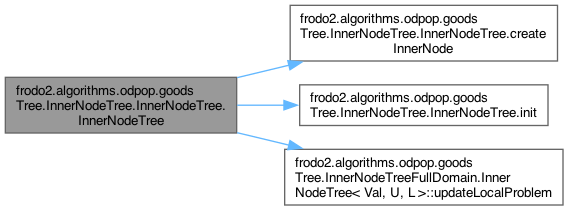
References createInnerNode(), frodo2.algorithms.odpop.goodsTree.InnerNodeTreeFullDomain.InnerNodeTree< Val, U, L >.domainSize, frodo2.algorithms.odpop.goodsTree.InnerNodeTreeFullDomain.InnerNodeTree< Val, U, L >.fullInfo, frodo2.algorithms.odpop.goodsTree.InnerNodeTreeFullDomain.InnerNodeTree< Val, U, L >.hasLocalProblem, init(), frodo2.algorithms.odpop.goodsTree.InnerNodeTreeFullDomain.InnerNodeTree< Val, U, L >.leafNodeInstance, frodo2.algorithms.odpop.goodsTree.InnerNodeTreeFullDomain.InnerNodeTree< Val, U, L >.numberOfChildren, frodo2.algorithms.odpop.goodsTree.InnerNodeTreeFullDomain.InnerNodeTree< Val, U, L >.root, and frodo2.algorithms.odpop.goodsTree.InnerNodeTreeFullDomain.InnerNodeTree< Val, U, L >.updateLocalProblem().
Member Function Documentation
◆ add() [1/2]
| boolean frodo2.algorithms.odpop.goodsTree.InnerNodeTree.InnerNodeTree< Val extends Addable< Val >, U extends Addable< U >, L extends LeafNode< U > >.add | ( | Good< Val, U > | g, |
| int | sender ) |
Adds a good to the tree.
- Parameters
-
g the good to be added sender the child that reported the good
- Returns
truewhen a new variable has been added, and false otherwise
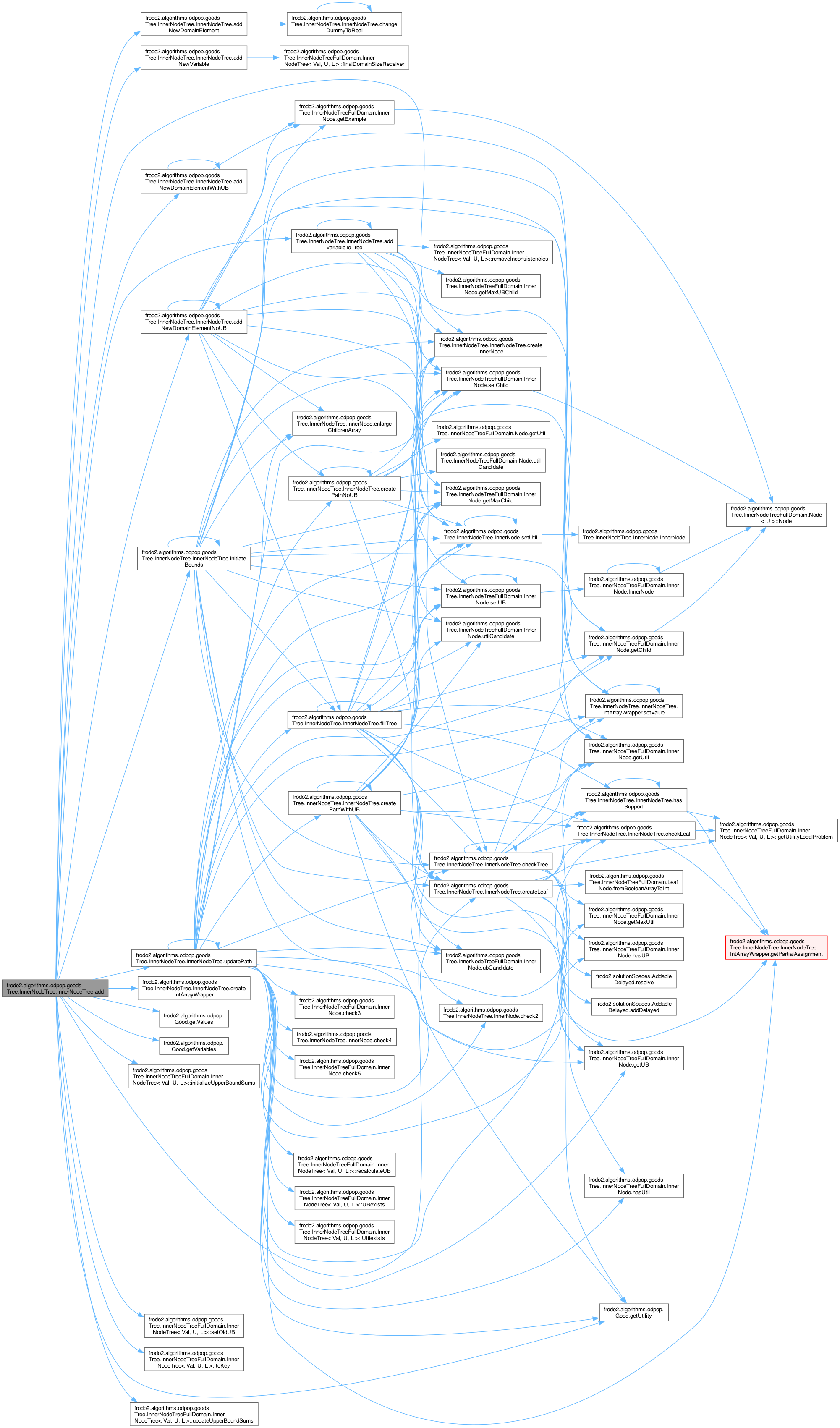
References addNewDomainElement(), addNewDomainElementNoUB(), addNewDomainElementWithUB(), addNewVariable(), addVariableToTree(), frodo2.algorithms.odpop.goodsTree.InnerNodeTreeFullDomain.InnerNodeTree< Val, U, L >.branchingFactor, checkTree(), frodo2.algorithms.odpop.goodsTree.InnerNodeTreeFullDomain.InnerNodeTree< Val, U, L >.childrenVariables, createInnerNode(), createIntArrayWrapper(), frodo2.algorithms.odpop.goodsTree.InnerNodeTreeFullDomain.InnerNodeTree< Val, U, L >.domainSize, dummy, frodo2.algorithms.odpop.goodsTree.InnerNodeTreeFullDomain.InnerNodeTree< Val, U, L >.finalDomainSize, frodo2.algorithms.odpop.Good< Val extends Addable< Val >, U extends Addable< U > >.getUtility(), frodo2.algorithms.odpop.Good< Val extends Addable< Val >, U extends Addable< U > >.getValues(), frodo2.algorithms.odpop.Good< Val extends Addable< Val >, U extends Addable< U > >.getVariables(), goodsReceived, frodo2.algorithms.odpop.goodsTree.InnerNodeTreeFullDomain.InnerNodeTree< Val, U, L >.initializeUpperBoundSums(), initiateBounds(), frodo2.algorithms.odpop.goodsTree.InnerNodeTreeFullDomain.InnerNodeTree< Val, U, L >.localCounter, frodo2.algorithms.odpop.goodsTree.InnerNodeTreeFullDomain.InnerNodeTree< Val, U, L >.maxNumberLocalProblemOccurences, frodo2.algorithms.odpop.goodsTree.InnerNodeTreeFullDomain.InnerNodeTree< Val, U, L >.numberOfChildren, frodo2.algorithms.odpop.goodsTree.InnerNodeTreeFullDomain.InnerNodeTree< Val, U, L >.oldUB, frodo2.algorithms.odpop.goodsTree.InnerNodeTreeFullDomain.InnerNodeTree< Val, U, L >.ownVariables, frodo2.algorithms.odpop.goodsTree.InnerNodeTreeFullDomain.InnerNodeTree< Val, U, L >.root, frodo2.algorithms.odpop.goodsTree.InnerNodeTreeFullDomain.InnerNodeTree< Val, U, L >.separatorSizePerChild, frodo2.algorithms.odpop.goodsTree.InnerNodeTreeFullDomain.InnerNodeTree< Val, U, L >.setOldUB(), frodo2.algorithms.odpop.goodsTree.InnerNodeTreeFullDomain.InnerNodeTree< Val, U, L >.storeReceivedGoods, frodo2.algorithms.odpop.goodsTree.InnerNodeTreeFullDomain.InnerNodeTree< Val, U, L >.toKey(), updatePath(), frodo2.algorithms.odpop.goodsTree.InnerNodeTreeFullDomain.InnerNodeTree< Val, U, L >.updateUpperBoundSums(), frodo2.algorithms.odpop.goodsTree.InnerNodeTreeFullDomain.InnerNodeTree< Val, U, L >.upperBoundIsInfiniteCounter, frodo2.algorithms.odpop.goodsTree.InnerNodeTreeFullDomain.InnerNodeTree< Val, U, L >.upperBounds, frodo2.algorithms.odpop.goodsTree.InnerNodeTreeFullDomain.InnerNodeTree< Val, U, L >.upperBoundSums, frodo2.algorithms.odpop.goodsTree.InnerNodeTreeFullDomain.InnerNodeTree< Val, U, L >.valuePointers, and frodo2.algorithms.odpop.goodsTree.InnerNodeTreeFullDomain.InnerNodeTree< Val, U, L >.variableToDepth.
◆ add() [2/2]
| boolean frodo2.algorithms.odpop.goodsTree.InnerNodeTree.InnerNodeTree< Val extends Addable< Val >, U extends Addable< U >, L extends LeafNode< U > >.add | ( | Good< Val, U > | g, |
| int | sender, | ||
| HashMap< String, Val[]> | domains ) |
- See also
- frodo2.algorithms.odpop.goodsTree.GoodsTree.add(frodo2.algorithms.odpop.Good, int, java.util.HashMap)
References frodo2.algorithms.odpop.goodsTree.InnerNodeTreeFullDomain.InnerNodeTree< Val, U, L >.domains.
◆ addNewDomainElement()
|
protected |
This method adds a new variable to the data structure.
Note that it does not need to update the tree, this automatically happens when adding the compatible paths to the tree
- Parameters
-
newValues The new domain elements that must be added
References frodo2.algorithms.odpop.goodsTree.InnerNodeTreeFullDomain.InnerNodeTree< Val, U, L >.branchingFactor, changeDummyToReal(), frodo2.algorithms.odpop.goodsTree.InnerNodeTreeFullDomain.InnerNodeTree< Val, U, L >.domains, frodo2.algorithms.odpop.goodsTree.InnerNodeTreeFullDomain.InnerNodeTree< Val, U, L >.domainSize, dummy, frodo2.algorithms.odpop.goodsTree.InnerNodeTreeFullDomain.InnerNodeTree< Val, U, L >.finalDomainSize, frodo2.algorithms.odpop.goodsTree.InnerNodeTreeFullDomain.InnerNodeTree< Val, U, L >.localCounter, frodo2.algorithms.odpop.goodsTree.InnerNodeTreeFullDomain.InnerNodeTree< Val, U, L >.maxNumberLocalProblemOccurences, frodo2.algorithms.odpop.goodsTree.InnerNodeTreeFullDomain.InnerNodeTree< Val, U, L >.ownVariables, frodo2.algorithms.odpop.goodsTree.InnerNodeTreeFullDomain.InnerNodeTree< Val, U, L >.root, frodo2.algorithms.odpop.goodsTree.InnerNodeTreeFullDomain.InnerNodeTree< Val, U, L >.upperBoundIsInfiniteCounter, frodo2.algorithms.odpop.goodsTree.InnerNodeTreeFullDomain.InnerNodeTree< Val, U, L >.valuePointers, and frodo2.algorithms.odpop.goodsTree.InnerNodeTreeFullDomain.InnerNodeTree< Val, U, L >.variableToDepth.
Referenced by add().

◆ addNewDomainElementNoUB()
|
protected |
This method is called when a new domain element is discovered before the UBs can be calculated.
It searches the tree up to the horizon depth for new branches to add. A new branch is only added when it represents a new domain element found in this round
- Parameters
-
depth the current depth horizon the maximal depth at which a dummy node can be found currentPath the current path taken partialPath the partial path defined by the received good newDomainPath the partial path defined by the new domain values currentNodeUncast the node currently visited g the received good utilityDelta the difference with the previously reported utility value for this particular good sender the sender of the good onPartialPath truewhen the partial path is still being followed, andfalseotherwisefill truewhen the tree should be extended by copying an already existing branch
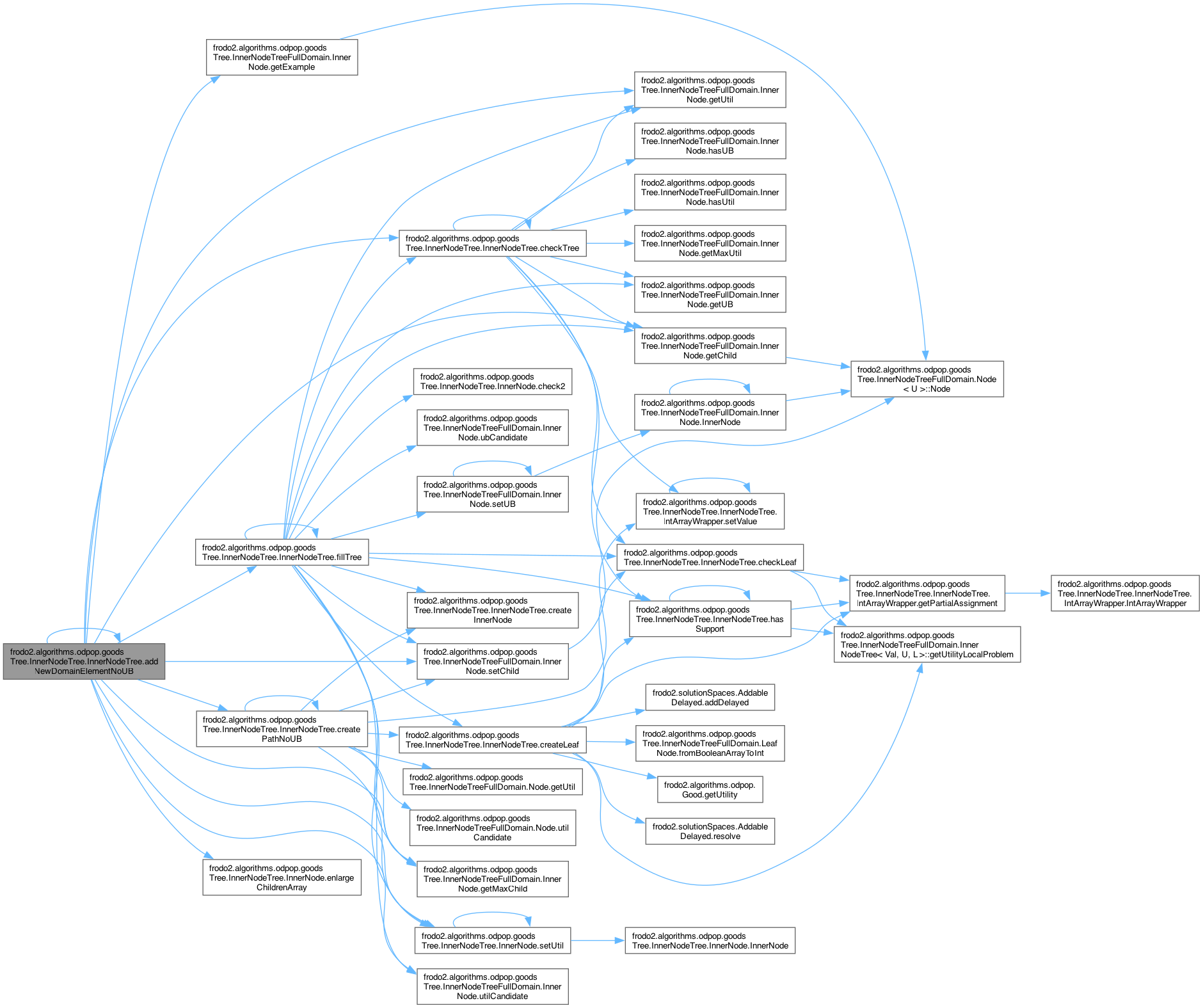
References addNewDomainElementNoUB(), frodo2.algorithms.odpop.goodsTree.InnerNodeTreeFullDomain.InnerNodeTree< Val, U, L >.branchingFactor, checkTree(), frodo2.algorithms.odpop.goodsTree.InnerNodeTreeFullDomain.InnerNode< U extends Addable< U >, L extends LeafNode< U > >.children, createPathNoUB(), frodo2.algorithms.odpop.goodsTree.InnerNodeTreeFullDomain.InnerNodeTree< Val, U, L >.domainSize, frodo2.algorithms.odpop.goodsTree.InnerNodeTree.InnerNode< U extends Addable< U >, L extends LeafNode< U > >.enlargeChildrenArray(), fillTree(), frodo2.algorithms.odpop.goodsTree.InnerNodeTreeFullDomain.InnerNode< U extends Addable< U >, L extends LeafNode< U > >.getChild(), frodo2.algorithms.odpop.goodsTree.InnerNodeTreeFullDomain.InnerNode< U extends Addable< U >, L extends LeafNode< U > >.getExample(), frodo2.algorithms.odpop.goodsTree.InnerNodeTreeFullDomain.InnerNode< U extends Addable< U >, L extends LeafNode< U > >.getMaxChild(), frodo2.algorithms.odpop.goodsTree.InnerNodeTreeFullDomain.InnerNode< U extends Addable< U >, L extends LeafNode< U > >.getUtil(), frodo2.algorithms.odpop.goodsTree.InnerNodeTree.InnerNode< U extends Addable< U >, L extends LeafNode< U > >.real, frodo2.algorithms.odpop.goodsTree.InnerNodeTreeFullDomain.InnerNode< U extends Addable< U >, L extends LeafNode< U > >.setChild(), frodo2.algorithms.odpop.goodsTree.InnerNodeTree.InnerNode< U extends Addable< U >, L extends LeafNode< U > >.setUtil(), and frodo2.algorithms.odpop.goodsTree.InnerNodeTreeFullDomain.InnerNode< U extends Addable< U >, L extends LeafNode< U > >.utilCandidate().
Referenced by add(), and addNewDomainElementNoUB().
◆ addNewDomainElementWithUB()
|
protected |
This method is called when a new domain element is discovered while the UB is already set.
It searches the tree up to the horizon depth for new branches to add. A new branch is only added when it represents a new domain element found. If the upper bound must be recalculated this is done.
- Parameters
-
depth The current depth horizon The depth until which the search for non-existing children must continue currentPath The current path partialPath The path dictated by the received good newDomainPath the partial path defined by the new domain values currentNodeUncast the node currently visited g the received good utilityDelta the difference between the already received utility and the new utility defined by the received good. Is only used in ASODPOP sender the sender of the good onPartialPath truewhen the partial path is still being followed, andfalseotherwisefill truewhen the tree should be extend by copying an already existing branch
- Todo
- copy this function into the ASODPOp goodstree and change it!
child is max util candidate
- Todo
- : again, in the case of ASODPOP this should only be done when the good is confirmed
References addNewDomainElementWithUB(), and frodo2.algorithms.odpop.goodsTree.InnerNodeTreeFullDomain.InnerNode< U extends Addable< U >, L extends LeafNode< U > >.getExample().
Referenced by add(), and addNewDomainElementWithUB().

◆ addNewVariable()
|
protected |
This method adds new variables to the data structure.
- Parameters
-
allVariables The current variables newVariables The variables to be added sender The child that reported the variables
- Returns
- the number of new variables
References frodo2.algorithms.odpop.goodsTree.InnerNodeTreeFullDomain.InnerNodeTree< Val, U, L >.branchingFactor, frodo2.algorithms.odpop.goodsTree.InnerNodeTreeFullDomain.InnerNodeTree< Val, U, L >.childrenVariables, frodo2.algorithms.odpop.goodsTree.InnerNodeTreeFullDomain.InnerNodeTree< Val, U, L >.domains, frodo2.algorithms.odpop.goodsTree.InnerNodeTreeFullDomain.InnerNodeTree< Val, U, L >.domainSize, dummy, dummyDepth, frodo2.algorithms.odpop.goodsTree.InnerNodeTreeFullDomain.InnerNodeTree< Val, U, L >.finalDomainSize, frodo2.algorithms.odpop.goodsTree.InnerNodeTreeFullDomain.InnerNodeTree< Val, U, L >.finalDomainSizeReceiver(), finalDomainSizeUnknownVariables, frodo2.algorithms.odpop.goodsTree.InnerNodeTreeFullDomain.InnerNodeTree< Val, U, L >.hasLocalProblem, frodo2.algorithms.odpop.goodsTree.InnerNodeTreeFullDomain.InnerNodeTree< Val, U, L >.localCounter, frodo2.algorithms.odpop.goodsTree.InnerNodeTreeFullDomain.InnerNodeTree< Val, U, L >.maxNumberLocalProblemOccurences, frodo2.algorithms.odpop.goodsTree.InnerNodeTreeFullDomain.InnerNodeTree< Val, U, L >.numberOfChildren, frodo2.algorithms.odpop.goodsTree.InnerNodeTreeFullDomain.InnerNodeTree< Val, U, L >.optimalLocalPath, frodo2.algorithms.odpop.goodsTree.InnerNodeTreeFullDomain.InnerNodeTree< Val, U, L >.ownVariables, frodo2.algorithms.odpop.goodsTree.InnerNodeTreeFullDomain.InnerNodeTree< Val, U, L >.valuePointers, and frodo2.algorithms.odpop.goodsTree.InnerNodeTreeFullDomain.InnerNodeTree< Val, U, L >.variableToDepth.
Referenced by add().

◆ addVariableToTree()
|
private |
This method is called when variables are received.
The new variables are placed at the root
- Parameters
-
nbrNewVariables The number of variables to add depth The current depth oldRoot The old root currentNode The current node possibleInconsistencies truewhen the reception of a new variable can make certain solutions infeasible
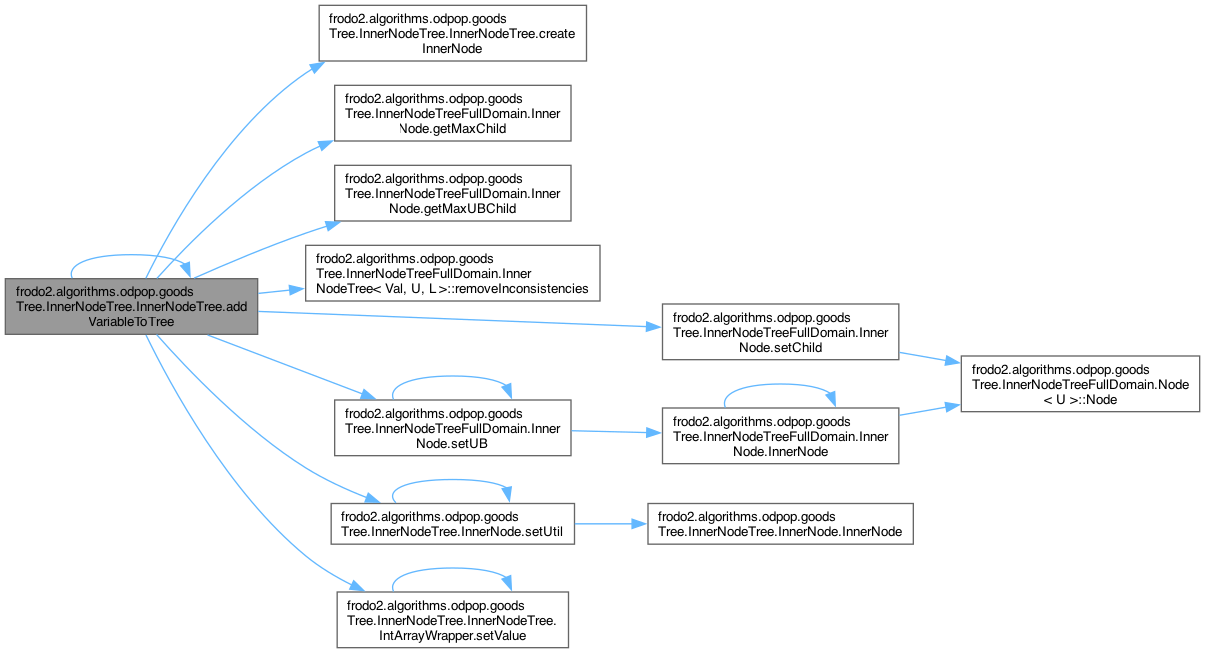
References addVariableToTree(), createInnerNode(), frodo2.algorithms.odpop.goodsTree.InnerNodeTreeFullDomain.InnerNode< U extends Addable< U >, L extends LeafNode< U > >.getMaxChild(), frodo2.algorithms.odpop.goodsTree.InnerNodeTreeFullDomain.InnerNode< U extends Addable< U >, L extends LeafNode< U > >.getMaxUBChild(), frodo2.algorithms.odpop.goodsTree.InnerNodeTreeFullDomain.InnerNodeTree< Val, U, L >.removeInconsistencies(), frodo2.algorithms.odpop.goodsTree.InnerNodeTreeFullDomain.InnerNode< U extends Addable< U >, L extends LeafNode< U > >.setChild(), frodo2.algorithms.odpop.goodsTree.InnerNodeTreeFullDomain.InnerNode< U extends Addable< U >, L extends LeafNode< U > >.setUB(), frodo2.algorithms.odpop.goodsTree.InnerNodeTree.InnerNode< U extends Addable< U >, L extends LeafNode< U > >.setUtil(), and frodo2.algorithms.odpop.goodsTree.InnerNodeTree.InnerNodeTree< Val extends Addable< Val >, U extends Addable< U >, L extends LeafNode< U > >.IntArrayWrapper.setValue().
Referenced by add(), and addVariableToTree().
◆ changeDummyToReal() [1/2]
|
protected |
Changes all dummy children of the variables in dummyToReal to real nodes.
- Parameters
-
depth the current depth currentNode the node currently being visited change truewhen we still want to change things
References changeDummyToReal(), and dummyDepth.
Referenced by addNewDomainElement(), changeDummyToReal(), and changeDummyToReal().
◆ changeDummyToReal() [2/2]
|
protected |
Changes all dummy children of the variables in dummyToReal to real nodes.
- Parameters
-
depth the current depth currentPath the path taken through the tree to get here currentNode the node currently being visited change truewhen we still want to change things
References changeDummyToReal().

◆ checkDummy()
|
private |
Check whether only the parts of the tree that should be dummy are dummy.
- Parameters
-
depth The current depth currentNode the current node being visited
- Returns
true
References frodo2.algorithms.odpop.goodsTree.InnerNodeTreeFullDomain.InnerNodeTree< Val, U, L >.branchingFactor, checkDummy(), dummy, and frodo2.algorithms.odpop.goodsTree.InnerNodeTreeFullDomain.InnerNode< U extends Addable< U >, L extends LeafNode< U > >.getChild().
Referenced by checkDummy().

◆ checkLeaf()
| boolean frodo2.algorithms.odpop.goodsTree.InnerNodeTree.InnerNodeTree< Val extends Addable< Val >, U extends Addable< U >, L extends LeafNode< U > >.checkLeaf | ( | L | leaf, |
| IntArrayWrapper | currentPath, | ||
| boolean | checkUB, | ||
| U | utility, | ||
| int | sender ) |
Method to check that the utility and UB are consistent with the available information.
The utility should match exactly, but because UBs are only recomputed when necessary, and then should only decrease by such a recomputation, the stored UB should be at least as high as the real UB
- Parameters
-
leaf the leaf to be checked currentPath the path to this leaf checkUB truewhen the UB must be checkedutility the utility reported by the sender sender the sender of the good
- Returns
- always returns true
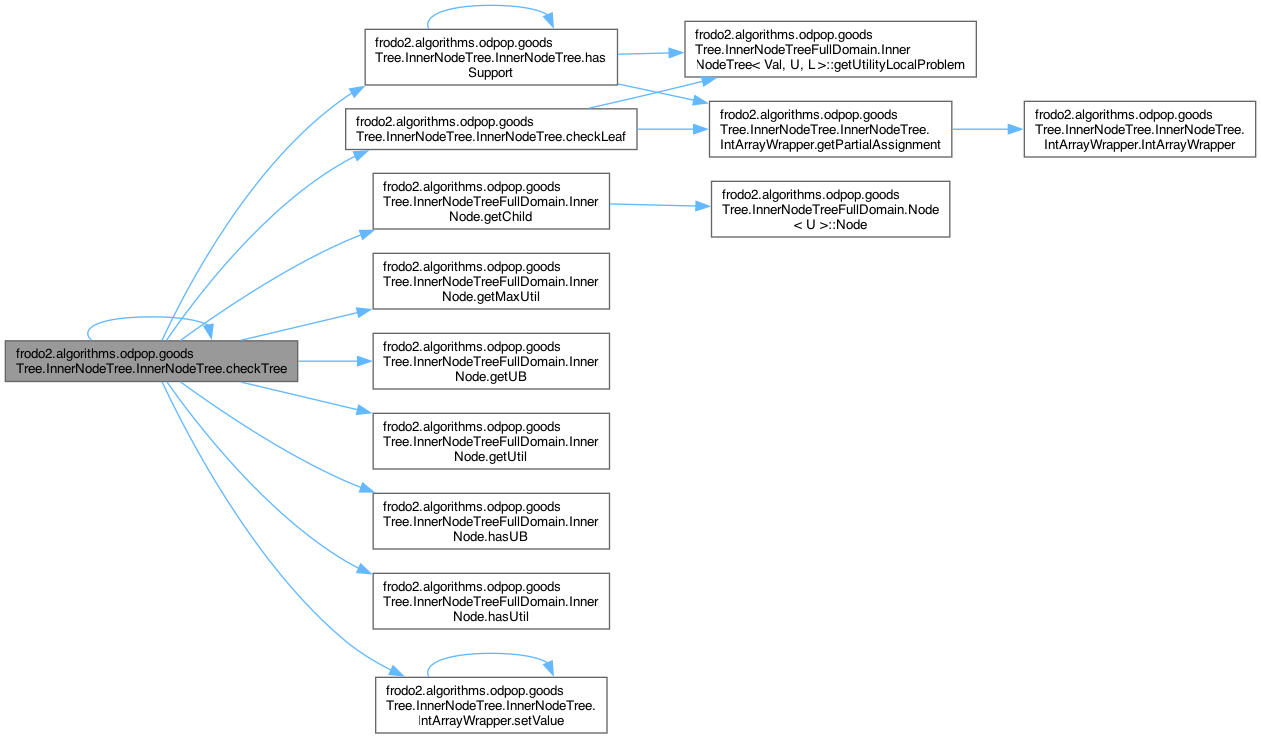
References frodo2.algorithms.odpop.goodsTree.InnerNodeTreeFullDomain.InnerNodeTree< Val, U, L >.childrenVariables, frodo2.algorithms.odpop.goodsTree.InnerNodeTree.InnerNodeTree< Val extends Addable< Val >, U extends Addable< U >, L extends LeafNode< U > >.IntArrayWrapper.getPartialAssignment(), frodo2.algorithms.odpop.goodsTree.InnerNodeTreeFullDomain.InnerNodeTree< Val, U, L >.getUtilityLocalProblem(), goodsReceived, frodo2.algorithms.odpop.goodsTree.InnerNodeTreeFullDomain.InnerNodeTree< Val, U, L >.numberOfChildren, and frodo2.algorithms.odpop.goodsTree.InnerNodeTreeFullDomain.InnerNodeTree< Val, U, L >.upperBounds.
Referenced by checkTree(), createLeaf(), createLeaf(), createPathWithUB(), fillTree(), and updatePath().

◆ checkTree()
|
protected |
This method checks the tree on the following properties.
- the UB is properly propagated
- the utility is properly propagated
- every leaf node with support is present
- no UB is greater than the old upper bound
- Parameters
-
depth the current depth currentNodeUncast the current node being visited currentPathUncast the current path taken UB the current UB checkLeafs truewhen the leaves are to be checkedcheckSupport checkwhether existing leaf nodes actually have supportcheckUtil truewhen utility values should be checked
- Returns
- always returns true
References frodo2.algorithms.odpop.goodsTree.InnerNodeTreeFullDomain.InnerNodeTree< Val, U, L >.branchingFactor, checkLeaf(), checkTree(), frodo2.algorithms.odpop.goodsTree.InnerNodeTreeFullDomain.InnerNodeTree< Val, U, L >.domainSize, dummy, frodo2.algorithms.odpop.goodsTree.InnerNodeTreeFullDomain.InnerNode< U extends Addable< U >, L extends LeafNode< U > >.getChild(), frodo2.algorithms.odpop.goodsTree.InnerNodeTreeFullDomain.InnerNode< U extends Addable< U >, L extends LeafNode< U > >.getMaxUtil(), frodo2.algorithms.odpop.goodsTree.InnerNodeTreeFullDomain.InnerNode< U extends Addable< U >, L extends LeafNode< U > >.getUB(), frodo2.algorithms.odpop.goodsTree.InnerNodeTreeFullDomain.InnerNode< U extends Addable< U >, L extends LeafNode< U > >.getUtil(), hasSupport(), frodo2.algorithms.odpop.goodsTree.InnerNodeTreeFullDomain.InnerNode< U extends Addable< U >, L extends LeafNode< U > >.hasUB(), frodo2.algorithms.odpop.goodsTree.InnerNodeTreeFullDomain.InnerNode< U extends Addable< U >, L extends LeafNode< U > >.hasUtil(), frodo2.algorithms.odpop.goodsTree.InnerNodeTree.InnerNodeTree< Val extends Addable< Val >, U extends Addable< U >, L extends LeafNode< U > >.IntArrayWrapper.setValue(), and frodo2.algorithms.odpop.goodsTree.InnerNodeTreeFullDomain.InnerNodeTree< Val, U, L >.upperBoundIsInfiniteCounter.
Referenced by add(), addNewDomainElementNoUB(), checkTree(), fillTree(), initiateBounds(), and updatePath().
◆ createInnerNode() [1/2]
|
protected |
- See also
- frodo2.algorithms.odpop.goodsTree.InnerNodeTreeFullDomain.InnerNodeTree.createInnerNode(int)
References frodo2.algorithms.odpop.goodsTree.InnerNodeTreeFullDomain.InnerNodeTree< Val, U, L >.numberOfChildren.
Referenced by add(), addVariableToTree(), createPathNoUB(), createPathWithUB(), fillTree(), initiateBounds(), InnerNodeTree(), and InnerNodeTree().
◆ createInnerNode() [2/2]
◆ createIntArrayWrapper() [1/2]
| IntArrayWrapper frodo2.algorithms.odpop.goodsTree.InnerNodeTree.InnerNodeTree< Val extends Addable< Val >, U extends Addable< U >, L extends LeafNode< U > >.createIntArrayWrapper | ( | int | size | ) |
◆ createIntArrayWrapper() [2/2]
| IntArrayWrapper frodo2.algorithms.odpop.goodsTree.InnerNodeTree.InnerNodeTree< Val extends Addable< Val >, U extends Addable< U >, L extends LeafNode< U > >.createIntArrayWrapper | ( | int[] | array | ) |
◆ createLeaf() [1/2]
|
protected |
Method to create a new leaf node.
- Parameters
-
currentPath The path to the leaf real truewhen the leaf points to a real assignmentwithUB truewhen the upper bound must be set
- Returns
- the new leaf node
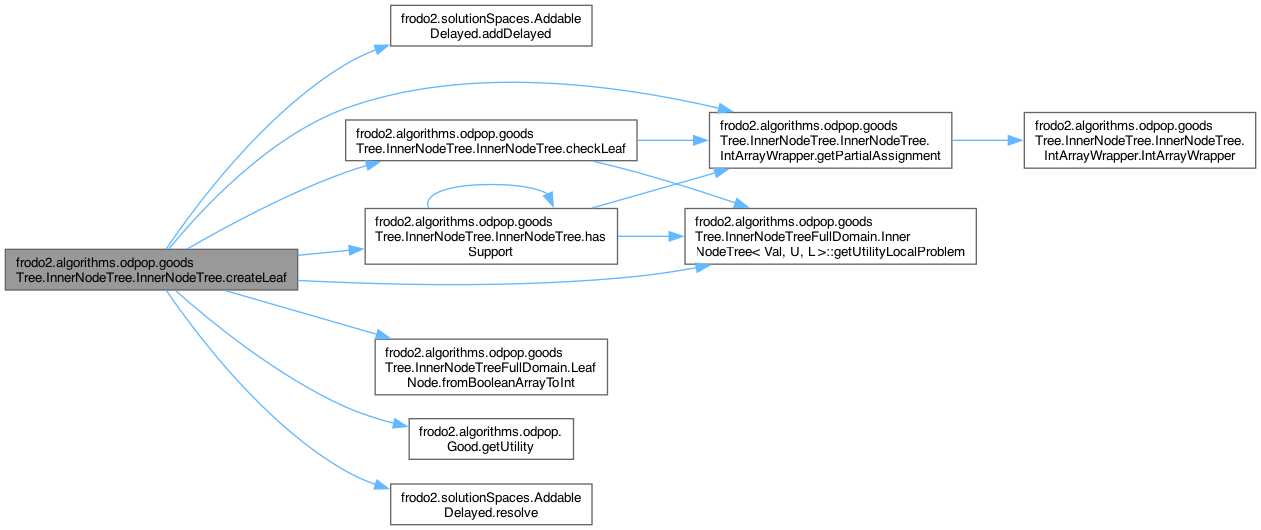
References frodo2.solutionSpaces.AddableDelayed< T extends Addable< T > >.addDelayed(), checkLeaf(), frodo2.algorithms.odpop.goodsTree.InnerNodeTreeFullDomain.InnerNodeTree< Val, U, L >.childrenVariables, frodo2.algorithms.odpop.goodsTree.InnerNodeTreeFullDomain.LeafNode< U extends Addable< U > >.fromBooleanArrayToInt(), frodo2.algorithms.odpop.goodsTree.InnerNodeTree.InnerNodeTree< Val extends Addable< Val >, U extends Addable< U >, L extends LeafNode< U > >.IntArrayWrapper.getPartialAssignment(), frodo2.algorithms.odpop.goodsTree.InnerNodeTreeFullDomain.InnerNodeTree< Val, U, L >.getUtilityLocalProblem(), goodsReceived, hasSupport(), frodo2.algorithms.odpop.goodsTree.InnerNodeTreeFullDomain.InnerNodeTree< Val, U, L >.leafNodeInstance, frodo2.algorithms.odpop.goodsTree.InnerNodeTreeFullDomain.InnerNodeTree< Val, U, L >.numberOfChildren, frodo2.algorithms.odpop.goodsTree.InnerNodeTreeFullDomain.InnerNodeTree< Val, U, L >.powersOf2, frodo2.solutionSpaces.AddableDelayed< T extends Addable< T > >.resolve(), frodo2.algorithms.odpop.goodsTree.InnerNodeTreeFullDomain.InnerNodeTree< Val, U, L >.storeReceivedGoods, and frodo2.algorithms.odpop.goodsTree.InnerNodeTreeFullDomain.InnerNodeTree< Val, U, L >.upperBoundSums.
◆ createLeaf() [2/2]
|
protected |
Method to create a new leaf node.
- Parameters
-
currentPath The path to the leaf real truewhen the leaf points to a real assignmentg the received good child the child that reported it withUB truewhen the upper bound must be set
- Returns
- the new leaf node
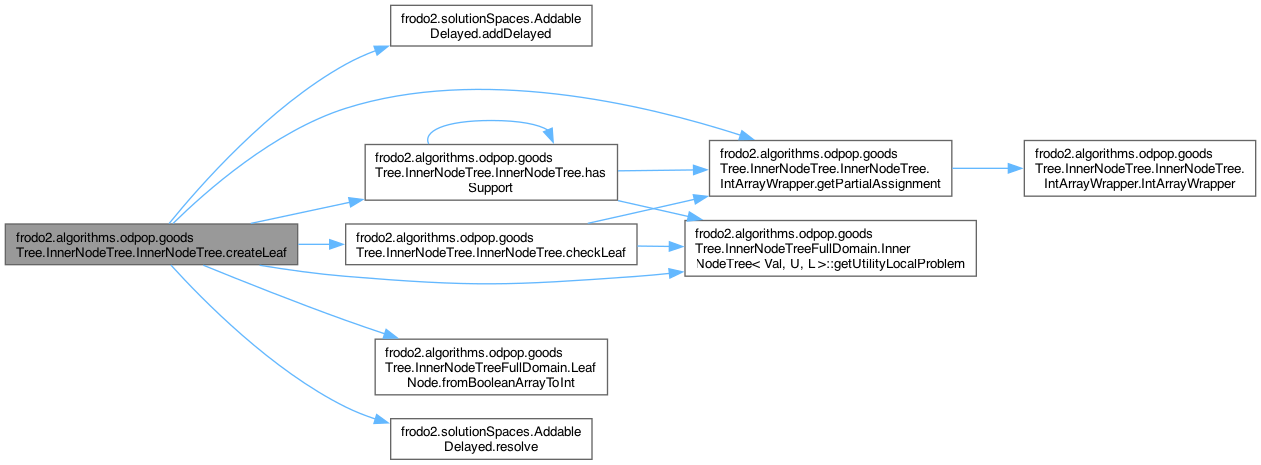
References frodo2.solutionSpaces.AddableDelayed< T extends Addable< T > >.addDelayed(), checkLeaf(), frodo2.algorithms.odpop.goodsTree.InnerNodeTreeFullDomain.InnerNodeTree< Val, U, L >.childrenVariables, frodo2.algorithms.odpop.goodsTree.InnerNodeTreeFullDomain.LeafNode< U extends Addable< U > >.fromBooleanArrayToInt(), frodo2.algorithms.odpop.goodsTree.InnerNodeTree.InnerNodeTree< Val extends Addable< Val >, U extends Addable< U >, L extends LeafNode< U > >.IntArrayWrapper.getPartialAssignment(), frodo2.algorithms.odpop.Good< Val extends Addable< Val >, U extends Addable< U > >.getUtility(), frodo2.algorithms.odpop.goodsTree.InnerNodeTreeFullDomain.InnerNodeTree< Val, U, L >.getUtilityLocalProblem(), goodsReceived, hasSupport(), frodo2.algorithms.odpop.goodsTree.InnerNodeTreeFullDomain.InnerNodeTree< Val, U, L >.leafNodeInstance, frodo2.algorithms.odpop.goodsTree.InnerNodeTreeFullDomain.InnerNodeTree< Val, U, L >.numberOfChildren, frodo2.algorithms.odpop.goodsTree.InnerNodeTreeFullDomain.InnerNodeTree< Val, U, L >.powersOf2, frodo2.solutionSpaces.AddableDelayed< T extends Addable< T > >.resolve(), frodo2.algorithms.odpop.goodsTree.InnerNodeTreeFullDomain.InnerNodeTree< Val, U, L >.storeReceivedGoods, and frodo2.algorithms.odpop.goodsTree.InnerNodeTreeFullDomain.InnerNodeTree< Val, U, L >.upperBoundSums.
Referenced by createPathNoUB(), createPathWithUB(), fillTree(), initiateBounds(), and updatePath().
◆ createPathNoUB()
|
protected |
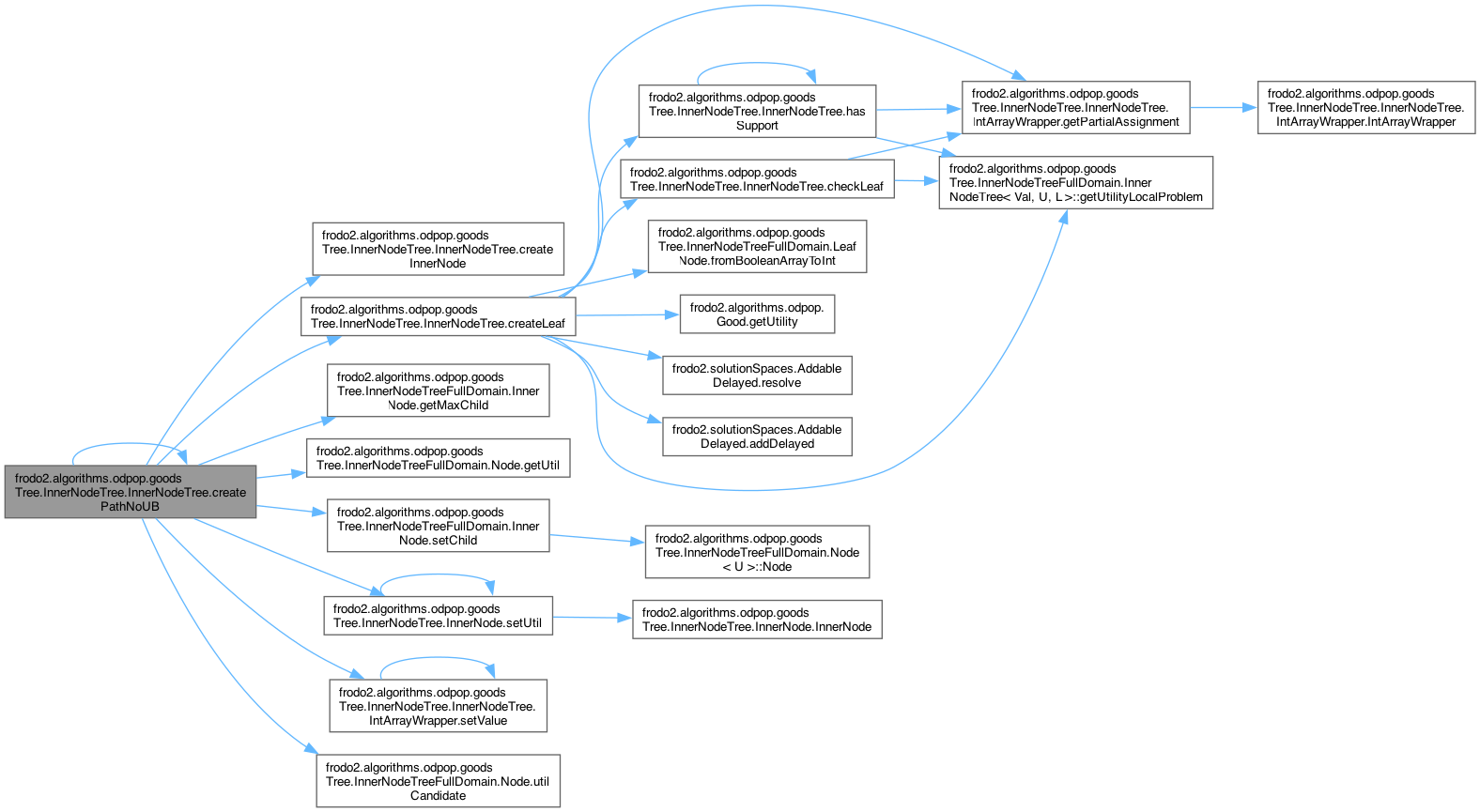
Given a partial path, this method creates the path in the tree.
This method should only be called after domain information is complete!
- Parameters
-
depth the current depth currentPathUncast the path taken partialPath the partial path defined by the received good real truewhen still in the real part of the treeg the received good sender the sender of the good
- Returns
- a new InnerNode
References frodo2.algorithms.odpop.goodsTree.InnerNodeTreeFullDomain.InnerNodeTree< Val, U, L >.branchingFactor, createInnerNode(), createLeaf(), createPathNoUB(), frodo2.algorithms.odpop.goodsTree.InnerNodeTreeFullDomain.InnerNodeTree< Val, U, L >.domains, frodo2.algorithms.odpop.goodsTree.InnerNodeTreeFullDomain.InnerNodeTree< Val, U, L >.domainSize, frodo2.algorithms.odpop.goodsTree.InnerNodeTreeFullDomain.InnerNode< U extends Addable< U >, L extends LeafNode< U > >.getMaxChild(), frodo2.algorithms.odpop.goodsTree.InnerNodeTreeFullDomain.Node< U extends Addable< U > >.getUtil(), frodo2.algorithms.odpop.goodsTree.InnerNodeTreeFullDomain.InnerNode< U extends Addable< U >, L extends LeafNode< U > >.setChild(), frodo2.algorithms.odpop.goodsTree.InnerNodeTree.InnerNode< U extends Addable< U >, L extends LeafNode< U > >.setUtil(), frodo2.algorithms.odpop.goodsTree.InnerNodeTree.InnerNodeTree< Val extends Addable< Val >, U extends Addable< U >, L extends LeafNode< U > >.IntArrayWrapper.setValue(), and frodo2.algorithms.odpop.goodsTree.InnerNodeTreeFullDomain.Node< U extends Addable< U > >.utilCandidate().
Referenced by addNewDomainElementNoUB(), createPathNoUB(), and updatePath().
◆ createPathWithUB()
|
private |
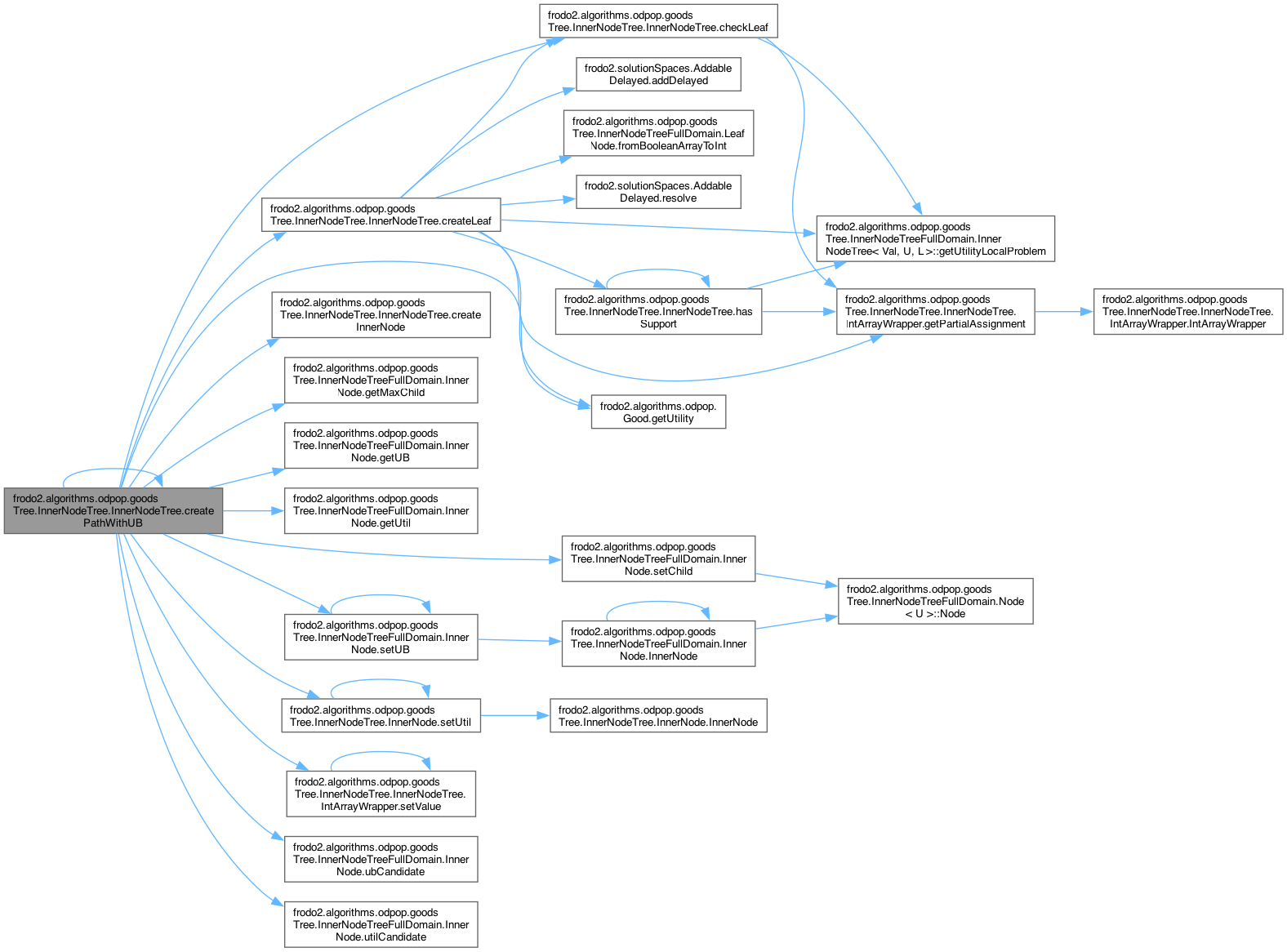
Given a partial path, this method creates the path in the tree.
This method should only be called after domain information is complete!
- Parameters
-
depth the current depth currentPathUncast the path taking in the tree partialPath the partial path defined by the received good real trueif the parent is a real nodeg the received good sender the sender of the good
- Returns
- a new InnerNode
References frodo2.algorithms.odpop.goodsTree.InnerNodeTreeFullDomain.InnerNodeTree< Val, U, L >.branchingFactor, checkLeaf(), createInnerNode(), createLeaf(), createPathWithUB(), frodo2.algorithms.odpop.goodsTree.InnerNodeTreeFullDomain.InnerNodeTree< Val, U, L >.domains, frodo2.algorithms.odpop.goodsTree.InnerNodeTreeFullDomain.InnerNodeTree< Val, U, L >.domainSize, dummy, frodo2.algorithms.odpop.goodsTree.InnerNodeTreeFullDomain.InnerNode< U extends Addable< U >, L extends LeafNode< U > >.getMaxChild(), frodo2.algorithms.odpop.goodsTree.InnerNodeTreeFullDomain.InnerNode< U extends Addable< U >, L extends LeafNode< U > >.getUB(), frodo2.algorithms.odpop.goodsTree.InnerNodeTreeFullDomain.InnerNode< U extends Addable< U >, L extends LeafNode< U > >.getUtil(), frodo2.algorithms.odpop.Good< Val extends Addable< Val >, U extends Addable< U > >.getUtility(), frodo2.algorithms.odpop.goodsTree.InnerNodeTreeFullDomain.InnerNode< U extends Addable< U >, L extends LeafNode< U > >.setChild(), frodo2.algorithms.odpop.goodsTree.InnerNodeTreeFullDomain.InnerNode< U extends Addable< U >, L extends LeafNode< U > >.setUB(), frodo2.algorithms.odpop.goodsTree.InnerNodeTree.InnerNode< U extends Addable< U >, L extends LeafNode< U > >.setUtil(), frodo2.algorithms.odpop.goodsTree.InnerNodeTree.InnerNodeTree< Val extends Addable< Val >, U extends Addable< U >, L extends LeafNode< U > >.IntArrayWrapper.setValue(), frodo2.algorithms.odpop.goodsTree.InnerNodeTreeFullDomain.InnerNode< U extends Addable< U >, L extends LeafNode< U > >.ubCandidate(), and frodo2.algorithms.odpop.goodsTree.InnerNodeTreeFullDomain.InnerNode< U extends Addable< U >, L extends LeafNode< U > >.utilCandidate().
Referenced by createPathWithUB(), and updatePath().
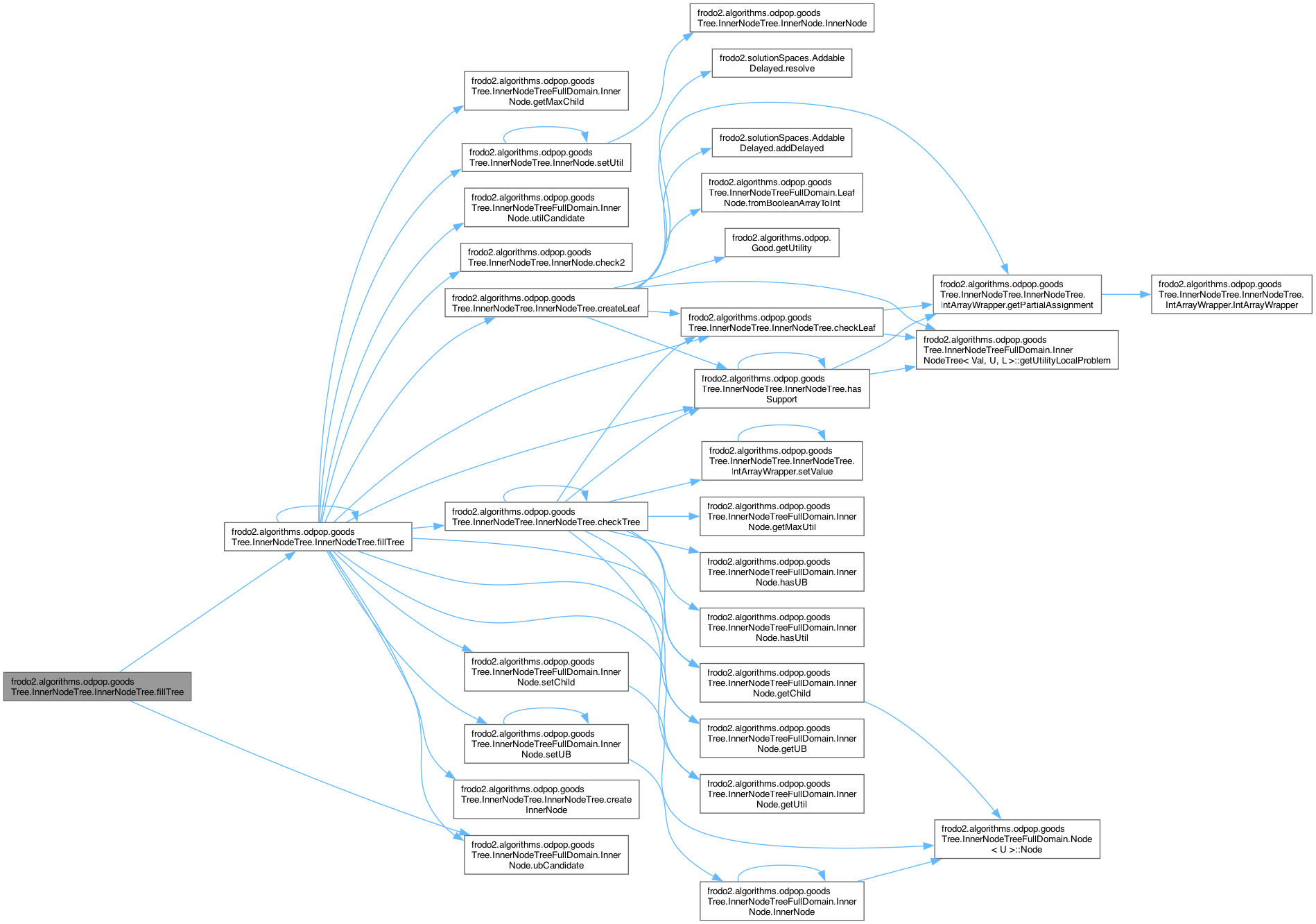
◆ fillTree() [1/2]
|
private |
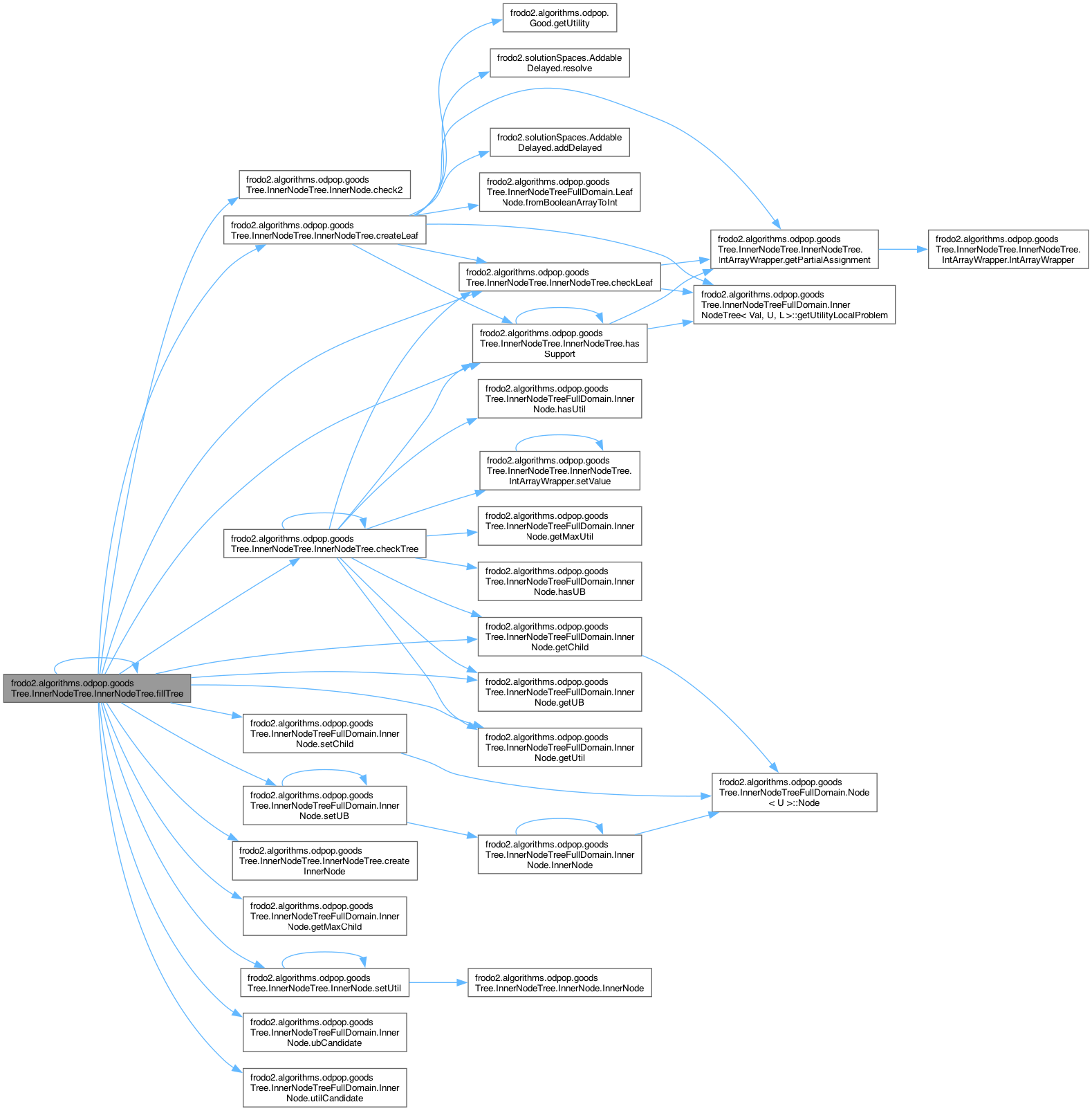
Fills a part of the tree that has been created by the reception of a new domain value.
- Parameters
-
depth the current depth currentPath the current path taken through the tree. Is only up to date up to depth real truewhen the current node should be a real node, andfalsewhen it should be a dummyonLocalPath truewhen we are still following the path of the currently best local solutionwithUB truewhen the UB must be instatiated as wellexample the example that is to be copied onPartialPath truethen the followed path is the same as the path defined by the received goodpartialPath the path defined by the received good g the received good sender the sender of the good
- Returns
- a new node
References frodo2.algorithms.odpop.goodsTree.InnerNodeTreeFullDomain.InnerNodeTree< Val, U, L >.branchingFactor, frodo2.algorithms.odpop.goodsTree.InnerNodeTree.InnerNode< U extends Addable< U >, L extends LeafNode< U > >.check2(), checkLeaf(), checkTree(), createInnerNode(), createLeaf(), frodo2.algorithms.odpop.goodsTree.InnerNodeTreeFullDomain.InnerNodeTree< Val, U, L >.domains, frodo2.algorithms.odpop.goodsTree.InnerNodeTreeFullDomain.InnerNodeTree< Val, U, L >.domainSize, fillTree(), frodo2.algorithms.odpop.goodsTree.InnerNodeTreeFullDomain.InnerNode< U extends Addable< U >, L extends LeafNode< U > >.getChild(), frodo2.algorithms.odpop.goodsTree.InnerNodeTreeFullDomain.InnerNode< U extends Addable< U >, L extends LeafNode< U > >.getMaxChild(), frodo2.algorithms.odpop.goodsTree.InnerNodeTreeFullDomain.InnerNode< U extends Addable< U >, L extends LeafNode< U > >.getUB(), frodo2.algorithms.odpop.goodsTree.InnerNodeTreeFullDomain.InnerNode< U extends Addable< U >, L extends LeafNode< U > >.getUtil(), hasSupport(), frodo2.algorithms.odpop.goodsTree.InnerNodeTreeFullDomain.InnerNodeTree< Val, U, L >.oldUB, frodo2.algorithms.odpop.goodsTree.InnerNodeTreeFullDomain.InnerNodeTree< Val, U, L >.optimalLocalPath, frodo2.algorithms.odpop.goodsTree.InnerNodeTreeFullDomain.InnerNode< U extends Addable< U >, L extends LeafNode< U > >.setChild(), frodo2.algorithms.odpop.goodsTree.InnerNodeTreeFullDomain.InnerNode< U extends Addable< U >, L extends LeafNode< U > >.setUB(), frodo2.algorithms.odpop.goodsTree.InnerNodeTree.InnerNode< U extends Addable< U >, L extends LeafNode< U > >.setUtil(), frodo2.algorithms.odpop.goodsTree.InnerNodeTreeFullDomain.InnerNode< U extends Addable< U >, L extends LeafNode< U > >.ubCandidate(), and frodo2.algorithms.odpop.goodsTree.InnerNodeTreeFullDomain.InnerNode< U extends Addable< U >, L extends LeafNode< U > >.utilCandidate().
Referenced by addNewDomainElementNoUB(), fillTree(), fillTree(), initiateBounds(), and updatePath().
◆ fillTree() [2/2]
|
private |
Fills a part of the tree that should be converted from dummy to real by the reception of a new domain value.
- Parameters
-
depth the current depth partialPath the partial path defined by the received good currentNode the current node currentPath the current path taken through the tree. Is only up to date up to depth g the received good utilityDelta the difference with the previously reported utility for this particlar good sender the sender of the good real truewhen the current node should be a real node, andfalsewhen it should be a dummyonLocalPath truewhen we are still following the path of the currently best local solutionwithUB truewhen the UB must be instantiated as wellonPartialPath truewhen we are still on the partial pathfill truewhen the tree should be extended by copying an already existing branch
References fillTree(), and frodo2.algorithms.odpop.goodsTree.InnerNodeTreeFullDomain.InnerNode< U extends Addable< U >, L extends LeafNode< U > >.ubCandidate().
◆ findUnused()
|
protected |
Check whether the assignment to the local problem, represented by localPath, can still be used somewhere.
Is only called from removeAmax()!!
- Parameters
-
depth the current depth localPath the part of the assignment to the local problem that has just been sent as a good currentNode the current node being visited
- Returns
truewhen there still is some use for the local problem assignment, andfalseotherwise
References findUnused().
Referenced by findUnused().
◆ getDomains()
| Val[][] frodo2.algorithms.odpop.goodsTree.InnerNodeTree.InnerNodeTree< Val extends Addable< Val >, U extends Addable< U >, L extends LeafNode< U > >.getDomains | ( | ) |
◆ getOwnVariableOptions()
|
protected |
Given the assignment of variables in its separator, this method returns the utility for all domain elements of the own variable.
- Parameters
-
optimalPath the path trough the tree that leads to the optimal leafnode assignments collection of assignments of variables in the separator
- Returns
- an array of utilities
References getOwnVariableOptions(), frodo2.algorithms.odpop.goodsTree.InnerNodeTreeFullDomain.InnerNodeTree< Val, U, L >.root, and frodo2.algorithms.odpop.goodsTree.InnerNodeTreeFullDomain.InnerNodeTree< Val, U, L >.valuePointers.
Referenced by getOwnVariableOptions().
◆ hasSupport()
|
protected |
Method to check whether a particular leaf node has support, i.e.
some child has reported an assignment compatible with currentPath
- Parameters
-
currentPath the path that leads to the leaf
- Returns
- true if the path has support and false otherwise
References frodo2.algorithms.odpop.goodsTree.InnerNodeTreeFullDomain.InnerNodeTree< Val, U, L >.childrenVariables, frodo2.algorithms.odpop.goodsTree.InnerNodeTree.InnerNodeTree< Val extends Addable< Val >, U extends Addable< U >, L extends LeafNode< U > >.IntArrayWrapper.getPartialAssignment(), frodo2.algorithms.odpop.goodsTree.InnerNodeTreeFullDomain.InnerNodeTree< Val, U, L >.getUtilityLocalProblem(), goodsReceived, hasSupport(), frodo2.algorithms.odpop.goodsTree.InnerNodeTreeFullDomain.InnerNodeTree< Val, U, L >.numberOfChildren, and frodo2.algorithms.odpop.goodsTree.InnerNodeTreeFullDomain.InnerNodeTree< Val, U, L >.storeReceivedGoods.
Referenced by checkTree(), createLeaf(), createLeaf(), fillTree(), and hasSupport().

◆ init()
|
protected |
Initialize all the variables of the tree.
- Parameters
-
numberOfChildren The number of children zero The zero utility
References frodo2.algorithms.odpop.goodsTree.InnerNodeTreeFullDomain.InnerNodeTree< Val, U, L >.branchingFactor, frodo2.algorithms.odpop.goodsTree.InnerNodeTreeFullDomain.InnerNodeTree< Val, U, L >.childrenVariables, frodo2.algorithms.odpop.goodsTree.InnerNodeTreeFullDomain.InnerNodeTree< Val, U, L >.childrenVariablesReportingOrder, frodo2.algorithms.odpop.goodsTree.InnerNodeTreeFullDomain.InnerNodeTree< Val, U, L >.domains, frodo2.algorithms.odpop.goodsTree.InnerNodeTreeFullDomain.InnerNodeTree< Val, U, L >.domainSize, dummy, dummyDepth, frodo2.algorithms.odpop.goodsTree.InnerNodeTreeFullDomain.InnerNodeTree< Val, U, L >.finalDomainSize, finalDomainSizeUnknownVariables, frodo2.algorithms.odpop.goodsTree.InnerNodeTreeFullDomain.InnerNodeTree< Val, U, L >.fullInfoCounter, goodsReceived, frodo2.algorithms.odpop.goodsTree.InnerNodeTreeFullDomain.InnerNodeTree< Val, U, L >.localCounter, frodo2.algorithms.odpop.goodsTree.InnerNodeTreeFullDomain.InnerNodeTree< Val, U, L >.maxNumberLocalProblemOccurences, numberOfAncestors, frodo2.algorithms.odpop.goodsTree.InnerNodeTreeFullDomain.InnerNodeTree< Val, U, L >.numberOfChildren, frodo2.algorithms.odpop.goodsTree.InnerNodeTreeFullDomain.InnerNodeTree< Val, U, L >.ownVariables, frodo2.algorithms.odpop.goodsTree.InnerNodeTreeFullDomain.InnerNodeTree< Val, U, L >.powersOf2, frodo2.algorithms.odpop.goodsTree.InnerNodeTreeFullDomain.InnerNodeTree< Val, U, L >.separatorSizePerChild, frodo2.algorithms.odpop.goodsTree.InnerNodeTreeFullDomain.InnerNodeTree< Val, U, L >.unpackedVariablesPerChild, upperboundArraySize, frodo2.algorithms.odpop.goodsTree.InnerNodeTreeFullDomain.InnerNodeTree< Val, U, L >.upperBoundIsInfiniteCounter, frodo2.algorithms.odpop.goodsTree.InnerNodeTreeFullDomain.InnerNodeTree< Val, U, L >.upperBoundIsMinInfiniteCounter, frodo2.algorithms.odpop.goodsTree.InnerNodeTreeFullDomain.InnerNodeTree< Val, U, L >.upperBounds, frodo2.algorithms.odpop.goodsTree.InnerNodeTreeFullDomain.InnerNodeTree< Val, U, L >.valuePointers, and frodo2.algorithms.odpop.goodsTree.InnerNodeTreeFullDomain.InnerNodeTree< Val, U, L >.variableToDepth.
Referenced by InnerNodeTree(), and InnerNodeTree().
◆ initiateBounds()
|
protected |
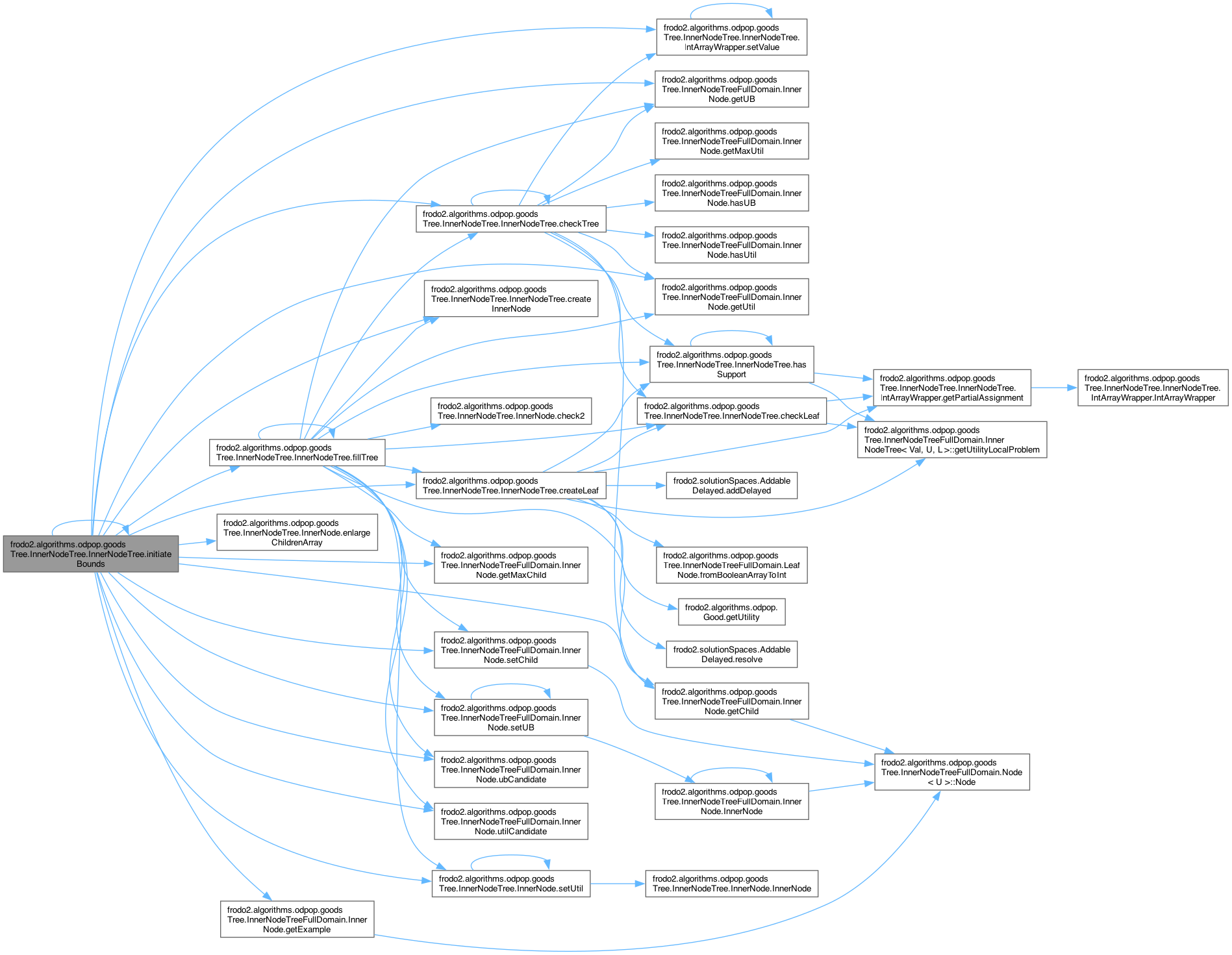
This method adds the dummy part to the tree.
It searches through the tree from left to right. Every time it needs to add a dummy node, it copies the tree below the left most child of the current node into the dummy node. Concurrently it also instantiates the upper bounds
- Parameters
-
currentNodeUncast the node currently being visited currentPathUncast the path taken depth the current depth onLocalPath truewhen we are still following the path of the currently best local solutiong the received good sender the sender of the good
- Returns
- the upperBound for this node
References frodo2.algorithms.odpop.goodsTree.InnerNodeTreeFullDomain.InnerNodeTree< Val, U, L >.branchingFactor, checkTree(), frodo2.algorithms.odpop.goodsTree.InnerNodeTreeFullDomain.InnerNode< U extends Addable< U >, L extends LeafNode< U > >.children, createInnerNode(), createLeaf(), frodo2.algorithms.odpop.goodsTree.InnerNodeTreeFullDomain.InnerNodeTree< Val, U, L >.domains, frodo2.algorithms.odpop.goodsTree.InnerNodeTreeFullDomain.InnerNodeTree< Val, U, L >.domainSize, dummy, frodo2.algorithms.odpop.goodsTree.InnerNodeTree.InnerNode< U extends Addable< U >, L extends LeafNode< U > >.enlargeChildrenArray(), fillTree(), frodo2.algorithms.odpop.goodsTree.InnerNodeTreeFullDomain.InnerNode< U extends Addable< U >, L extends LeafNode< U > >.getChild(), frodo2.algorithms.odpop.goodsTree.InnerNodeTreeFullDomain.InnerNode< U extends Addable< U >, L extends LeafNode< U > >.getExample(), frodo2.algorithms.odpop.goodsTree.InnerNodeTreeFullDomain.InnerNode< U extends Addable< U >, L extends LeafNode< U > >.getMaxChild(), frodo2.algorithms.odpop.goodsTree.InnerNodeTreeFullDomain.InnerNode< U extends Addable< U >, L extends LeafNode< U > >.getUB(), frodo2.algorithms.odpop.goodsTree.InnerNodeTreeFullDomain.InnerNode< U extends Addable< U >, L extends LeafNode< U > >.getUtil(), initiateBounds(), frodo2.algorithms.odpop.goodsTree.InnerNodeTreeFullDomain.InnerNodeTree< Val, U, L >.optimalLocalPath, frodo2.algorithms.odpop.goodsTree.InnerNodeTree.InnerNode< U extends Addable< U >, L extends LeafNode< U > >.real, frodo2.algorithms.odpop.goodsTree.InnerNodeTreeFullDomain.InnerNode< U extends Addable< U >, L extends LeafNode< U > >.setChild(), frodo2.algorithms.odpop.goodsTree.InnerNodeTreeFullDomain.InnerNode< U extends Addable< U >, L extends LeafNode< U > >.setUB(), frodo2.algorithms.odpop.goodsTree.InnerNodeTree.InnerNode< U extends Addable< U >, L extends LeafNode< U > >.setUtil(), frodo2.algorithms.odpop.goodsTree.InnerNodeTree.InnerNodeTree< Val extends Addable< Val >, U extends Addable< U >, L extends LeafNode< U > >.IntArrayWrapper.setValue(), frodo2.algorithms.odpop.goodsTree.InnerNodeTreeFullDomain.InnerNode< U extends Addable< U >, L extends LeafNode< U > >.ubCandidate(), frodo2.algorithms.odpop.goodsTree.InnerNodeTreeFullDomain.InnerNodeTree< Val, U, L >.upperBoundSums, and frodo2.algorithms.odpop.goodsTree.InnerNodeTreeFullDomain.InnerNode< U extends Addable< U >, L extends LeafNode< U > >.utilCandidate().
Referenced by add(), and initiateBounds().
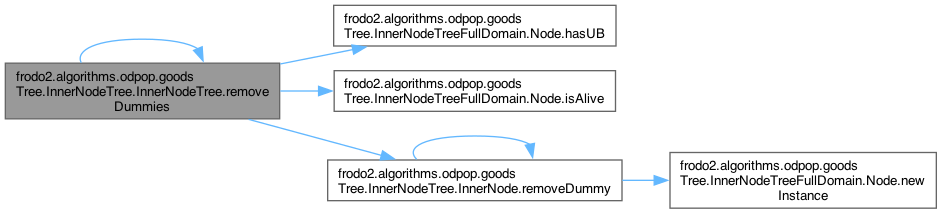
◆ removeDummies()
|
protected |
Remove the dummy element for the variables marked in change.
- Parameters
-
removalDepth the maximal depth until where dummy elements are to be found change for each variable whether the dummy elements must be removed depth the current depth currentNodeUncast the current node that is being visited
References frodo2.algorithms.odpop.goodsTree.InnerNodeTreeFullDomain.InnerNodeTree< Val, U, L >.branchingFactor, frodo2.algorithms.odpop.goodsTree.InnerNodeTreeFullDomain.Node< U extends Addable< U > >.hasUB(), frodo2.algorithms.odpop.goodsTree.InnerNodeTreeFullDomain.Node< U extends Addable< U > >.isAlive(), removeDummies(), and frodo2.algorithms.odpop.goodsTree.InnerNodeTree.InnerNode< U extends Addable< U >, L extends LeafNode< U > >.removeDummy().
Referenced by removeDummies(), and setFinalDomainSize().
◆ setFinalDomainSize() [1/2]
|
private |
Sets the final size of the domain of a variable.
- Parameters
-
change boolean to store the variables whose size has been set variable the variable whose final domain size is to be set size the final domain size depth the depth of variable
- Returns
- the depth of the variable to be changed
References frodo2.algorithms.odpop.goodsTree.InnerNodeTreeFullDomain.InnerNodeTree< Val, U, L >.branchingFactor, frodo2.algorithms.odpop.goodsTree.InnerNodeTreeFullDomain.InnerNodeTree< Val, U, L >.domainSize, dummy, frodo2.algorithms.odpop.goodsTree.InnerNodeTreeFullDomain.InnerNodeTree< Val, U, L >.finalDomainSize, and numberOfDummies.
◆ setFinalDomainSize() [2/2]
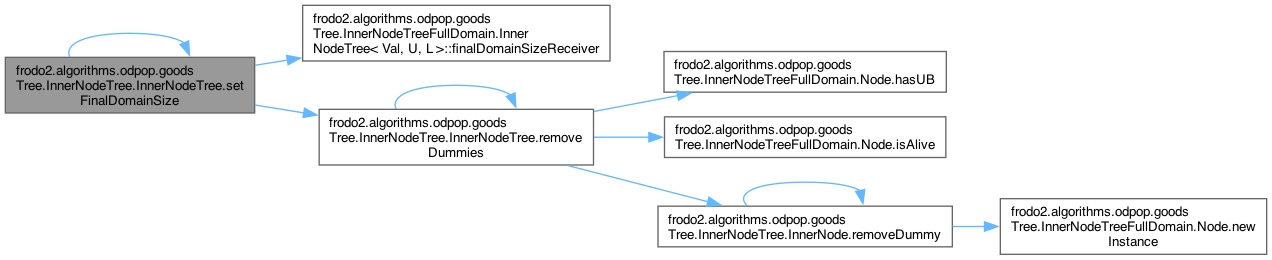
| void frodo2.algorithms.odpop.goodsTree.InnerNodeTree.InnerNodeTree< Val extends Addable< Val >, U extends Addable< U >, L extends LeafNode< U > >.setFinalDomainSize | ( | String[] | variables, |
| int[] | domainSize ) |
- See also
- frodo2.algorithms.odpop.goodsTree.GoodsTree.setFinalDomainSize(java.lang.String[], int[])
References frodo2.algorithms.odpop.goodsTree.InnerNodeTreeFullDomain.InnerNodeTree< Val, U, L >.domainSize, frodo2.algorithms.odpop.goodsTree.InnerNodeTreeFullDomain.InnerNodeTree< Val, U, L >.finalDomainSizeReceiver(), frodo2.algorithms.odpop.goodsTree.InnerNodeTreeFullDomain.InnerNodeTree< Val, U, L >.fullInfoCounter, removeDummies(), frodo2.algorithms.odpop.goodsTree.InnerNodeTreeFullDomain.InnerNodeTree< Val, U, L >.root, setFinalDomainSize(), and frodo2.algorithms.odpop.goodsTree.InnerNodeTreeFullDomain.InnerNodeTree< Val, U, L >.variableToDepth.
Referenced by setFinalDomainSize().
◆ toString()
| String frodo2.algorithms.odpop.goodsTree.InnerNodeTree.InnerNodeTree< Val extends Addable< Val >, U extends Addable< U >, L extends LeafNode< U > >.toString | ( | ) |
Method used for debugging purposes.
It prints the state of the tree
- See also
- java.lang.Object#toString()
References frodo2.algorithms.odpop.goodsTree.InnerNodeTreeFullDomain.InnerNodeTree< Val, U, L >.branchingFactor, goodsReceived, frodo2.algorithms.odpop.goodsTree.InnerNodeTreeFullDomain.InnerNodeTree< Val, U, L >.hasLocalProblem, frodo2.algorithms.odpop.goodsTree.InnerNodeTreeFullDomain.InnerNodeTree< Val, U, L >.localUpperBound, frodo2.algorithms.odpop.goodsTree.InnerNodeTreeFullDomain.InnerNodeTree< Val, U, L >.numberOfChildren, frodo2.algorithms.odpop.goodsTree.InnerNodeTreeFullDomain.InnerNodeTree< Val, U, L >.optimalLocalPath, frodo2.algorithms.odpop.goodsTree.InnerNodeTreeFullDomain.InnerNodeTree< Val, U, L >.root, and frodo2.algorithms.odpop.goodsTree.InnerNodeTreeFullDomain.InnerNodeTree< Val, U, L >.storeReceivedGoods.
◆ updatePath()
|
protected |
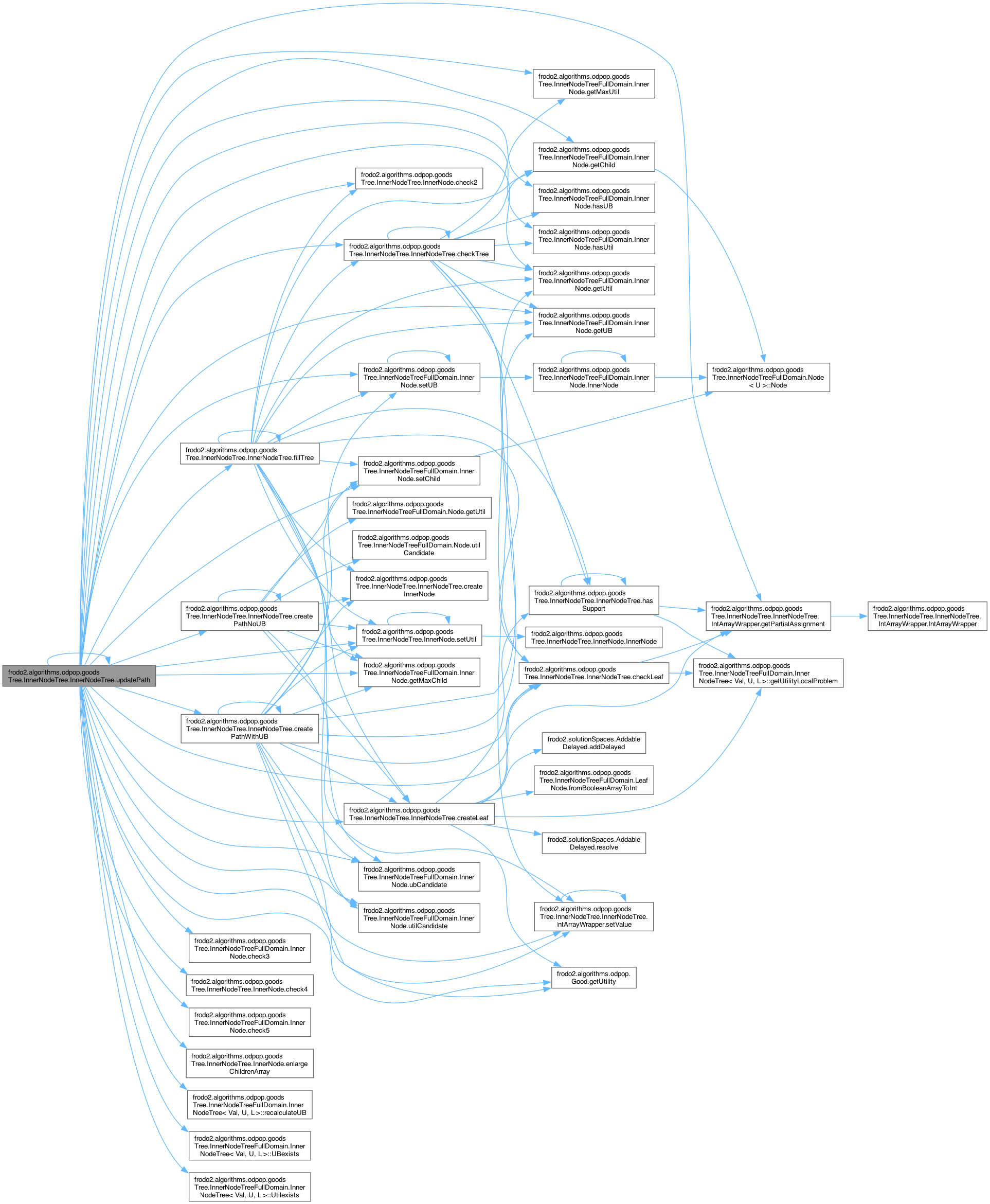
This method walks trough the tree according to the given partial path and finds all leaf nodes that correspond to assignments that are compatible with the good to be added.
- Parameters
-
depth The current depth currentPathUncast The current path partialPath The path dictated by the received good currentNodeUncast The current node g the utility reported utilityDelta The difference with the previously reported utility for the assignment belonging to the partial path sender The sender of the good onLocalPath truewhen we are still following the path of the currently best local solutionwithUB truewhen the UB must be updated as well
References frodo2.algorithms.odpop.goodsTree.InnerNodeTreeFullDomain.InnerNodeTree< Val, U, L >.branchingFactor, frodo2.algorithms.odpop.goodsTree.InnerNodeTree.InnerNode< U extends Addable< U >, L extends LeafNode< U > >.check2(), frodo2.algorithms.odpop.goodsTree.InnerNodeTreeFullDomain.InnerNode< U extends Addable< U >, L extends LeafNode< U > >.check3(), frodo2.algorithms.odpop.goodsTree.InnerNodeTree.InnerNode< U extends Addable< U >, L extends LeafNode< U > >.check4(), frodo2.algorithms.odpop.goodsTree.InnerNodeTreeFullDomain.InnerNode< U extends Addable< U >, L extends LeafNode< U > >.check5(), checkLeaf(), checkTree(), frodo2.algorithms.odpop.goodsTree.InnerNodeTreeFullDomain.InnerNode< U extends Addable< U >, L extends LeafNode< U > >.children, frodo2.algorithms.odpop.goodsTree.InnerNodeTreeFullDomain.InnerNodeTree< Val, U, L >.childrenVariables, createLeaf(), createPathNoUB(), createPathWithUB(), frodo2.algorithms.odpop.goodsTree.InnerNodeTreeFullDomain.InnerNodeTree< Val, U, L >.domains, frodo2.algorithms.odpop.goodsTree.InnerNodeTreeFullDomain.InnerNodeTree< Val, U, L >.domainSize, dummy, frodo2.algorithms.odpop.goodsTree.InnerNodeTree.InnerNode< U extends Addable< U >, L extends LeafNode< U > >.enlargeChildrenArray(), fillTree(), frodo2.algorithms.odpop.goodsTree.InnerNodeTreeFullDomain.InnerNode< U extends Addable< U >, L extends LeafNode< U > >.getChild(), frodo2.algorithms.odpop.goodsTree.InnerNodeTreeFullDomain.InnerNode< U extends Addable< U >, L extends LeafNode< U > >.getMaxChild(), frodo2.algorithms.odpop.goodsTree.InnerNodeTreeFullDomain.InnerNode< U extends Addable< U >, L extends LeafNode< U > >.getMaxUtil(), frodo2.algorithms.odpop.goodsTree.InnerNodeTree.InnerNodeTree< Val extends Addable< Val >, U extends Addable< U >, L extends LeafNode< U > >.IntArrayWrapper.getPartialAssignment(), frodo2.algorithms.odpop.goodsTree.InnerNodeTreeFullDomain.InnerNode< U extends Addable< U >, L extends LeafNode< U > >.getUB(), frodo2.algorithms.odpop.goodsTree.InnerNodeTreeFullDomain.InnerNode< U extends Addable< U >, L extends LeafNode< U > >.getUtil(), frodo2.algorithms.odpop.Good< Val extends Addable< Val >, U extends Addable< U > >.getUtility(), goodsReceived, frodo2.algorithms.odpop.goodsTree.InnerNodeTreeFullDomain.InnerNode< U extends Addable< U >, L extends LeafNode< U > >.hasUB(), frodo2.algorithms.odpop.goodsTree.InnerNodeTreeFullDomain.InnerNode< U extends Addable< U >, L extends LeafNode< U > >.hasUtil(), frodo2.algorithms.odpop.goodsTree.InnerNodeTreeFullDomain.InnerNodeTree< Val, U, L >.optimalLocalPath, frodo2.algorithms.odpop.goodsTree.InnerNodeTreeFullDomain.InnerNodeTree< Val, U, L >.powersOf2, frodo2.algorithms.odpop.goodsTree.InnerNodeTree.InnerNode< U extends Addable< U >, L extends LeafNode< U > >.real, frodo2.algorithms.odpop.goodsTree.InnerNodeTreeFullDomain.InnerNodeTree< Val, U, L >.recalculateUB(), frodo2.algorithms.odpop.goodsTree.InnerNodeTreeFullDomain.InnerNode< U extends Addable< U >, L extends LeafNode< U > >.setChild(), frodo2.algorithms.odpop.goodsTree.InnerNodeTreeFullDomain.InnerNode< U extends Addable< U >, L extends LeafNode< U > >.setUB(), frodo2.algorithms.odpop.goodsTree.InnerNodeTree.InnerNode< U extends Addable< U >, L extends LeafNode< U > >.setUtil(), frodo2.algorithms.odpop.goodsTree.InnerNodeTree.InnerNodeTree< Val extends Addable< Val >, U extends Addable< U >, L extends LeafNode< U > >.IntArrayWrapper.setValue(), frodo2.algorithms.odpop.goodsTree.InnerNodeTreeFullDomain.InnerNodeTree< Val, U, L >.storeReceivedGoods, frodo2.algorithms.odpop.goodsTree.InnerNodeTreeFullDomain.InnerNode< U extends Addable< U >, L extends LeafNode< U > >.ubCandidate(), frodo2.algorithms.odpop.goodsTree.InnerNodeTreeFullDomain.InnerNodeTree< Val, U, L >.UBexists(), updatePath(), frodo2.algorithms.odpop.goodsTree.InnerNodeTreeFullDomain.InnerNodeTree< Val, U, L >.upperBoundSums, frodo2.algorithms.odpop.goodsTree.InnerNodeTreeFullDomain.InnerNode< U extends Addable< U >, L extends LeafNode< U > >.utilCandidate(), and frodo2.algorithms.odpop.goodsTree.InnerNodeTreeFullDomain.InnerNodeTree< Val, U, L >.Utilexists().
Referenced by add(), and updatePath().
◆ upperBoundChangesUtil()
|
protected |
Member Data Documentation
◆ dummy
|
protected |
Used to determine whether a variable has a dummy element or not.
Referenced by add(), addNewDomainElement(), addNewVariable(), checkDummy(), checkTree(), createPathWithUB(), init(), initiateBounds(), setFinalDomainSize(), and updatePath().
◆ dummyDepth
|
protected |
The depth until where one can find dummy variables.
Referenced by addNewVariable(), changeDummyToReal(), and init().
◆ finalDomainSizeUnknownVariables
|
protected |
the final domain sizes of as yet unknown variables
Referenced by addNewVariable(), and init().
◆ goodsReceived
|
protected |
For each child a map that stores the utilities received from children.
This is needed due to the assumption that both domain and variable information can be incomplete
Referenced by add(), checkLeaf(), createLeaf(), createLeaf(), hasSupport(), init(), toString(), and updatePath().
◆ numberOfAncestors
|
protected |
Stores the number of higher priority neighbours.
Referenced by init().
◆ numberOfDummies
|
protected |
Counts the number of dummy variables in the tree.
Referenced by setFinalDomainSize().
◆ serialVersionUID
|
staticprivate |
Used for serialization.
◆ upperboundArraySize
|
protected |
The size of the array containing precalculated upperbounds.
Referenced by init().
The documentation for this class was generated from the following file:
- src/frodo2/algorithms/odpop/goodsTree/InnerNodeTree/InnerNodeTree.java
