This class is designed to store GOODs received by a node from its children, and is used in the ASODPOP algorithm. More...

Public Member Functions | |
| InnerNodeTree (String ownVariable, Val[] ownVariableDomain, UtilitySolutionSpace< Val, U > space, int numberOfChildren, U zero, U infeasibleUtil, boolean maximize, boolean collectStats) | |
| A constructor (Only used in testing the datastructure). | |
| InnerNodeTree (String ownVariable, Val[] ownVariableDomain, List< UtilitySolutionSpace< Val, U > > spaces, int numberOfChildren, U zero, U infeasibleUtil, boolean maximize, boolean collectStats) | |
| A constructor. | |
| int | add (Good< Val, U > g, int sender, HashMap< String, Val[]> domains) |
| This method adds a received GOOD to the tree. | |
| Good< Val, U > | getAmax () |
| This method obtains the aMax. | |
| void | getBestAssignmentForOwnVariable (HashMap< String, Val > assignments) |
| Given the assignment of variables in its separator, this method returns the best assignment possible. | |
| Val | getRandomValue () |
| HashMap< String, Val > | getChildValues (HashMap< String, Val > parentContext, int child) |
| Given a map that maps variables to values, this method returns the values belonging to the variables in a child's separator. | |
| int | getVariableIndex (String variable) |
| int | getSpeculativeUTILcounter () |
| int | getUTILcounter () |
| boolean | knowsVariable (String variable) |
| boolean | notEnoughInfo () |
| If there is only one variable in this tree, that means that there is not enough information to send a good. | |
| int | getNbrVariables () |
| boolean | ignoreGood (Good< Val, U > g, int sender) |
| If this good reports a value for an already confirmed assignment, the information in the good can be considered outdated and should be ignored. | |
| void | ownVariableValue (HashMap< String, Val > currentContext) |
| Returns the value of the trees own variable for the current next best assignment. | |
| boolean | checkLeaf (LeafNode< U > leaf, IntArrayWrapper currentPath, boolean checkUB, U utility, int sender) |
| Method to check that the utility and UB are consistent with the available information. | |
| Public Member Functions inherited from frodo2.algorithms.odpop.goodsTree.InnerNodeTreeBinaryDomains.InnerNodeTree< Val, U, LeafNode< U > > | |
| boolean | add (Good< Val, U > g, int sender, HashMap< String, Val[]> domains) |
| Adds a good to the tree. | |
Protected Member Functions | |
| LeafNode< U > | createLeaf (IntArrayWrapper currentPath, frodo2.algorithms.odpop.Good< Val, U > g, int child, final boolean withUB) |
| Method to create a new leaf node. | |
| LeafNode< U > | createLeaf (IntArrayWrapper currentPath, final boolean withUB) |
| Method to create a new leaf node. | |
| boolean | findUnused (int depth, int[] localPath, int[] unusedPath, InnerNode< U, LeafNode< U > > currentNode) |
| Looks for parts of the tree where the local solution as defined by localPath can still be used to create new leafs. | |
| U | getOwnVariableOptions (int[] optimalPath, Val[] assignments) |
| Given the assignment of variables in its separator, this method returns the utility for all domain elements of the own variable. | |
| void | init (int numberOfChildren, U zero) |
| Initialize all the variables of the tree. | |
| void | nextVariableAssignment (int[] max, int[] position) |
| Given a point in the domain space of value combinations between 0 and max, the next point is calculated and position is set to this new point. | |
| void | updateLocalProblem () |
| Protected Member Functions inherited from frodo2.algorithms.odpop.goodsTree.InnerNodeTreeBinaryDomains.InnerNodeTree< Val, U, LeafNode< U > > | |
| InnerNodeTree (L leafNodeInstance, String ownVariable, Val[] ownVariableDomain, UtilitySolutionSpace< Val, U > space, U zero, int numberOfChildren, U infeasibleUtil, boolean maximize, boolean collectStats) | |
| A dummy constructor to be used by extending classes. | |
| frodo2.algorithms.odpop.goodsTree.InnerNodeTreeFullDomain.InnerNode< U, L > | createInnerNode (int numberOfChildren) |
| void | updateLocalProblem () |
| U | recalculateUB (int depth, frodo2.algorithms.odpop.goodsTree.InnerNodeTreeFullDomain.InnerNode< U, L > currentNode, U UBtoBeat, boolean recalculateUtil, boolean recalculateUB) |
| This method recalculates the upper bound for a particular node. | |
Protected Attributes | |
| U[] | localOptions |
| For each option the optimal utility your own local problem provides. | |
Private Member Functions | |
| boolean | checkGood (Val[] values) |
| Method used to check whether the assignment to be reported by the good point to an existing assignment. | |
Private Attributes | |
| ArrayList< HashMap< IntArrayWrapper, Boolean > > | goodsConfirmed |
| For each child a map that stores the utilities received from children. | |
| Val[] | optimalLocalSolution |
| The optimal solution of the local problem. | |
| int | speculativeUTILcounter |
| Counts the number of speculative UTIL messages. | |
| int | UTILcounter = 0 |
| Counts the total number of UTIl messages received. | |
Static Private Attributes | |
| static final long | serialVersionUID = 4206985864919963001L |
| Used for serialization. | |
Additional Inherited Members | |
| Static Protected Attributes inherited from frodo2.algorithms.odpop.goodsTree.InnerNodeTreeBinaryDomains.InnerNodeTree< Val, U, LeafNode< U > > | |
| static final long | serialVersionUID |
| Used for serialization. | |
Detailed Description
This class is designed to store GOODs received by a node from its children, and is used in the ASODPOP algorithm.
A GOOD contains an assignment to a set of variables, a utility and a variable denoting whether it is a confirmed or speculative good. A GOOD is identified by its assignment, and in this class the GOODs are ordered using a tree based on these assignments.
The basic functionality of this class is to either add a received GOOD to the tree, or to obtain the assignment that has the highest utility.
- Parameters
-
<Val> type used for variable values <U> type used for utility values
- Todo
- write Unit test for this class
Constructor & Destructor Documentation
◆ InnerNodeTree() [1/2]
| frodo2.algorithms.asodpop.goodsTree.innerNodeTreeBinaryDomains.InnerNodeTree< Val extends Addable< Val >, U extends Addable< U > >.InnerNodeTree | ( | String | ownVariable, |
| Val[] | ownVariableDomain, | ||
| UtilitySolutionSpace< Val, U > | space, | ||
| int | numberOfChildren, | ||
| U | zero, | ||
| U | infeasibleUtil, | ||
| boolean | maximize, | ||
| boolean | collectStats ) |
A constructor (Only used in testing the datastructure).
- Warning
- we assume that the agent's own variable is put in the end of variables_order
- Parameters
-
ownVariable The variable ID ownVariableDomain The domain of ownVariablespace A list of utility values for the different value combinations numberOfChildren The number of children zero The zero utility infeasibleUtil The infeasible utility maximize when truewe are maximizing, whenfalsewe are minimizingcollectStats truewhen statistics should be collected, andfalseotherwise
References init(), and updateLocalProblem().

◆ InnerNodeTree() [2/2]
| frodo2.algorithms.asodpop.goodsTree.innerNodeTreeBinaryDomains.InnerNodeTree< Val extends Addable< Val >, U extends Addable< U > >.InnerNodeTree | ( | String | ownVariable, |
| Val[] | ownVariableDomain, | ||
| List< UtilitySolutionSpace< Val, U > > | spaces, | ||
| int | numberOfChildren, | ||
| U | zero, | ||
| U | infeasibleUtil, | ||
| boolean | maximize, | ||
| boolean | collectStats ) |
A constructor.
- Warning
- we assume that the agents own variable is put in the end of variables_order
- Parameters
-
ownVariable The variable ID ownVariableDomain The domain of ownVariablespaces The hypercubes representing the local problem numberOfChildren The number of children zero The zero utility infeasibleUtil The infeasible utility maximize when truewe are maximizing, whenfalsewe are minimizingcollectStats truewhen statistics should be collected, andfalseotherwise
References init(), and updateLocalProblem().

Member Function Documentation
◆ add()
| int frodo2.algorithms.asodpop.goodsTree.innerNodeTreeBinaryDomains.InnerNodeTree< Val extends Addable< Val >, U extends Addable< U > >.add | ( | Good< Val, U > | g, |
| int | sender, | ||
| HashMap< String, Val[]> | domains ) |
This method adds a received GOOD to the tree.
- Parameters
-
g The good to be added sender The sender of the good domains The domains of the reported variables
- Returns
truewhen a new variable has been discovered
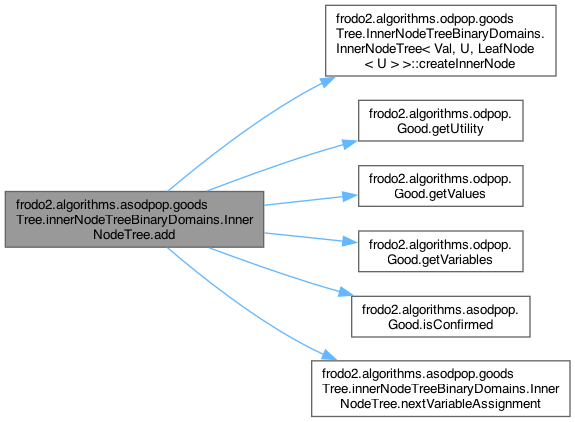
References frodo2.algorithms.odpop.goodsTree.InnerNodeTreeBinaryDomains.InnerNodeTree< Val, U, LeafNode< U > >.createInnerNode(), frodo2.algorithms.odpop.Good< Val extends Addable< Val >, U extends Addable< U > >.getUtility(), frodo2.algorithms.odpop.Good< Val extends Addable< Val >, U extends Addable< U > >.getValues(), frodo2.algorithms.odpop.Good< Val extends Addable< Val >, U extends Addable< U > >.getVariables(), goodsConfirmed, frodo2.algorithms.asodpop.Good< Val extends Addable< Val >, U extends Addable< U > >.isConfirmed(), and nextVariableAssignment().
◆ checkGood()
|
private |
Method used to check whether the assignment to be reported by the good point to an existing assignment.
- Parameters
-
values the values constituting the assigment
- Returns
truewhen the assignment exists and false otherwise
References checkGood(), and frodo2.algorithms.odpop.goodsTree.InnerNodeTreeFullDomain.Node< U extends Addable< U > >.isAlive().
Referenced by checkGood(), and updateLocalProblem().

◆ checkLeaf()
| boolean frodo2.algorithms.asodpop.goodsTree.innerNodeTreeBinaryDomains.InnerNodeTree< Val extends Addable< Val >, U extends Addable< U > >.checkLeaf | ( | LeafNode< U > | leaf, |
| IntArrayWrapper | currentPath, | ||
| boolean | checkUB, | ||
| U | utility, | ||
| int | sender ) |
Method to check that the utility and UB are consistent with the available information.
The utility should match exactly, but because UBs are only recomputed when necessary, and then should only decrease by such a recomputation, the stored UB should be at least as high as the real UB
- Parameters
-
leaf the leaf to be checked currentPath the path to this leaf checkUB truewhen the UB must be checkedutility the utility reported by the sender sender the sender of the good
- Returns
- always returns true
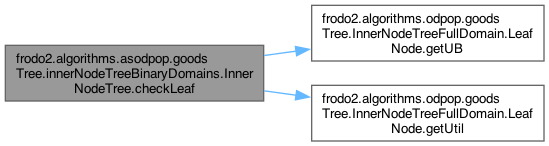
References frodo2.algorithms.odpop.goodsTree.InnerNodeTreeFullDomain.LeafNode< U extends Addable< U > >.getUB(), frodo2.algorithms.odpop.goodsTree.InnerNodeTreeFullDomain.LeafNode< U extends Addable< U > >.getUtil(), and goodsConfirmed.
◆ createLeaf() [1/2]
|
protected |
Method to create a new leaf node.
- Parameters
-
currentPath The path to the leaf withUB truewhen the upper bound must be set
- Returns
- the new leaf node
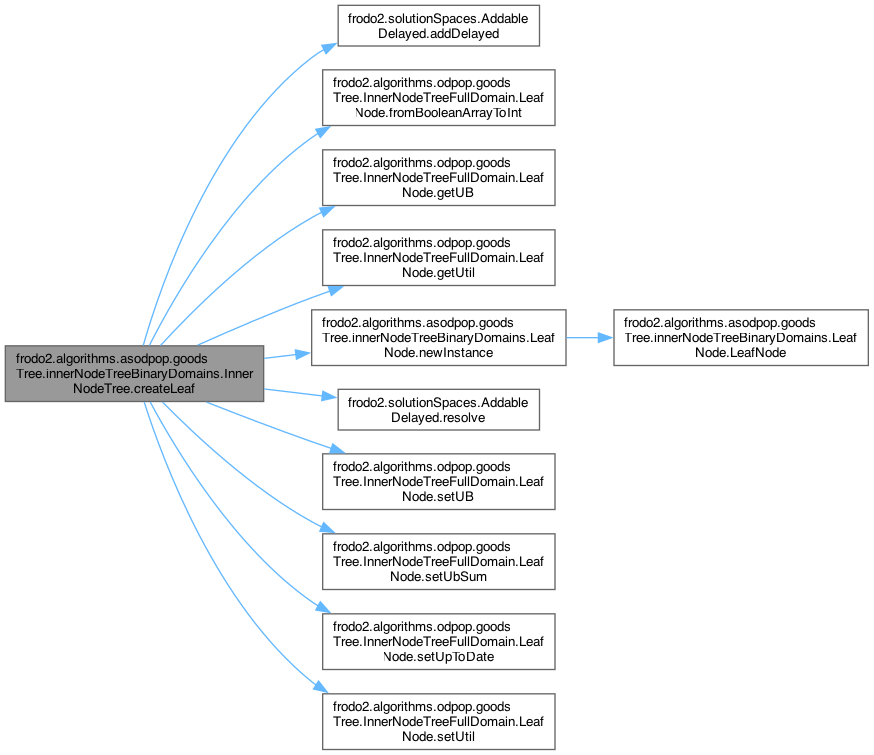
References frodo2.solutionSpaces.AddableDelayed< T extends Addable< T > >.addDelayed(), frodo2.algorithms.odpop.goodsTree.InnerNodeTreeFullDomain.LeafNode< U extends Addable< U > >.counter, frodo2.algorithms.odpop.goodsTree.InnerNodeTreeFullDomain.LeafNode< U extends Addable< U > >.fromBooleanArrayToInt(), frodo2.algorithms.odpop.goodsTree.InnerNodeTreeFullDomain.LeafNode< U extends Addable< U > >.getUB(), frodo2.algorithms.odpop.goodsTree.InnerNodeTreeFullDomain.LeafNode< U extends Addable< U > >.getUtil(), goodsConfirmed, frodo2.algorithms.asodpop.goodsTree.innerNodeTreeBinaryDomains.LeafNode< U extends Addable< U > >.newInstance(), frodo2.solutionSpaces.AddableDelayed< T extends Addable< T > >.resolve(), frodo2.algorithms.odpop.goodsTree.InnerNodeTreeFullDomain.LeafNode< U extends Addable< U > >.setUB(), frodo2.algorithms.odpop.goodsTree.InnerNodeTreeFullDomain.LeafNode< U extends Addable< U > >.setUbSum(), frodo2.algorithms.odpop.goodsTree.InnerNodeTreeFullDomain.LeafNode< U extends Addable< U > >.setUpToDate(), frodo2.algorithms.odpop.goodsTree.InnerNodeTreeFullDomain.LeafNode< U extends Addable< U > >.setUtil(), and frodo2.algorithms.odpop.goodsTree.InnerNodeTreeFullDomain.LeafNode< U extends Addable< U > >.updateUB.
◆ createLeaf() [2/2]
|
protected |
Method to create a new leaf node.
- Parameters
-
currentPath The path to the leaf g the received good child the child that reported it withUB truewhen the upper bound must be set
- Returns
- the new leaf node
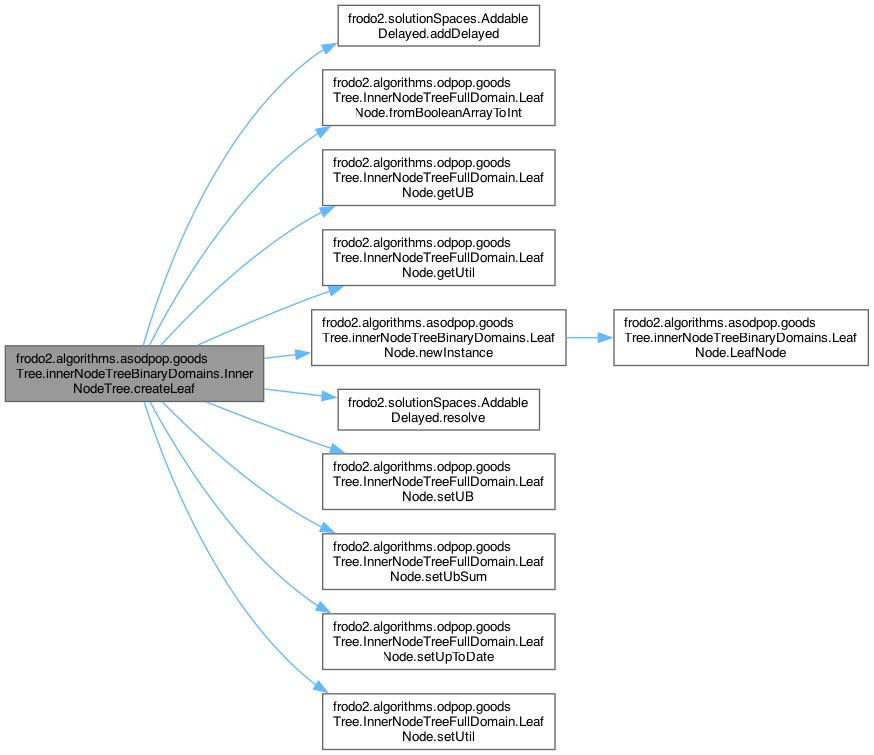
References frodo2.solutionSpaces.AddableDelayed< T extends Addable< T > >.addDelayed(), frodo2.algorithms.odpop.goodsTree.InnerNodeTreeFullDomain.LeafNode< U extends Addable< U > >.counter, frodo2.algorithms.odpop.goodsTree.InnerNodeTreeFullDomain.LeafNode< U extends Addable< U > >.fromBooleanArrayToInt(), frodo2.algorithms.odpop.goodsTree.InnerNodeTreeFullDomain.LeafNode< U extends Addable< U > >.getUB(), frodo2.algorithms.odpop.goodsTree.InnerNodeTreeFullDomain.LeafNode< U extends Addable< U > >.getUtil(), goodsConfirmed, frodo2.algorithms.asodpop.goodsTree.innerNodeTreeBinaryDomains.LeafNode< U extends Addable< U > >.newInstance(), frodo2.solutionSpaces.AddableDelayed< T extends Addable< T > >.resolve(), frodo2.algorithms.odpop.goodsTree.InnerNodeTreeFullDomain.LeafNode< U extends Addable< U > >.setUB(), frodo2.algorithms.odpop.goodsTree.InnerNodeTreeFullDomain.LeafNode< U extends Addable< U > >.setUbSum(), frodo2.algorithms.odpop.goodsTree.InnerNodeTreeFullDomain.LeafNode< U extends Addable< U > >.setUpToDate(), frodo2.algorithms.odpop.goodsTree.InnerNodeTreeFullDomain.LeafNode< U extends Addable< U > >.setUtil(), and frodo2.algorithms.odpop.goodsTree.InnerNodeTreeFullDomain.LeafNode< U extends Addable< U > >.updateUB.
◆ findUnused()
|
protected |
Looks for parts of the tree where the local solution as defined by localPath can still be used to create new leafs.
- Parameters
-
depth the current depth in the tree localPath the path representing the local solution unusedPath a path where the local solution has not yet been used currentNode the current node being visited
- Returns
truewhen there are unused parts of the tree, andfalseotherwise
References findUnused().
Referenced by findUnused().
◆ getAmax()
| Good< Val, U > frodo2.algorithms.asodpop.goodsTree.innerNodeTreeBinaryDomains.InnerNodeTree< Val extends Addable< Val >, U extends Addable< U > >.getAmax | ( | ) |
◆ getBestAssignmentForOwnVariable()
| void frodo2.algorithms.asodpop.goodsTree.innerNodeTreeBinaryDomains.InnerNodeTree< Val extends Addable< Val >, U extends Addable< U > >.getBestAssignmentForOwnVariable | ( | HashMap< String, Val > | assignments | ) |
Given the assignment of variables in its separator, this method returns the best assignment possible.
- Parameters
-
assignments the, possible partial, assignment to the variables in the variables separator
References getOwnVariableOptions().

◆ getChildValues()
| HashMap< String, Val > frodo2.algorithms.asodpop.goodsTree.innerNodeTreeBinaryDomains.InnerNodeTree< Val extends Addable< Val >, U extends Addable< U > >.getChildValues | ( | HashMap< String, Val > | parentContext, |
| int | child ) |
Given a map that maps variables to values, this method returns the values belonging to the variables in a child's separator.
- Parameters
-
parentContext the value map child the child for who we want to know the separator values
- Returns
- an array containing the values of the child's separator variables
◆ getNbrVariables()
| int frodo2.algorithms.asodpop.goodsTree.innerNodeTreeBinaryDomains.InnerNodeTree< Val extends Addable< Val >, U extends Addable< U > >.getNbrVariables | ( | ) |
- Returns
- the number of variables stored in this goods tree
◆ getOwnVariableOptions()
|
protected |
Given the assignment of variables in its separator, this method returns the utility for all domain elements of the own variable.
- Parameters
-
optimalPath the path to the optimal solution assignments collection of assignments of variables in the separator
- Returns
- an array of utilities
References getOwnVariableOptions().
Referenced by getBestAssignmentForOwnVariable(), and getOwnVariableOptions().
◆ getRandomValue()
| Val frodo2.algorithms.asodpop.goodsTree.innerNodeTreeBinaryDomains.InnerNodeTree< Val extends Addable< Val >, U extends Addable< U > >.getRandomValue | ( | ) |
- Returns
- a random value in the domain of the owning variable
◆ getSpeculativeUTILcounter()
| int frodo2.algorithms.asodpop.goodsTree.innerNodeTreeBinaryDomains.InnerNodeTree< Val extends Addable< Val >, U extends Addable< U > >.getSpeculativeUTILcounter | ( | ) |
- Returns
- total number of speculative UTIl messages received
◆ getUTILcounter()
| int frodo2.algorithms.asodpop.goodsTree.innerNodeTreeBinaryDomains.InnerNodeTree< Val extends Addable< Val >, U extends Addable< U > >.getUTILcounter | ( | ) |
- Returns
- total number of UTIl messages received
◆ getVariableIndex()
| int frodo2.algorithms.asodpop.goodsTree.innerNodeTreeBinaryDomains.InnerNodeTree< Val extends Addable< Val >, U extends Addable< U > >.getVariableIndex | ( | String | variable | ) |
- Parameters
-
variable variable ID
- Returns
- the depth of the variable in the array
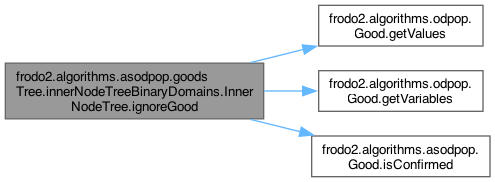
◆ ignoreGood()
| boolean frodo2.algorithms.asodpop.goodsTree.innerNodeTreeBinaryDomains.InnerNodeTree< Val extends Addable< Val >, U extends Addable< U > >.ignoreGood | ( | Good< Val, U > | g, |
| int | sender ) |
If this good reports a value for an already confirmed assignment, the information in the good can be considered outdated and should be ignored.
- Parameters
-
g the good to be checked sender the sender of the good
- Returns
truewhen the assignment in the good already has a confirmed utility
References frodo2.algorithms.odpop.Good< Val extends Addable< Val >, U extends Addable< U > >.getValues(), frodo2.algorithms.odpop.Good< Val extends Addable< Val >, U extends Addable< U > >.getVariables(), goodsConfirmed, and frodo2.algorithms.asodpop.Good< Val extends Addable< Val >, U extends Addable< U > >.isConfirmed().
◆ init()
|
protected |
Initialize all the variables of the tree.
- Parameters
-
numberOfChildren The number of children zero The zero utility
References goodsConfirmed, init(), localOptions, and optimalLocalSolution.
Referenced by init(), InnerNodeTree(), and InnerNodeTree().
◆ knowsVariable()
| boolean frodo2.algorithms.asodpop.goodsTree.innerNodeTreeBinaryDomains.InnerNodeTree< Val extends Addable< Val >, U extends Addable< U > >.knowsVariable | ( | String | variable | ) |
- Parameters
-
variable The variable for which we want to know whether this tree is aware of it
- Returns
trueif this tree is familier with this variable
◆ nextVariableAssignment()
|
protected |
Given a point in the domain space of value combinations between 0 and max, the next point is calculated and position is set to this new point.
- Parameters
-
max for each entry the maximal value position the position in the domain space
Referenced by add().
◆ notEnoughInfo()
| boolean frodo2.algorithms.asodpop.goodsTree.innerNodeTreeBinaryDomains.InnerNodeTree< Val extends Addable< Val >, U extends Addable< U > >.notEnoughInfo | ( | ) |
If there is only one variable in this tree, that means that there is not enough information to send a good.
- Returns
- boolean
◆ ownVariableValue()
| void frodo2.algorithms.asodpop.goodsTree.innerNodeTreeBinaryDomains.InnerNodeTree< Val extends Addable< Val >, U extends Addable< U > >.ownVariableValue | ( | HashMap< String, Val > | currentContext | ) |
Returns the value of the trees own variable for the current next best assignment.
- Parameters
-
currentContext The current assignment of all variables in ownVariable'sseparator
References frodo2.algorithms.odpop.goodsTree.InnerNodeTreeFullDomain.InnerNode< U extends Addable< U >, L extends LeafNode< U > >.getChild(), frodo2.algorithms.odpop.goodsTree.InnerNodeTreeFullDomain.InnerNode< U extends Addable< U >, L extends LeafNode< U > >.getMaxChild(), and ownVariableValue().
Referenced by ownVariableValue().

◆ updateLocalProblem()
|
protected |
- See also
- frodo2.algorithms.odpop.goodsTree.InnerNodeTreeBinaryDomains.InnerNodeTree.updateLocalProblem()
References checkGood(), and optimalLocalSolution.
Referenced by InnerNodeTree(), and InnerNodeTree().

Member Data Documentation
◆ goodsConfirmed
|
private |
For each child a map that stores the utilities received from children.
Referenced by add(), checkLeaf(), createLeaf(), createLeaf(), ignoreGood(), and init().
◆ localOptions
|
protected |
For each option the optimal utility your own local problem provides.
Referenced by init().
◆ optimalLocalSolution
|
private |
The optimal solution of the local problem.
Referenced by init(), and updateLocalProblem().
◆ serialVersionUID
|
staticprivate |
Used for serialization.
◆ speculativeUTILcounter
|
private |
Counts the number of speculative UTIL messages.
◆ UTILcounter
|
private |
Counts the total number of UTIl messages received.
The documentation for this class was generated from the following file:
- src/frodo2/algorithms/asodpop/goodsTree/innerNodeTreeBinaryDomains/InnerNodeTree.java
