Loading...
Searching...
No Matches
frodo2.communication.tcp.QueueInputPipeTCP.Receiver Class Reference
Whenever a request for connection is received, one such a thread is spawn to establish the connection. More...
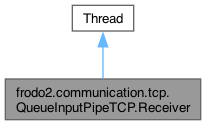
Inheritance diagram for frodo2.communication.tcp.QueueInputPipeTCP.Receiver:
Public Member Functions | |
| Receiver (Socket socket, QueueInputPipeTCP server) | |
| Constructor. | |
| void | start () |
| void | run () |
| Receives messages and passes them to the queue. | |
Private Attributes | |
| QueueInputPipeTCP | server |
| The QueueInputPipeTCP that spawned this thread. | |
| Socket | socket |
| The socket from which messages should be read. | |
Detailed Description
Whenever a request for connection is received, one such a thread is spawn to establish the connection.
Constructor & Destructor Documentation
◆ Receiver()
| frodo2.communication.tcp.QueueInputPipeTCP.Receiver.Receiver | ( | Socket | socket, |
| QueueInputPipeTCP | server ) |
Constructor.
- Parameters
-
socket the socket used to exchange messages server the QueueInputPipeTCP that spawned this thread
References frodo2.communication.tcp.QueueInputPipeTCP.QueueInputPipeTCP(), server, socket, and start().
Here is the call graph for this function:

Member Function Documentation
◆ run()
| void frodo2.communication.tcp.QueueInputPipeTCP.Receiver.run | ( | ) |
Receives messages and passes them to the queue.
References frodo2.communication.Message.readExternal(), server, and socket.
Here is the call graph for this function:

◆ start()
| void frodo2.communication.tcp.QueueInputPipeTCP.Receiver.start | ( | ) |
- See also
- java.lang.Thread#start()
Referenced by Receiver().
Member Data Documentation
◆ server
|
private |
The QueueInputPipeTCP that spawned this thread.
Referenced by Receiver(), and run().
◆ socket
|
private |
The socket from which messages should be read.
Referenced by Receiver(), and run().
The documentation for this class was generated from the following file:
- src/frodo2/communication/tcp/QueueInputPipeTCP.java
